Key Highlights
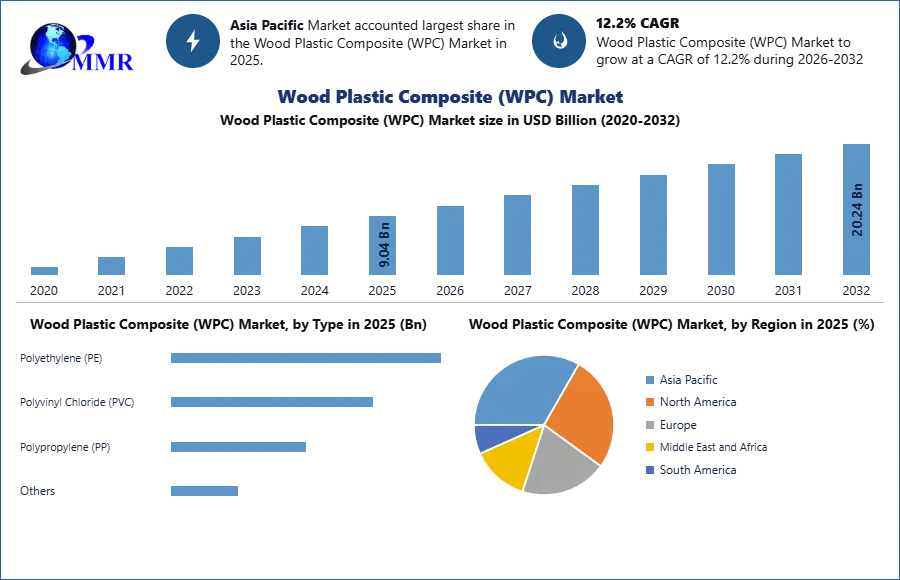
- The global Wood Plastic Composite (WPC) Market was valued at USD 9.04 billion in 2025 and is projected to reach nearly USD 20.24 billion by 2032, growing at a CAGR of 12.2%. This growth signals accelerating investment in sustainable material technologies and advanced manufacturing solutions.
- Polyethylene-based WPC remains a major material category because of its processing flexibility and broad application range.
- Building and construction continues to represent the largest application segment, creating scale advantages for manufacturers and suppliers.
- Automotive components are emerging as an important opportunity area as manufacturers pursue lightweight and recyclable materials.
- Sustainability regulations and circular economy initiatives are increasing demand for recycled-material-based composite solutions.
Why This Matters Now
The race toward lower emissions is no longer confined to powertrains. Manufacturers are increasingly examining every kilogram of vehicle weight, every component material, and every supply-chain input in pursuit of carbon reduction targets.
Wood Plastic Composite materials have moved beyond niche applications. They now sit at the intersection of sustainability, lightweight engineering, recycled material utilization, and advanced manufacturing. For automotive suppliers, construction companies, and material innovators, this transition is creating new competitive opportunities.
Market Overview
The Wood Plastic Composite market is experiencing rapid expansion as industries seek alternatives to traditional wood, metal, and conventional plastic materials. The market reached USD 9.04 billion in 2025 and is expected to approach USD 20.24 billion by 2032. The scale of this growth indicates increasing acceptance of composite materials across multiple industrial sectors.
What changed is the strategic role of materials themselves. Sustainability goals once focused primarily on energy consumption. Today, manufacturers are scrutinizing the entire product lifecycle, including sourcing, production, durability, maintenance requirements, and recyclability.
WPC materials align with these priorities by combining wood fibers with thermoplastics to create durable products that offer resistance to moisture, weather exposure, and degradation while supporting resource efficiency.
Key Trends Driving Growth
The strongest market driver is the global shift toward sustainable materials. Governments, corporations, and consumers are demanding products that reduce environmental impact without sacrificing performance. WPC materials satisfy this requirement through their ability to incorporate recycled plastics and wood waste streams.
Another significant trend is lightweight engineering. Automotive manufacturers are increasingly evaluating composite materials that reduce vehicle weight while maintaining structural performance. Lightweight components support fuel efficiency improvements in conventional vehicles and help extend driving range in electric vehicles.
Infrastructure modernization is creating additional demand. Urban development projects, residential construction, and commercial building activity continue to expand globally. WPC products offer durability, moisture resistance, and lower maintenance requirements compared with traditional alternatives. These characteristics are becoming increasingly valuable as lifecycle costs receive greater attention.
Manufacturing technology is also improving. Advances in extrusion and molding processes are enabling producers to deliver higher-quality products with improved aesthetics, performance characteristics, and customization capabilities. This expands the addressable market beyond traditional applications.
𝐃𝐨𝐰𝐧𝐥𝐨𝐚𝐝 𝐏𝐃𝐅 𝐁𝐫𝐨𝐜𝐡𝐮𝐫𝐞 @ https://www.maximizemarketresearch.com/request-sample/76219/
Segment Insights
- Dominant Segment: Building & Construction remains the largest application segment due to extensive use in decking, flooring, fencing, railings, windows, and exterior applications. The segment’s leadership demonstrates that infrastructure and construction remain the primary engines of demand.
- Fastest-Growing Segment: Automotive Components are emerging as one of the fastest-growing opportunity areas as vehicle manufacturers seek lightweight, recyclable, and durable materials. This trend directly aligns with broader transportation decarbonization strategies.
- Polyethylene (PE) continues to represent a leading material category due to its widespread availability and processing advantages.
- Residential end-use demand remains significant as homeowners increasingly prioritize low-maintenance and environmentally conscious building materials.
Regional Growth Story
North America remains a critical market because of strong adoption of decking, outdoor living products, and sustainable construction materials. Established manufacturers and mature distribution networks continue to support market expansion.
Asia-Pacific is becoming the most strategically important growth region. Rapid urbanization, industrial expansion, and infrastructure investment across China, India, and Southeast Asia are increasing demand for advanced building materials. The region’s manufacturing capabilities also support large-scale production growth.
Europe is creating opportunities through sustainability regulations and recycling initiatives. Material innovation is increasingly linked to carbon reduction targets and circular economy policies. Automotive lightweighting initiatives further strengthen demand for advanced composite materials.
India represents a particularly important growth market. Rising urbanization, green building initiatives, and infrastructure development are increasing demand for durable and environmentally responsible construction materials.
Competitive Landscape
Competition is shifting from simple product manufacturing toward material innovation and sustainability leadership.
Leading companies including Trex Company, The AZEK Company, Fiberon, UFP Industries, Dow, RENOLIT SE, and Green Dot Bioplastics are competing on product durability, recycled content, manufacturing efficiency, and application diversity. Their investments indicate that future market leadership will depend on technology differentiation rather than production scale alone.
For suppliers, the strategic opportunity lies in controlling feedstock quality, improving composite performance, and developing application-specific solutions. Companies capable of integrating recycled materials while maintaining product consistency are likely to gain pricing advantages and stronger customer relationships.
The next phase of competition will increasingly focus on circular economy capabilities. Manufacturers that can demonstrate measurable sustainability benefits will be better positioned to capture premium demand from both industrial and consumer customers.
Recent Developments
- Increasing adoption of recycled plastics and wood waste in WPC production is strengthening sustainability credentials across the industry.
- Automotive manufacturers continue exploring WPC-based components to support lightweighting initiatives and improve resource efficiency.
- Regulatory attention on sustainable materials is encouraging broader adoption of composite solutions across construction and industrial sectors.
- Product innovation efforts are improving durability, aesthetics, and performance across multiple end-use applications.
Strategic Implications
For automotive OEMs, WPC materials offer an opportunity to support lightweighting and sustainability objectives simultaneously.
For Tier-1 suppliers, the market creates opportunities to develop differentiated interior and exterior component solutions that balance performance with environmental compliance.
For investors, growth is increasingly linked to material science innovation, recycling infrastructure, and advanced manufacturing technologies.
For policymakers, WPC adoption aligns with broader environmental goals focused on waste reduction, resource efficiency, and carbon mitigation.
Future Outlook
The future of the Wood Plastic Composite market will not be defined solely by construction demand. It will be shaped by how effectively manufacturers integrate sustainability, lightweight engineering, recycled feedstocks, and advanced processing technologies into next-generation products.
The companies that transform WPC from an alternative material into a strategic platform for circular manufacturing will define the next era of industrial competitiveness, while those dependent on traditional material models risk losing relevance in a sustainability-driven economy.
Analyst Perspective
“Wood Plastic Composite materials are evolving from specialty products into strategic industrial materials. As sustainability targets become more stringent and manufacturers seek lightweight, durable, and recyclable alternatives, WPC adoption is expected to expand across multiple sectors, creating significant opportunities for innovators throughout the value chain.” — Tejaswini Kakade, Research Analyst
About Maximize Market Research
Maximize Market Research Pvt. Ltd. (MMR) is a global market research and consulting company that provides reliable, data-focused, and practical business insights. The firm serves a wide range of industries, including healthcare, pharmaceuticals, technology, automotive, electronics, chemicals, personal care, and consumer goods. Through market forecasts, competitive analysis, strategic consulting, and industry impact assessments, MMR helps organizations understand changing market conditions, identify growth opportunities, and make informed business decisions for long-term success.
2nd Floor, Navale IT Park Phase 3
Pune Banglore Highway, Narhe
Pune, Maharashtra 411041, India
+91 9607365656
sales@maximizemarketresearch.com
