Key Highlights
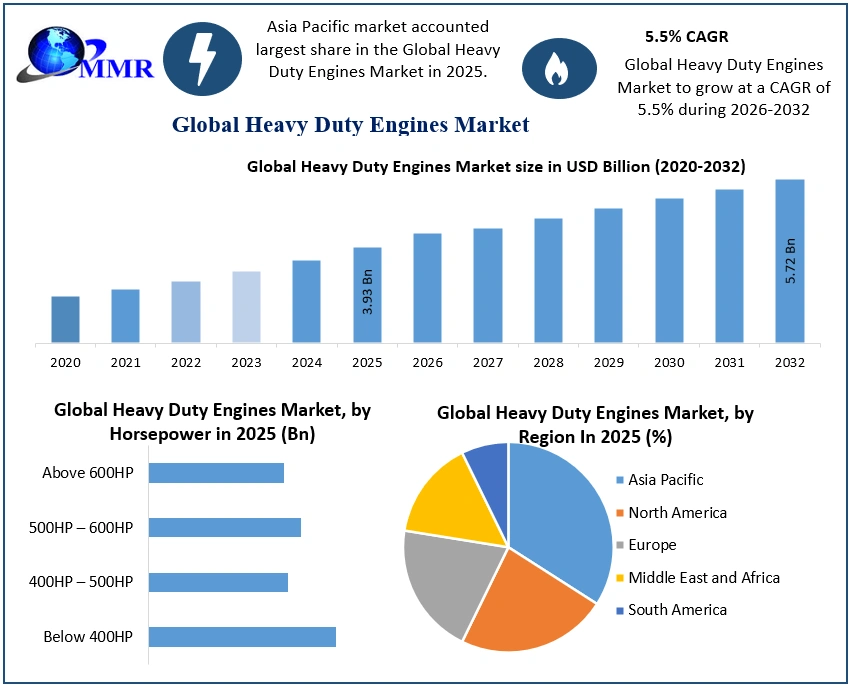
- Heavy Duty Engines Market valued at USD 3.93 billion in 2025.
- Market projected to reach USD 5.72 billion by 2032.
- Expected CAGR of 5.5% from 2026 to 2032.
- Freight transportation growth continues to support engine demand globally.
- Infrastructure and construction investments are increasing equipment utilization.
- Emission regulations are accelerating engine technology upgrades.
- Fleet operators are prioritizing fuel efficiency and lifecycle cost reduction.
- Digital monitoring and predictive maintenance solutions are becoming competitive differentiators.
- Emerging low-emission engine technologies are creating new growth opportunities.
Why This Matters Now
OEMs, fleet operators, engine suppliers, and investors face a critical transition period as commercial transportation demand rises while regulatory pressure intensifies. Companies that delay investment in next-generation engine platforms risk losing competitiveness as fleets prioritize efficiency, compliance, and operational reliability.
The Heavy Duty Engines Market is entering a new phase of growth driven by infrastructure expansion, rising freight movement, and increasingly stringent environmental standards. Every engine purchase now carries strategic implications for operating costs, emissions compliance, and long-term fleet productivity.
Market Overview
According to Maximize Market Research, the Heavy Duty Engines Market was valued at USD 3.93 billion in 2025 and is expected to reach nearly USD 5.72 billion by 2032, growing at a CAGR of 5.5% during the forecast period.
Heavy-duty engines remain essential across commercial transportation, mining, construction, agriculture, marine applications, and industrial operations. Despite accelerating electrification across passenger vehicles, internal combustion technology continues to dominate heavy-duty applications where high torque, long operating hours, and operational flexibility remain critical requirements.
The market’s growth trajectory signals continued investment in freight transportation networks, industrial development projects, and large-scale infrastructure programs. For engine manufacturers, the opportunity extends beyond unit sales toward integrated solutions that improve efficiency, reduce downtime, and ensure regulatory compliance.
At the same time, customers are demanding lower fuel consumption, reduced emissions, and enhanced digital capabilities. This is transforming competition across the industry and reshaping investment priorities throughout the value chain.
Key Trends Driving Growth
Infrastructure spending remains one of the strongest growth drivers. Governments across major economies are investing heavily in transportation networks, logistics facilities, industrial corridors, and construction projects. These investments directly increase demand for heavy-duty equipment and the engines that power them.
Freight transportation activity continues to expand as global supply chains recover and e-commerce volumes grow. Commercial vehicle operators are upgrading fleets to improve fuel efficiency and meet tightening emissions requirements. This creates sustained demand for advanced engine platforms capable of delivering higher performance with lower operating costs.
Emission regulations are accelerating technological innovation. Engine manufacturers are investing in cleaner combustion systems, advanced fuel injection technologies, turbocharging solutions, and emissions control systems. Compliance is no longer simply a regulatory requirement; it has become a competitive advantage.
Digitalization is also changing the market. Predictive maintenance, telematics integration, remote diagnostics, and performance monitoring systems help operators maximize equipment utilization while reducing maintenance expenses. Engine suppliers increasingly compete on software and analytics capabilities alongside mechanical performance.
Alternative fuel strategies are gaining attention as fleet operators evaluate long-term decarbonization pathways. While conventional diesel technology remains dominant, industry stakeholders continue exploring low-carbon fuels and hybrid powertrain solutions for specific heavy-duty applications.
Download PDF Sample:https://www.maximizemarketresearch.com/request-sample/124930/
Segment Insights
- Dominant Segment: Heavy-duty diesel engines continue to hold the largest market share due to their superior torque output, durability, fuel availability, and suitability for long-haul transportation, construction, mining, and industrial applications.
- Fastest-Growing Segment: Advanced emission-compliant engine technologies are experiencing the fastest growth as fleets modernize equipment to meet evolving environmental standards while improving fuel efficiency.
- Application Leadership: Commercial transportation remains the primary demand generator, supported by increasing freight movement and logistics expansion.
- Industrial Opportunity: Construction, mining, and infrastructure equipment continue to generate strong demand for high-performance engine solutions.
- Technology Trend: Connected engine systems and predictive maintenance platforms are creating new revenue streams across aftermarket and fleet service operations.
Regional Growth Story
Asia-Pacific continues to represent the largest growth opportunity for heavy-duty engine manufacturers. Rapid industrialization, urbanization, infrastructure development, and expanding logistics networks are driving demand for commercial vehicles and heavy equipment across the region.
China remains a major manufacturing and consumption hub. Large-scale infrastructure projects, industrial activity, and freight transportation requirements continue to support engine demand. The country’s focus on emissions reduction is also accelerating adoption of advanced engine technologies.
India is emerging as a significant growth market. Government investment in highways, logistics infrastructure, industrial corridors, and construction projects is increasing demand for heavy-duty vehicles and equipment. Fleet modernization initiatives further strengthen long-term market potential.
Japan and South Korea continue to contribute through technological innovation and advanced manufacturing capabilities. Engine manufacturers in these markets focus on efficiency improvements, emissions reduction, and digital integration.
North America remains a strategically important market due to its extensive freight transportation sector and strong construction activity. Fleet operators continue investing in fuel-efficient engines to improve profitability and comply with environmental regulations.
Europe’s market is shaped primarily by regulatory developments. Strict emissions standards encourage adoption of cleaner engine technologies and create opportunities for manufacturers capable of delivering compliant solutions without compromising performance.
Competitive Landscape
Competition in the Heavy Duty Engines Market is increasingly centered on efficiency, emissions performance, and digital capabilities rather than traditional power metrics alone.
Engine manufacturers are investing in next-generation platforms that balance productivity with regulatory compliance. Capacity expansion and technology investments signal confidence in sustained demand from transportation, industrial, and construction sectors.
Strategic partnerships and technology collaborations indicate a broader shift toward integrated powertrain ecosystems. Suppliers that combine engine expertise with telematics, diagnostics, and lifecycle services are strengthening customer relationships while creating recurring revenue opportunities.
The competitive environment also highlights growing pressure on suppliers to manage raw material costs, maintain manufacturing flexibility, and improve supply chain resilience. Companies that achieve scale while preserving technological differentiation are likely to gain pricing power.
Recent Developments
- Increased investment in fuel-efficient heavy-duty engine technologies.
- Rising adoption of advanced emissions control systems.
- Expansion of digital diagnostics and predictive maintenance capabilities.
- Growing focus on fleet modernization across commercial transportation sectors.
- Continued investment in infrastructure projects supporting heavy equipment demand.
- Greater emphasis on reducing total cost of ownership for fleet operators.
- Technology upgrades aimed at meeting evolving environmental regulations.
Strategic Implications
For OEMs, the priority is clear: develop engine platforms that deliver efficiency gains without sacrificing durability. Regulatory compliance must be integrated into product strategy rather than treated as an engineering requirement.
Tier-1 suppliers have opportunities to expand their role through software-enabled services, connected solutions, and emissions technologies. Fleet operators should prioritize lifecycle economics as fuel costs, maintenance requirements, and compliance expenses become increasingly important decision factors.
Investors should closely monitor companies positioned at the intersection of engine technology, digital fleet management, and emissions solutions. These areas are likely to attract a growing share of industry investment over the next decade.
Future Outlook
The Heavy Duty Engines Market is expected to maintain steady growth through 2032 as freight transportation, infrastructure development, and industrial expansion continue supporting demand. The industry’s next phase will be defined by cleaner combustion technologies, connected engine systems, and operational efficiency improvements.
Future market leaders will be those that combine emissions compliance, digital intelligence, and lifecycle cost advantages while competitors focused solely on conventional performance metrics risk losing relevance.
Analyst Perspective
“The Heavy Duty Engines Market is evolving beyond traditional performance benchmarks. Future growth will be driven by fuel efficiency, emissions compliance, digital connectivity, and the ability of manufacturers to support increasingly sophisticated fleet requirements. Companies investing in these capabilities today will be best positioned to capture long-term market opportunities.”
— Tejaswini Kakade
About Maximize Market Research
Maximize Market Research Pvt. Ltd. (MMR) is a global market research and consulting company that provides reliable, data-focused, and practical business insights. The firm serves a wide range of industries, including healthcare, pharmaceuticals, technology, automotive, electronics, chemicals, personal care, and consumer goods. Through market forecasts, competitive analysis, strategic consulting, and industry impact assessments, MMR helps organizations understand changing market conditions, identify growth opportunities, and make informed business decisions for long-term success.
Contact Us:
2nd Floor, Navale IT Park Phase 3
Pune Banglore Highway, Narhe
Pune, Maharashtra 411041, India
+91 9607365656
sales@maximizemarketresearch.com
