Key Highlights
- The Bionics Market is evolving from assistive medical devices to intelligent human-machine systems capable of restoring and enhancing physical and sensory functions.
- Advances in neural interfaces, robotic prosthetics, and artificial organs are accelerating clinical adoption.
- Artificial intelligence and sensor technologies are improving device responsiveness and patient outcomes.
- Rehabilitation systems are increasingly integrating robotics and data analytics.
- Healthcare systems are investing in advanced assistive technologies to address growing demand for personalized treatment solutions.
Why This Matters Now
Healthcare is entering an era where technology is no longer simply supporting human function. It is increasingly capable of restoring capabilities once considered permanently lost.
Patients, clinicians, and healthcare providers are embracing solutions that combine advanced engineering, robotics, neuroscience, and artificial intelligence. The result is a rapidly evolving market where bionic technologies are moving from specialized applications toward mainstream medical adoption.
For medical device manufacturers, healthcare providers, investors, and technology innovators, the bionics market represents one of the most transformative opportunities in modern healthcare.
Market Overview
The Bionics Market reflects the convergence of medicine, engineering, artificial intelligence, robotics, and neuroscience. Traditional medical interventions often focused on managing disabilities and chronic conditions. Bionic technologies aim to restore functionality through direct technological integration.
The market includes robotic prosthetics, cochlear implants, retinal implants, exoskeleton systems, artificial organs, and neural interface technologies. Each category contributes to a broader shift toward personalized and technology-driven healthcare.
What changed is the sophistication of device capabilities. Improvements in sensors, microelectronics, machine learning, and biomedical engineering have enabled devices to respond more naturally to user intent and physiological signals.
This transformation is creating new possibilities for mobility restoration, sensory enhancement, neurological rehabilitation, and long-term patient care.
The significance extends beyond clinical outcomes. Bionics is increasingly becoming a platform for innovation that influences medical technology development, healthcare delivery models, and future human-machine interaction.
Key Trends Driving Growth
One of the strongest drivers is the advancement of robotic prosthetics. Modern prosthetic systems increasingly incorporate intelligent sensors, adaptive controls, and machine-learning algorithms that improve movement precision and usability.
Neural interface development is accelerating innovation across the market. Brain-computer interfaces and nerve-integrated technologies are enabling more intuitive communication between humans and medical devices.
Artificial intelligence is playing a growing role in device performance. AI-powered systems can analyze user behavior, optimize functionality, and improve rehabilitation outcomes through continuous adaptation.
The rise of wearable rehabilitation technologies is another important trend. Exoskeleton systems and robotic therapy devices are supporting recovery processes for patients with neurological and mobility-related conditions.
Artificial organs are attracting significant attention as healthcare systems seek alternatives to traditional treatment approaches. Technological improvements continue expanding the potential applications of these advanced medical systems.
Miniaturization is improving device accessibility. Smaller components, enhanced battery efficiency, and advanced semiconductor technologies are enabling more comfortable and practical solutions for patients.
Healthcare digitization is also contributing to market expansion. Connected medical devices increasingly generate valuable patient data, supporting personalized treatment strategies and remote monitoring capabilities.
𝐃𝐨𝐰𝐧𝐥𝐨𝐚𝐝 𝐏𝐃𝐅 𝐁𝐫𝐨𝐜𝐡𝐮𝐫𝐞 @ https://www.maximizemarketresearch.com/request-sample/44070/
Segment Insights
- Dominant Segment: Prosthetic bionics remains the dominant segment due to widespread adoption of advanced limb replacement technologies and continuous innovation in robotic mobility solutions.
- Fastest-Growing Segment: Neural and sensory bionics are emerging as the fastest-growing segments as advances in neuroscience and bioelectronic technologies expand clinical applications.
- Robotic rehabilitation systems continue gaining momentum because healthcare providers increasingly seek technology-assisted recovery solutions.
- Artificial organs and implantable devices are expanding opportunities for long-term patient care and chronic disease management.
Regional Growth Story
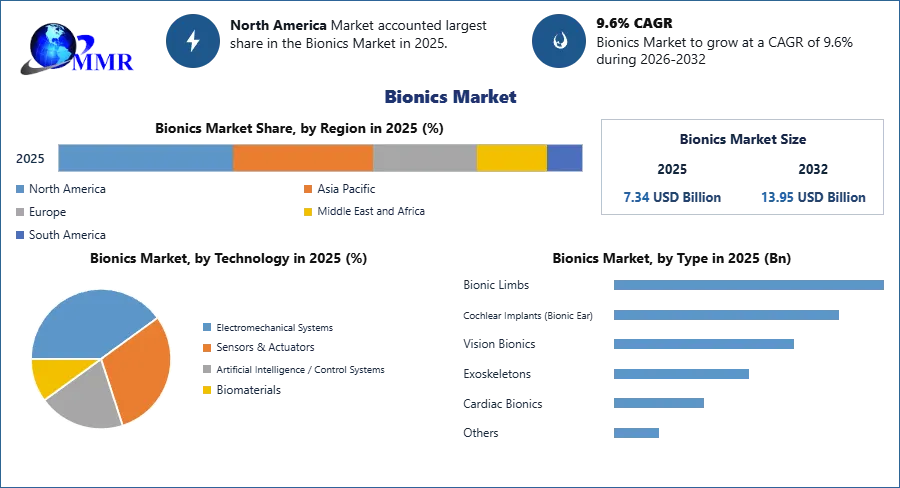
North America continues to lead the Bionics Market due to strong healthcare infrastructure, advanced research capabilities, and substantial investments in medical technology innovation.
The United States remains a major center for bionic technology development. Collaboration between healthcare providers, research institutions, and medical device manufacturers is accelerating commercialization efforts.
Europe is strengthening its position through investments in biomedical engineering, rehabilitation technologies, and advanced healthcare systems. Germany remains a key contributor due to its engineering expertise and medical technology ecosystem.
Asia-Pacific is emerging as a major growth region. China, Japan, South Korea, and India are expanding investments in healthcare innovation, robotics, and biotechnology.
Japan plays an important role because of its leadership in robotics and advanced manufacturing. South Korea continues investing heavily in healthcare technology and digital health infrastructure.
India is becoming increasingly significant as healthcare modernization initiatives create opportunities for advanced rehabilitation and assistive technologies.
Across regions, demographic changes and increasing demand for improved quality of life are supporting long-term market development.
Competitive Landscape
Competition is shifting beyond device manufacturing toward integrated healthcare technology ecosystems.
Companies such as Medtronic, Cochlear Limited, Abbott Laboratories, Össur, Sonova, Second Sight Medical Products, and Ekso Bionics are investing in advanced sensors, neural technologies, robotic systems, and digital healthcare capabilities.
This signals a broader transformation. Future market leadership will depend on the ability to combine hardware innovation, software intelligence, clinical effectiveness, and patient-centered design.
Artificial intelligence capabilities are becoming a major competitive differentiator. Companies that can deliver adaptive, intelligent systems capable of learning from patient behavior may gain significant advantages.
Partnerships between medical device manufacturers, research organizations, and healthcare institutions are accelerating innovation cycles and improving commercialization pathways.
The competitive landscape increasingly rewards organizations capable of integrating neuroscience, robotics, data analytics, and medical engineering into unified solutions.
Recent Developments
- Robotic prosthetic systems continue incorporating advanced AI-driven functionality.
- Neural interface research is expanding clinical possibilities for human-machine communication.
- Exoskeleton technologies are gaining adoption in rehabilitation and mobility assistance applications.
- Artificial organ development programs continue advancing across multiple healthcare disciplines.
- Connected medical devices are improving patient monitoring and treatment optimization capabilities.
Strategic Implications
For medical device manufacturers, bionics creates opportunities to develop highly differentiated technologies that address critical healthcare needs.
For healthcare providers, advanced assistive technologies can improve patient outcomes while supporting personalized treatment strategies.
For investors, the market represents a convergence of healthcare, robotics, artificial intelligence, and biotechnology.
For research institutions, continued innovation in neural engineering and biomedical science will influence future industry direction.
For patients, the growing availability of intelligent bionic systems has the potential to significantly improve mobility, independence, sensory function, and overall quality of life.
Future Outlook
The future of bionics will be defined by the integration of neural intelligence, artificial intelligence, advanced robotics, bioelectronics, and personalized healthcare platforms that increasingly blur the boundary between biological capability and technological enhancement.
Organizations that successfully combine clinical evidence, intelligent device design, and scalable human-machine integration technologies will define the next era of healthcare innovation, while those relying solely on conventional medical device models risk falling behind as bionics evolves into a foundational pillar of modern medicine.
Analyst Perspective
“The bionics industry is moving beyond traditional assistive technologies toward intelligent systems capable of restoring and enhancing human function. Organizations that integrate neuroscience, robotics, artificial intelligence, and personalized healthcare solutions will shape the future of medical innovation.” — Komal Patil, Research Analyst
About Maximize Market Research
Maximize Market Research Pvt. Ltd. (MMR) is a global market research and consulting company that provides reliable, data-focused, and practical business insights. The firm serves a wide range of industries, including healthcare, pharmaceuticals, technology, automotive, electronics, chemicals, personal care, and consumer goods. Through market forecasts, competitive analysis, strategic consulting, and industry impact assessments, MMR helps organizations understand changing market conditions, identify growth opportunities, and make informed business decisions for long-term success.
2nd Floor, Navale IT Park Phase 3
Pune Banglore Highway, Narhe
Pune, Maharashtra 411041, India
+91 9607365656
sales@maximizemarketresearch.com
