Key Highlights
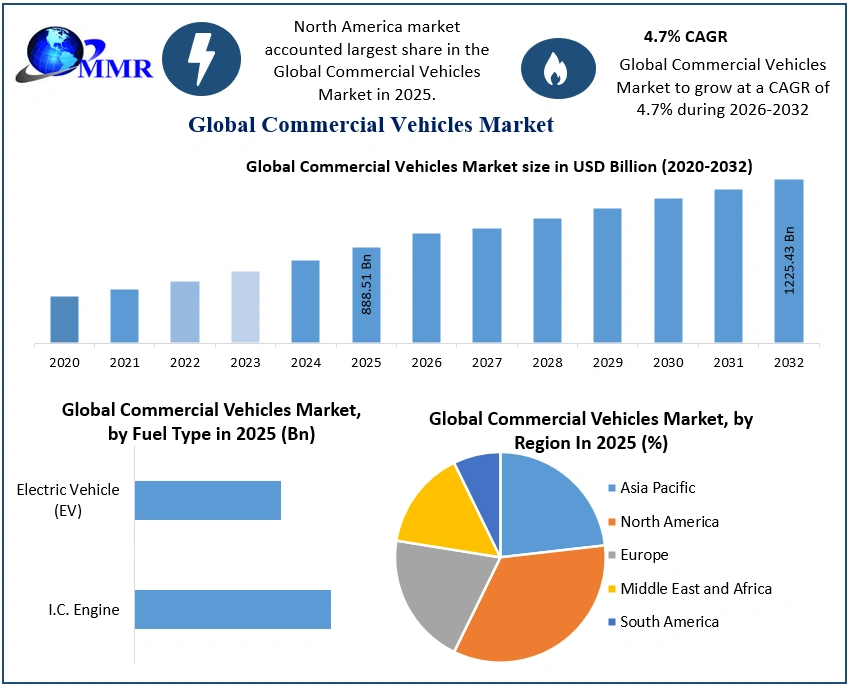
- Commercial Vehicles Market valued at USD 888.51 Billion in 2025.
- Market expected to reach USD 1,225.43 Billion by 2032.
- Revenue projected to grow at a CAGR of 4.7% from 2025 to 2032.
- Fleet electrification is becoming a core investment priority across logistics and transportation sectors.
- Connected vehicle technologies are transforming fleet efficiency and operational visibility.
- Emissions regulations are accelerating powertrain innovation and alternative fuel adoption.
- OEMs are expanding software, telematics, and digital service ecosystems alongside vehicle manufacturing.
- Supply-chain resilience and localization strategies remain central competitive priorities.
Why This Matters Now
Commercial transportation is moving from a hardware-driven business to a software-enabled mobility ecosystem. Fleet operators are no longer competing solely on vehicle ownership costs; they are competing on data, uptime, energy efficiency, and logistics intelligence.
The Commercial Vehicles Market was valued at USD 888.51 Billion in 2025 and is expected to reach USD 1,225.43 Billion by 2032, growing at a CAGR of 4.7%. That expansion signals more than market growth. It highlights an industry-wide shift toward connected operations, electrified fleets, digital transportation platforms, and stricter sustainability targets.
For OEMs, suppliers, logistics providers, investors, and regulators, the next decade will determine who controls the future economics of freight movement and commercial mobility.
Market Overview
Commercial vehicles sit at the center of global economic activity. Every supply chain, manufacturing network, retail ecosystem, and infrastructure project depends on efficient movement of goods and people.
What has changed is the definition of efficiency. Historically, fleet operators focused on fuel consumption and maintenance costs. Today, transportation companies are prioritizing predictive maintenance, route optimization, telematics integration, driver analytics, emissions reduction, and vehicle connectivity.
Commercial vehicle manufacturers are responding by transforming their product portfolios. Traditional vehicle production is increasingly being paired with software subscriptions, fleet analytics platforms, remote diagnostics, and connected service offerings.
This transition is creating new revenue pools while intensifying competition among vehicle manufacturers, technology providers, and mobility platform operators.
Key Trends Driving Growth
Fleet electrification continues to gain strategic importance across urban delivery, public transportation, and regional logistics operations. Rising pressure to reduce emissions is pushing operators toward battery-electric and alternative-fuel commercial vehicle deployments.
Software-defined vehicle architecture is becoming a critical differentiator. Fleet operators increasingly expect vehicles to support over-the-air updates, predictive diagnostics, cybersecurity features, and integrated fleet management capabilities.
Connected vehicle ecosystems are also expanding rapidly. Real-time tracking, fuel optimization, asset monitoring, driver performance analytics, and maintenance forecasting are becoming standard fleet requirements rather than premium features.
Supply-chain resilience has emerged as another defining trend. Semiconductor disruptions exposed vulnerabilities across global vehicle production networks. Manufacturers are strengthening supplier diversification strategies and increasing visibility across sourcing operations.
Meanwhile, transportation digitization is creating opportunities for logistics providers to improve utilization rates, reduce operating costs, and increase asset productivity.
Download Free PDF Sample:https://www.maximizemarketresearch.com/request-sample/112685/
Segment Insights
- Dominant Segment: Information not specified in the source report.
- Fastest-Growing Segment: Information not specified in the source report.
- Electrification is creating new opportunities across medium-duty and heavy-duty fleet categories.
- Connected fleet solutions continue to gain traction among logistics operators seeking operational efficiency improvements.
- Advanced driver assistance systems (ADAS) are increasingly integrated into commercial vehicle platforms to improve safety and compliance.
- Digital fleet management solutions are becoming key purchasing criteria for commercial vehicle buyers.
The growing convergence of transportation hardware and software is reshaping vehicle purchasing decisions. Fleet operators increasingly evaluate vehicles based on lifecycle productivity rather than upfront acquisition costs alone.
This shift favors manufacturers capable of combining vehicle engineering with digital service ecosystems.
Regional Growth Story
The United States remains a critical market for commercial transportation modernization. Fleet operators are investing in connected logistics infrastructure, telematics platforms, and emissions-compliant vehicle technologies to improve productivity and regulatory compliance.
China continues to influence global commercial vehicle transformation through large-scale manufacturing capabilities, electrification initiatives, and transportation infrastructure investments. The country’s role in battery production and supply-chain development also impacts global commercial vehicle strategies.
Germany remains a focal point for advanced commercial vehicle engineering, manufacturing innovation, and industrial transportation solutions. European emissions regulations are accelerating investments in cleaner commercial transportation technologies.
Japan and South Korea continue to strengthen their positions through advanced manufacturing, powertrain innovation, and connected mobility technologies. Both countries remain important contributors to commercial vehicle technology development.
India is emerging as a significant growth market as logistics modernization, infrastructure expansion, and e-commerce growth drive demand for commercial transportation solutions. Fleet digitization initiatives are creating opportunities across both urban and long-haul transportation segments.
Across regions, the common theme is modernization. Governments, logistics providers, and manufacturers are aligning investments around efficiency, sustainability, and digital transportation capabilities.
Competitive Landscape
Competition in the Commercial Vehicles Market is no longer centered exclusively on manufacturing scale. The next competitive battleground is ecosystem ownership.
OEMs are expanding beyond vehicle sales into connected services, fleet analytics, predictive maintenance, and subscription-based software offerings. This transition strengthens recurring revenue opportunities while deepening customer relationships.
For Tier-1 suppliers, the shift creates both opportunity and pressure. Suppliers that provide connectivity solutions, advanced electronics, telematics systems, sensors, software integration, and digital infrastructure are moving closer to strategic decision-making roles within vehicle programs.
Powertrain transformation is also reshaping supplier dynamics. Companies with expertise in battery systems, energy management technologies, lightweight materials, and electrified drivetrains are positioned to capture growing investment flows.
Manufacturing competitiveness remains essential, but future leadership will increasingly depend on software capabilities, platform scalability, supply-chain resilience, and technology integration.
As transportation becomes more data-driven, vehicle intelligence may become as important as vehicle performance.
Recent Developments
- Commercial vehicle manufacturers are increasing investments in connected fleet technologies.
- Fleet operators are accelerating digital transformation initiatives to improve operational efficiency.
- Emissions compliance requirements are driving continued powertrain innovation.
- Transportation companies are expanding deployment of telematics and predictive maintenance platforms.
- Supply-chain resilience programs remain a major strategic focus across the industry.
- Logistics operators are increasing investments in fleet optimization and transportation visibility solutions.
Strategic Implications
For investors, the most attractive opportunities may increasingly emerge from transportation technology ecosystems rather than vehicle production alone.
For OEMs, long-term competitiveness will depend on balancing traditional manufacturing excellence with software innovation, connectivity capabilities, and fleet service integration.
For logistics operators, digitization offers measurable gains in asset utilization, maintenance efficiency, route optimization, and cost control.
For suppliers, growth opportunities are shifting toward electronics, software platforms, advanced sensors, energy management systems, and connected mobility solutions.
The industry is entering a period where value creation extends beyond the vehicle itself. Data, analytics, and operational intelligence are becoming core commercial assets.
Future Outlook
The Commercial Vehicles Market is expected to grow from USD 888.51 Billion in 2025 to USD 1,225.43 Billion by 2032 at a CAGR of 4.7%, reflecting sustained investment in transportation modernization, fleet efficiency, and digital mobility infrastructure.
The next phase of industry competition will be defined by the convergence of electrification, connectivity, automation, and software-driven fleet management. Vehicle manufacturers that successfully integrate transportation hardware with intelligent digital ecosystems will gain stronger customer retention, higher-margin revenue streams, and greater strategic control over mobility networks.
The winners of the next decade will not be the companies that build the most vehicles—they will be the companies that build the most intelligent transportation ecosystems.
Analyst Perspective
“The Commercial Vehicles Market is evolving beyond conventional vehicle manufacturing toward integrated mobility, connectivity, and fleet intelligence solutions. Organizations that align vehicle innovation with digital transportation capabilities will be best positioned to capture long-term value creation opportunities across the global commercial mobility ecosystem.” — Tejaswini Kakade, Analyst
About Maximize Market Research
Maximize Market Research Pvt. Ltd. (MMR) is a global market research and consulting company that provides reliable, data-focused, and practical business insights. The firm serves a wide range of industries, including healthcare, pharmaceuticals, technology, automotive, electronics, chemicals, personal care, and consumer goods. Through market forecasts, competitive analysis, strategic consulting, and industry impact assessments, MMR helps organizations understand changing market conditions, identify growth opportunities, and make informed business decisions for long-term success.
Contact Us:
2nd Floor, Navale IT Park Phase 3
Pune Banglore Highway, Narhe
Pune, Maharashtra 411041, India
+91 9607365656
sales@maximizemarketresearch.com
