Key Highlights
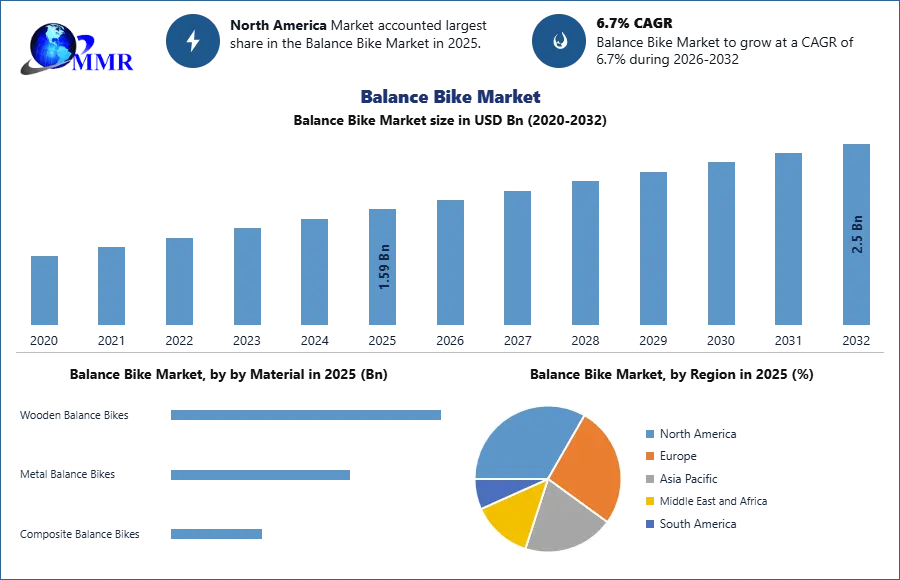
- Global Balance Bike Market valued at USD 1.59 Billion in 2025.
- Market projected to reach USD 2.5 Billion by 2032.
- Revenue expected to grow at a CAGR of 6.7% during the forecast period.
- Manufacturers are investing in lightweight materials and safety-focused product innovation.
- Premiumization is creating new opportunities across developed markets.
- Sustainability initiatives are influencing product development and manufacturing decisions.
- E-commerce expansion is increasing global market accessibility.
- Growing awareness of early mobility development is supporting long-term demand.
Why This Matters Now
The transportation industry’s transformation is starting earlier than many executives anticipated. The same forces reshaping automotive mobility—lightweight engineering, sustainability, user-centric design, and digital retail ecosystems—are increasingly influencing the balance bike market.
The Global Balance Bike Market was valued at USD 1.59 Billion in 2025 and is expected to reach USD 2.5 Billion by 2032, growing at a CAGR of 6.7% during the forecast period. That growth signals rising investment in early-stage mobility products and highlights how manufacturers are creating value through innovation, safety, and premium consumer experiences.
For investors, mobility companies, sporting goods manufacturers, and transportation stakeholders, the category offers insight into changing consumer behavior and future mobility preferences.
Market Overview
Balance bikes have evolved from simple learning tools into sophisticated mobility products designed to improve coordination, balance, and confidence before children transition to traditional bicycles.
The category sits at the intersection of recreation, mobility training, health, and consumer lifestyle spending. Manufacturers increasingly compete on product design, material innovation, safety certifications, weight reduction, and sustainability performance.
The market’s expansion reflects broader shifts in consumer spending patterns. Parents are investing more in products that combine physical activity, skill development, and outdoor engagement.
What changed is the level of product sophistication. Modern balance bikes increasingly incorporate advanced materials, ergonomic design principles, and enhanced safety features once associated with higher-end bicycle segments.
As a result, the category is attracting greater attention from established bicycle manufacturers and emerging mobility brands.
Key Trends Driving Growth
Lightweight material innovation remains one of the most influential trends shaping the market. Manufacturers are reducing product weight to improve usability for young riders while maintaining durability and safety standards.
Safety continues to drive purchasing decisions. Parents increasingly evaluate products based on stability, frame construction, ergonomic design, and overall riding confidence.
Premiumization is creating new growth opportunities. Consumers are demonstrating willingness to spend more on products that offer enhanced quality, stronger brand reputation, and superior user experience.
Sustainability is becoming a competitive differentiator. Manufacturers are exploring environmentally responsible materials, recyclable components, and more efficient production methods to align with evolving consumer expectations.
Digital commerce is also transforming market access. Online retail platforms enable brands to reach broader customer bases while improving product visibility and consumer education.
The category’s growth increasingly mirrors broader transportation and mobility trends where user experience, design efficiency, and sustainability influence purchasing decisions.
Download Free PDF Sample:https://www.maximizemarketresearch.com/request-sample/206143/
Segment Insights
- Dominant Segment: Information not specified in the source report.
- Fastest-Growing Segment: Information not specified in the source report.
- Lightweight product categories continue to gain attention among consumers seeking improved usability.
- Premium product offerings are expanding across developed consumer markets.
- Safety-focused product innovations remain central to manufacturer differentiation strategies.
- Sustainable manufacturing initiatives are influencing future product development roadmaps.
The market’s most significant shift is the movement from utility-focused products toward experience-focused mobility solutions. Consumers increasingly value quality, design, and developmental benefits alongside affordability.
Manufacturers capable of combining these attributes are strengthening their competitive positioning.
Regional Growth Story
The United States remains an important market due to strong consumer spending, established outdoor recreation culture, and growing awareness of child development products.
Germany continues to influence product design standards through its long-standing bicycle manufacturing expertise and emphasis on engineering quality. European consumers increasingly prioritize sustainability and premium product attributes.
China plays a critical role in manufacturing and supply-chain operations. The country’s production capabilities help support global distribution networks and product availability.
Japan and South Korea contribute through innovation-driven consumer markets where product quality, safety, and design excellence often command premium pricing.
India represents an emerging opportunity as rising disposable incomes, urbanization, and growing participation in recreational activities support demand for mobility-related products.
Across regions, the common growth driver is increasing recognition of outdoor activity and early mobility development as important aspects of childhood learning and recreation.
Competitive Landscape
Competition is intensifying as established bicycle brands, specialty mobility companies, and emerging consumer-product manufacturers expand their presence in the market.
The strategic significance extends beyond product sales. Balance bikes often serve as entry points into broader customer relationships that can extend into bicycles, sporting goods, and mobility-related product categories.
Manufacturers investing in lightweight materials are strengthening their ability to differentiate products while improving user experience. Those investments also signal broader capabilities in engineering, product design, and manufacturing innovation.
Brand positioning is becoming increasingly important. Companies that successfully communicate safety, developmental value, durability, and sustainability are building stronger pricing power and customer loyalty.
Supply-chain efficiency remains another competitive factor. Companies with resilient sourcing networks and manufacturing flexibility are better positioned to respond to demand fluctuations and evolving consumer preferences.
The market is gradually shifting from price-based competition toward innovation-based competition, creating advantages for manufacturers with strong design and product-development capabilities.
Recent Developments
- Manufacturers continue introducing lighter and more ergonomic product designs.
- Sustainability initiatives are becoming more prominent across product development programs.
- E-commerce channels are expanding market reach and consumer engagement.
- Premium product offerings are increasing across key regional markets.
- Safety-focused innovations remain a major area of competitive investment.
- Global brands are strengthening distribution networks to improve market penetration.
Strategic Implications
For manufacturers, the balance bike segment offers an opportunity to build long-term customer relationships at an early stage of the consumer journey.
For investors, the category demonstrates how mobility-related consumer products can generate growth through innovation, premiumization, and brand development rather than scale alone.
For suppliers, opportunities are emerging in lightweight materials, sustainable components, ergonomic design technologies, and advanced manufacturing processes.
For retailers, expanding digital commerce channels are creating new pathways for customer acquisition and product education.
The broader implication is clear: mobility ecosystems increasingly begin with consumer experiences rather than transportation infrastructure. Early engagement can influence future purchasing behavior across multiple mobility categories.
Future Outlook
The Balance Bike Market is expected to grow from USD 1.59 Billion in 2025 to USD 2.5 Billion by 2032, expanding at a CAGR of 6.7%. That trajectory highlights sustained demand for products that combine recreation, skill development, and mobility training.
Future competition will be shaped by lightweight engineering, sustainable manufacturing, safety innovation, and premium consumer experiences. As product quality standards rise and customer expectations evolve, manufacturers will need to differentiate through design excellence and brand trust rather than pricing alone.
The next generation of market leaders will be the companies that treat balance bikes not as children’s products, but as the first platform in a lifelong mobility ecosystem, while laggards remain trapped in commodity competition.
Analyst Perspective
“The Balance Bike Market is entering a phase where innovation, safety, sustainability, and premium product design are becoming the primary growth drivers. Companies that align product development with evolving consumer expectations will be best positioned to capture long-term opportunities in the global mobility and recreation landscape.” — Tejaswini Kakade, Analyst
About Maximize Market Research
Maximize Market Research Pvt. Ltd. (MMR) is a global market research and consulting company that provides reliable, data-focused, and practical business insights. The firm serves a wide range of industries, including healthcare, pharmaceuticals, technology, automotive, electronics, chemicals, personal care, and consumer goods. Through market forecasts, competitive analysis, strategic consulting, and industry impact assessments, MMR helps organizations understand changing market conditions, identify growth opportunities, and make informed business decisions for long-term success.
Contact Us:
2nd Floor, Navale IT Park Phase 3
Pune Banglore Highway, Narhe
Pune, Maharashtra 411041, India
+91 9607365656
sales@maximizemarketresearch.com
