Key Highlights
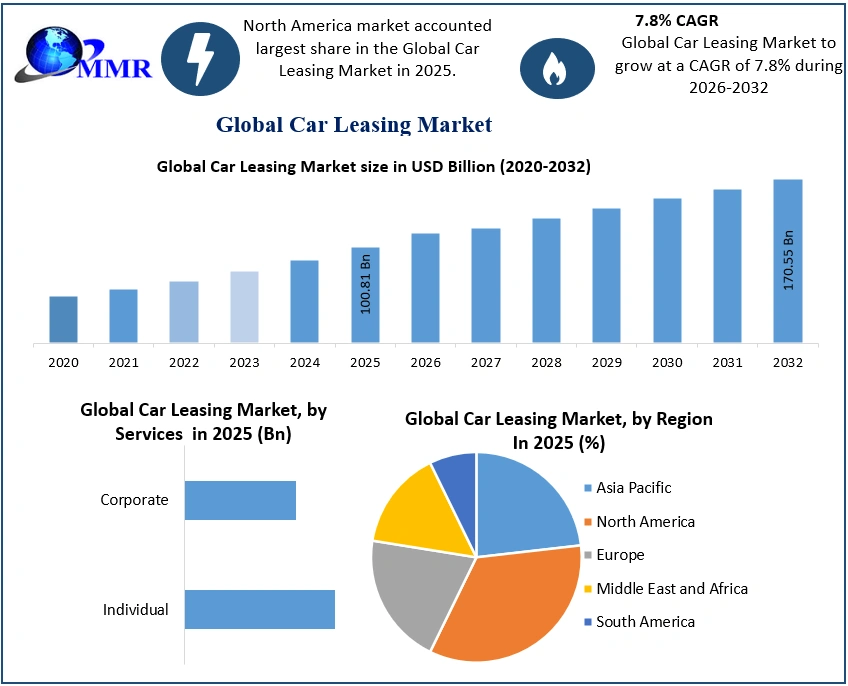
- Car Leasing Market valued at USD 100.81 Billion in 2025.
- Market expected to reach nearly USD 170.55 Billion by 2032.
- Revenue projected to grow at a CAGR of 7.8% from 2026 to 2032.
- Vehicle access models are gaining momentum over traditional ownership structures.
- Fleet electrification is creating new leasing opportunities for corporate customers.
- Digital leasing platforms are streamlining vehicle acquisition and management.
- Connected vehicle technologies are improving fleet monitoring and lifecycle management.
- Mobility-as-a-service models are expanding the role of leasing providers within transportation ecosystems.
Why This Matters Now
The automotive industry is entering one of its most significant business model transitions in decades. The debate is no longer centered on which vehicles consumers buy; it is increasingly focused on how they access mobility.
The Car Leasing Market was valued at USD 100.81 Billion in 2025 and is expected to reach USD 170.55 Billion by 2032, growing at a CAGR of 7.8% from 2026 to 2032. That expansion signals rising demand for flexible mobility solutions and highlights a broader shift away from traditional ownership toward usage-based transportation models.
For automakers, leasing companies, fleet operators, investors, and mobility providers, this transition is creating new competitive opportunities while reshaping revenue models across the automotive sector.
Market Overview
Car leasing has evolved from a financing alternative into a strategic component of modern mobility ecosystems. Consumers increasingly value flexibility, predictable costs, and access to newer vehicle technologies without long-term ownership commitments.
The industry’s transformation is closely linked to broader changes occurring across transportation markets. Electrification, connectivity, software-defined vehicles, digital commerce, and mobility subscriptions are all influencing leasing demand.
For businesses, leasing provides an effective pathway to fleet modernization without large upfront capital expenditures. For consumers, it offers access to advanced safety technologies, connected services, and electric vehicle options with reduced financial risk.
As vehicle technologies evolve more rapidly, leasing becomes increasingly attractive because it enables faster fleet turnover and technology adoption.
Key Trends Driving Growth
Electrification is emerging as one of the most important drivers of leasing demand. Many consumers and businesses remain cautious about long-term EV ownership due to evolving battery technologies, residual value uncertainty, and charging infrastructure development.
Leasing helps reduce those concerns by shortening commitment periods and enabling easier transitions to newer vehicle generations. As a result, leasing providers are becoming important facilitators of EV adoption.
Connected vehicle ecosystems are also influencing market growth. Modern vehicles generate valuable operational data that can improve fleet utilization, maintenance planning, insurance management, and vehicle lifecycle optimization.
Digital transformation is reshaping leasing operations. Online applications, automated approvals, digital contract management, remote vehicle monitoring, and predictive analytics are improving customer experiences while reducing operational complexity.
Mobility-as-a-service models continue to gain traction. Businesses increasingly view transportation as a service rather than a fixed asset, creating favorable conditions for flexible leasing solutions.
At the same time, regulatory pressure to reduce emissions is encouraging fleet operators to replace older vehicles more frequently. Leasing structures provide a practical mechanism for achieving those objectives.
Get a free sample now:https://www.maximizemarketresearch.com/request-sample/67834/
Segment Insights
- Dominant Segment: Information not specified in the source report.
- Fastest-Growing Segment: Information not specified in the source report.
- Corporate fleet leasing remains a critical growth opportunity as organizations pursue fleet modernization.
- EV leasing programs are gaining strategic importance within mobility portfolios.
- Digital leasing solutions are improving operational efficiency and customer acquisition.
- Connected vehicle integration is strengthening fleet management capabilities.
The most important market shift is the convergence of automotive financing and mobility services. Leasing providers increasingly function as mobility managers rather than traditional finance companies.
This evolution is expanding revenue opportunities through data services, fleet management, maintenance programs, and digital mobility platforms.
Regional Growth Story
The United States remains one of the most influential car leasing markets due to its mature automotive finance ecosystem, strong fleet demand, and growing interest in flexible mobility solutions.
Germany continues to play a central role in vehicle leasing because of its leadership in automotive manufacturing, corporate fleet management, and transportation innovation. European emissions regulations are also encouraging fleet renewal activities.
China’s automotive transformation is creating significant opportunities for leasing providers. Rapid electrification initiatives, digital commerce adoption, and mobility platform expansion are reshaping vehicle access models.
Japan and South Korea continue contributing through advanced automotive technologies, connected vehicle development, and fleet modernization programs.
India represents an increasingly important growth opportunity as corporate mobility requirements, urban transportation needs, and vehicle financing alternatives expand. The country’s digital transformation efforts are also supporting broader adoption of technology-enabled leasing solutions.
Across regions, leasing is becoming an important tool for accelerating transportation modernization while managing financial and technological risks.
Competitive Landscape
Competition within the Car Leasing Market is increasingly focused on platform capabilities rather than financing products alone.
Leasing providers are investing in digital infrastructure, analytics platforms, connected vehicle integration, and customer experience technologies. These investments signal a broader shift toward technology-enabled mobility services.
For OEMs, leasing programs have become strategic tools for maintaining customer relationships throughout the vehicle lifecycle. Leasing can improve customer retention while accelerating adoption of new vehicle technologies, including electric and connected vehicles.
Tier-1 suppliers also benefit from this transition. As leased fleets increasingly adopt connected technologies, demand grows for sensors, telematics systems, software platforms, cybersecurity solutions, and predictive maintenance tools.
Vehicle data is becoming a competitive asset. Organizations capable of converting operational information into actionable fleet intelligence are gaining stronger market positioning.
The next phase of competition may increasingly revolve around ecosystem ownership. Companies that control customer relationships, vehicle data, service networks, and mobility platforms are likely to capture a larger share of industry value.
Recent Developments
- Leasing providers continue expanding digital customer engagement platforms.
- Fleet electrification initiatives are increasing demand for EV leasing programs.
- Connected vehicle technologies are improving fleet visibility and lifecycle management.
- Data analytics capabilities are becoming more important across leasing operations.
- Mobility subscription models are gaining industry attention.
- Fleet operators are accelerating modernization efforts to meet efficiency and sustainability goals.
Strategic Implications
For investors, leasing represents one of the most attractive pathways to participate in the mobility transformation without direct exposure to vehicle manufacturing cycles.
For OEMs, leasing programs support technology adoption, improve customer retention, and create recurring revenue opportunities beyond vehicle sales.
For fleet operators, leasing reduces capital intensity while enabling access to newer vehicle technologies and operational efficiencies.
For suppliers, connected vehicle ecosystems create opportunities in software, telematics, analytics, cybersecurity, and digital fleet management.
The broader transportation industry is moving toward service-based economics where value increasingly comes from vehicle utilization, data generation, and customer engagement rather than ownership alone.
Future Outlook
The Car Leasing Market is expected to grow from USD 100.81 Billion in 2025 to nearly USD 170.55 Billion by 2032, supported by digital mobility platforms, fleet modernization strategies, electrification initiatives, and evolving transportation preferences.
Future industry leadership will depend on the ability to integrate leasing, connectivity, software services, and fleet intelligence into unified mobility ecosystems. Organizations that successfully combine financing expertise with technology-enabled mobility solutions will gain significant competitive advantages across the automotive value chain.
The next generation of market leaders will be the companies that transform leasing into a data-driven mobility platform, while laggards remain tied to traditional vehicle financing models.
Analyst Perspective
“The Car Leasing Market is increasingly becoming a critical enabler of automotive transformation. Electrification, connectivity, digital platforms, and flexible mobility models are reshaping customer expectations and creating new opportunities across the transportation ecosystem. Companies that adapt early will be best positioned for long-term growth.” — Tejaswini Kakade, Analyst
About Maximize Market Research
Maximize Market Research Pvt. Ltd. (MMR) is a global market research and consulting company that provides reliable, data-focused, and practical business insights. The firm serves a wide range of industries, including healthcare, pharmaceuticals, technology, automotive, electronics, chemicals, personal care, and consumer goods. Through market forecasts, competitive analysis, strategic consulting, and industry impact assessments, MMR helps organizations understand changing market conditions, identify growth opportunities, and make informed business decisions for long-term success.
Contact Us:
2nd Floor, Navale IT Park Phase 3
Pune Banglore Highway, Narhe
Pune, Maharashtra 411041, India
+91 9607365656
sales@maximizemarketresearch.com
