Key Highlights
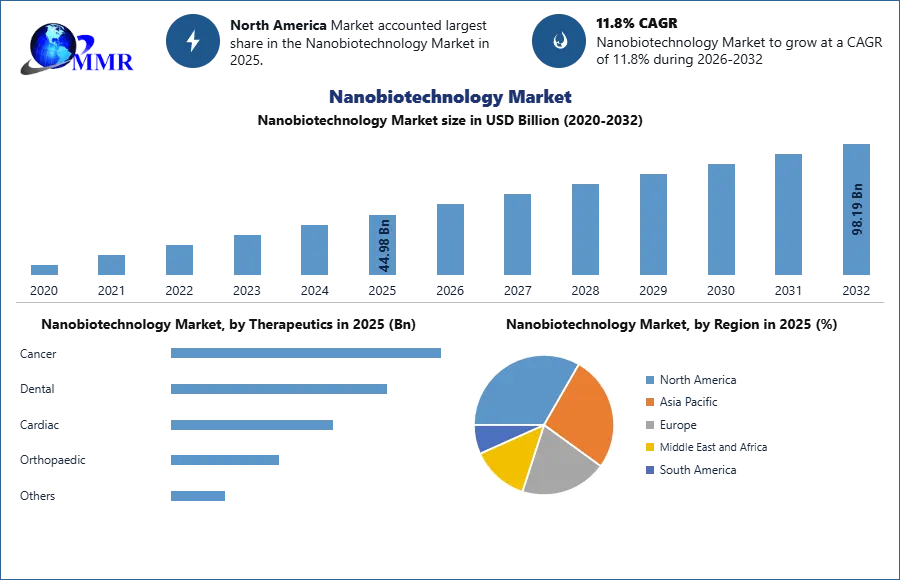
- Nanobiotechnology Market was valued at USD 44.98 billion in 2025.
- Market revenue is projected to reach nearly USD 98.19 billion by 2032.
- Expected CAGR stands at 11.8% during 2026–2032.
- Rising prevalence of chronic diseases is accelerating demand for advanced treatment and diagnostic technologies.
- Precision medicine and targeted drug delivery continue to attract significant investment.
- Integration of biotechnology and nanotechnology is creating new pathways for disease detection and therapeutic development.
- Expanding pharmaceutical and biotechnology research is increasing commercialization opportunities.
Why This Matters Now
Healthcare systems face mounting pressure from chronic diseases, aging populations, and rising treatment costs. Traditional therapeutic approaches often struggle to deliver targeted outcomes while maintaining efficiency and affordability.
Nanobiotechnology is moving from research laboratories into clinical and commercial healthcare applications. As pharmaceutical companies pursue precision medicine strategies and providers seek earlier disease detection, nanotechnology-enabled diagnostics and therapeutics are becoming strategic assets rather than experimental technologies. For investors, healthcare providers, and biotech innovators, the timing is critical because the organizations establishing scalable nanobiotechnology capabilities today will shape future treatment standards.
Market Overview
The Nanobiotechnology Market was valued at USD 44.98 billion in 2025, and total market revenue is expected to grow at a CAGR of 11.8% from 2026 to 2032, reaching nearly USD 98.19 billion.
The market sits at the intersection of biotechnology, medicine, and nanotechnology. What has changed is the scale of healthcare challenges and the maturity of nanotechnology-based solutions. Chronic diseases continue to drive demand for more effective therapies, while healthcare providers increasingly require diagnostic tools capable of detecting diseases earlier and more accurately.
Nanobiotechnology addresses both needs. Nanoparticles, nanosensors, and nanomaterials enable highly targeted drug delivery, enhanced imaging, improved diagnostics, and personalized treatment approaches. The commercial significance extends beyond patient outcomes. Better targeting can reduce treatment inefficiencies, shorten development timelines, and improve healthcare resource utilization.
As healthcare systems increasingly emphasize value-based care, technologies that improve outcomes while reducing unnecessary interventions are attracting broader adoption across hospitals, pharmaceutical companies, research institutions, and diagnostic developers.
Key Trends Driving Growth
The most significant growth catalyst is the increasing prevalence of chronic diseases. Conditions such as cancer, cardiovascular disorders, diabetes, and neurological diseases require long-term management and increasingly sophisticated treatment approaches. Nanobiotechnology offers targeted therapeutic mechanisms that can improve efficacy while minimizing adverse effects.
Precision medicine continues to reshape healthcare investment priorities. Healthcare providers and pharmaceutical companies are moving away from one-size-fits-all treatment models toward personalized therapies. Nanotechnology enables highly specific delivery systems that align with individualized treatment strategies.
Advanced diagnostics represent another major growth avenue. Earlier disease detection can significantly improve patient outcomes and reduce healthcare expenditures. Nanobiotechnology-based diagnostic tools are improving sensitivity, speed, and accuracy, creating value for healthcare systems and patients alike.
Artificial intelligence is also becoming increasingly important. AI-driven analysis combined with nanoscale diagnostic technologies can accelerate disease identification and support clinical decision-making. The convergence of digital health and nanobiotechnology is opening new opportunities for predictive and preventive healthcare.
Pharmaceutical and biotechnology companies are expanding research investments as commercialization pathways become clearer. The focus has shifted from scientific feasibility to scalable deployment, creating opportunities across therapeutic development, diagnostics, and drug delivery platforms.
Get a free sample:https://www.maximizemarketresearch.com/request-sample/207986/
Segment Insights
- Dominant Segment: Nanomedicine remains a leading application area due to growing demand for targeted therapies, advanced drug delivery systems, and improved treatment outcomes.
- Fastest-Growing Segment: Diagnostic and imaging applications are witnessing rapid expansion as healthcare providers prioritize earlier detection, precision diagnostics, and personalized treatment planning.
- Nanoparticle-enabled drug delivery technologies are attracting significant pharmaceutical investment due to their ability to enhance therapeutic effectiveness.
- Research and development applications continue to expand as biotechnology companies pursue innovative treatment platforms and next-generation healthcare solutions.
- Clinical applications are gaining momentum as regulatory pathways mature and healthcare organizations seek measurable outcome improvements.
Regional Growth Story
North America remains a major center for nanobiotechnology innovation due to strong healthcare spending, advanced research infrastructure, and extensive pharmaceutical and biotechnology activity. The region benefits from robust commercialization ecosystems that accelerate technology translation from research to clinical use.
The United States continues to lead in biotechnology investment, precision medicine initiatives, and advanced therapeutic development. Regulatory support for innovative healthcare technologies has helped create a favorable environment for commercialization.
Germany and the United Kingdom are strengthening Europe’s position through research collaboration, healthcare innovation programs, and growing adoption of advanced diagnostic technologies. The region’s emphasis on patient outcomes and healthcare efficiency supports continued investment in nanobiotechnology applications.
China is rapidly expanding its capabilities through substantial healthcare investments, biotechnology research initiatives, and manufacturing development. The country’s growing healthcare demands and innovation ecosystem are creating significant market opportunities.
Japan and South Korea continue to advance nanotechnology research while integrating innovative healthcare solutions into clinical settings. Their focus on aging populations and chronic disease management aligns closely with nanobiotechnology’s strengths.
India is emerging as an increasingly important market due to expanding healthcare infrastructure, growing biotechnology activity, and rising demand for advanced diagnostics and therapeutics. Continued investment in healthcare modernization is expected to support future adoption.
Competitive Landscape
Competition is increasingly centered on intellectual property, clinical validation, and platform scalability. Companies that can demonstrate measurable clinical benefits while navigating regulatory requirements are gaining strategic advantages.
Partnerships between pharmaceutical companies, biotechnology firms, research institutions, and healthcare providers are becoming more common. These collaborations reduce development risk and accelerate commercialization timelines.
Investment activity signals growing confidence in nanobiotechnology’s commercial potential. Organizations are focusing on technologies capable of addressing major disease burdens, particularly oncology, cardiovascular disorders, and neurological conditions.
The competitive environment is also shifting toward integrated healthcare solutions. Companies that combine nanotechnology platforms with diagnostics, digital health capabilities, and personalized treatment approaches are likely to capture greater long-term value.
Recent Developments
- Growing investment in precision medicine programs is increasing demand for nanotechnology-enabled therapeutic solutions.
- Pharmaceutical companies are expanding research into targeted drug delivery platforms.
- Diagnostic developers are advancing nanoscale technologies designed to improve disease detection accuracy.
- Increased collaboration between biotechnology firms and research institutions is accelerating innovation.
- Integration of AI and advanced analytics with nanotechnology applications is expanding healthcare use cases.
Strategic Implications
For pharmaceutical companies, nanobiotechnology creates opportunities to improve treatment effectiveness and differentiate therapeutic portfolios. Better targeting capabilities can strengthen competitive positioning while supporting value-based healthcare objectives.
Healthcare providers benefit through improved diagnostics, enhanced treatment precision, and potentially better patient outcomes. Earlier disease detection and more personalized therapies can help address growing chronic disease burdens.
Investors should monitor organizations with strong intellectual property portfolios, scalable technology platforms, and clear commercialization strategies. Market leadership will increasingly depend on the ability to translate scientific innovation into clinical and economic value.
Regulators and payers face growing pressure to balance innovation access with evidence-based reimbursement decisions. Technologies demonstrating measurable improvements in outcomes and healthcare efficiency are likely to gain broader acceptance.
Future Outlook
The next phase of growth will be driven by the convergence of nanotechnology, biotechnology, artificial intelligence, and precision medicine, with market leaders distinguished by their ability to deliver clinically validated, commercially scalable solutions.
Analyst Perspective
“The increasing prevalence of chronic diseases is accelerating demand for advanced diagnostics, targeted therapeutics, and precision medicine solutions. Nanobiotechnology is evolving into a strategic healthcare platform that can improve patient outcomes while supporting innovation across pharmaceutical, biotechnology, and healthcare ecosystems.” — Komal Patil, Analyst
About Maximize Market Research
Maximize Market Research Pvt. Ltd. (MMR) is a global market research and consulting company that provides reliable, data-focused, and practical business insights. The firm serves a wide range of industries, including healthcare, pharmaceuticals, technology, automotive, electronics, chemicals, personal care, and consumer goods. Through market forecasts, competitive analysis, strategic consulting, and industry impact assessments, MMR helps organizations understand changing market conditions, identify growth opportunities, and make informed business decisions for long-term success.
2nd Floor, Navale IT Park Phase 3
Pune Banglore Highway, Narhe
Pune, Maharashtra 411041, India
+91 9607365656
sales@maximizemarketresearch.com
