Key Highlights
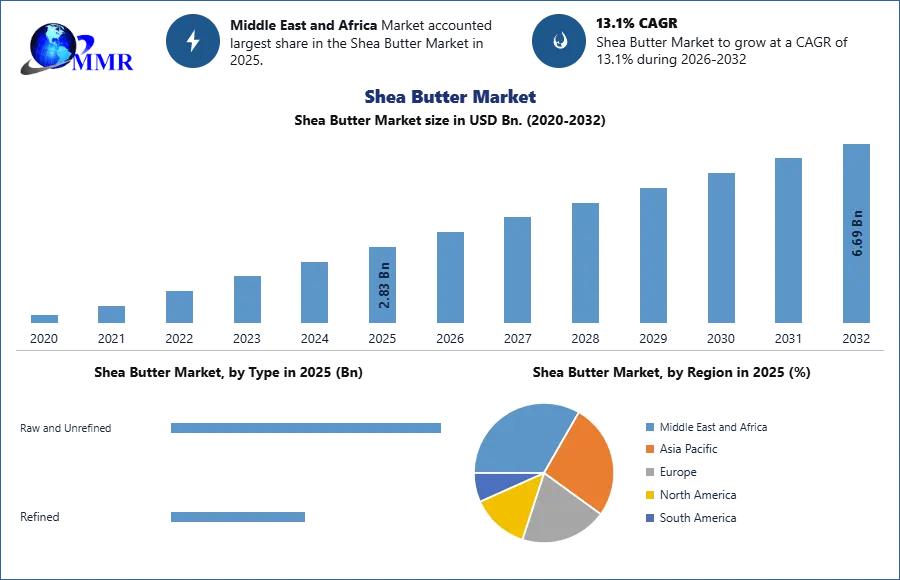
- Global Shea Butter Market is expected to reach USD 6.69 billion by 2032, expanding at a CAGR of 13.1%.
- Rising costs of synthetic ingredients are accelerating the shift toward plant-derived alternatives.
- Investments from major players are driving product diversification across raw, refined, ultra-refined, cosmetic-grade, and food-grade shea butter.
- Demand is expanding beyond cosmetics into food, pharmaceuticals, and cocoa butter equivalents (CBE).
- Blockchain-enabled ethical sourcing and AI-supported logistics are emerging as competitive differentiators.
Why This Matters Now
The economics of natural ingredients have changed faster than many consumer goods companies anticipated. As supply-chain disruptions and rising costs pressure traditional raw materials, manufacturers are searching for alternatives that can deliver performance, sustainability, and consumer trust simultaneously.
Shea butter sits at the center of that shift. Once viewed primarily as a cosmetic ingredient, it is increasingly becoming a strategic raw material across beauty, food, pharmaceutical, and specialty fat applications. Companies that secure supply and processing capabilities today may gain a significant advantage as demand accelerates over the coming decade.
Market Overview
The global Shea Butter Market is expected to reach USD 6.69 billion by 2032, growing at a CAGR of 13.1%. The growth story is being shaped by increasing adoption across cosmetics, food products, pharmaceuticals, and cocoa butter equivalents.
What makes this growth significant is not simply rising consumption. The market is evolving from a commodity ingredient business into a value-added ecosystem centered on traceability, sustainability, product-grade specialization, and supply-chain resilience. Investments from industry participants are increasingly focused on refining capabilities, quality certification, and sourcing transparency.
For manufacturers, the implication is clear: margin expansion will likely come from differentiated products rather than volume alone.
Key Trends Driving Growth
Consumer behavior is moving decisively toward natural and clean-label products. Across personal care and beauty categories, buyers are scrutinizing ingredient lists and rewarding brands that can demonstrate authenticity and sustainability. Shea butter’s natural moisturizing properties position it directly within this trend.
Another major shift is the growing role of sustainability as a commercial requirement rather than a branding exercise. Ethical sourcing programs, women-led supply networks, and traceable procurement models are becoming important purchasing criteria for global brands.
Technology is also entering the category. AI-driven logistics systems and blockchain-based verification tools are helping companies manage sourcing risks while improving transparency. This signals a broader transformation in agricultural ingredient supply chains, where digital capabilities increasingly influence competitiveness.
The food industry represents another growth engine. Demand for cocoa butter equivalents and plant-based ingredients is expanding the addressable market beyond traditional skincare applications. This diversification reduces reliance on any single end-use industry and creates new revenue streams for suppliers.
Get a free sample:https://www.maximizemarketresearch.com/request-sample/23770/
Segment Insights
- Dominant Segment: Cosmetics and personal care applications remain the leading demand center for shea butter, supported by growing consumer preference for natural skincare and beauty products.
- Fastest-Growing Segment: Cocoa butter equivalents, food-grade applications, and advanced specialty formulations are emerging as high-growth opportunities as manufacturers seek plant-based functional ingredients.
- By Type: Product diversification continues across raw, unrefined, refined, ultra-refined, cosmetic-grade, and food-grade shea butter, enabling suppliers to target higher-value applications.
- By Nature: Demand for naturally sourced and minimally processed ingredients is creating opportunities for premium-grade offerings aligned with clean-label positioning.
- By Distribution Channel: Digital commerce and direct-to-brand procurement models are increasing visibility and access for specialty ingredient suppliers, supporting broader market penetration.
Regional Growth Story
The market spans the Middle East & Africa, North America, Europe, Asia Pacific, and South America. The regional story is increasingly defined by two interconnected forces: production concentration in African sourcing regions and consumption growth in developed consumer markets.
North America and Europe continue to benefit from strong demand for natural personal care products and sustainable ingredients. At the same time, Asia-Pacific is emerging as a significant growth opportunity as beauty, wellness, and food industries accelerate adoption of plant-derived ingredients.
The strategic importance of African supply chains is also increasing. Companies with stronger sourcing relationships and local processing capabilities may gain an advantage as demand intensifies and traceability requirements become stricter.
Competitive Landscape
Competition is shifting away from simple sourcing scale toward ecosystem control.
Leading participants including AAK, Bunge Loders Croklaan, Fuji Oil, and Olvea are investing in supply-chain modernization, processing capabilities, and product-grade diversification. These moves signal that future competition will increasingly be based on reliability, certification, and application-specific expertise rather than raw material access alone.
The growing emphasis on blockchain verification and AI-enabled logistics suggests that transparency is becoming a competitive asset. Companies that can verify origin, sustainability credentials, and supply continuity are likely to command stronger relationships with multinational FMCG and food manufacturers.
For rivals, this creates pressure to invest in technology, traceability, and partnerships. Over the next 12–24 months, the market is likely to see greater integration between sourcing networks, processors, and branded manufacturers seeking secure access to premium shea butter supplies.
Recent Developments
- Major industry participants increased investments in supply-chain modernization and product-grade diversification.
- Expansion of raw, refined, ultra-refined, cosmetic-grade, and food-grade portfolios is reshaping product positioning strategies.
- AI-powered logistics solutions are being adopted to improve supply-chain resilience and efficiency.
- Blockchain-enabled ethical sourcing initiatives are gaining traction among global suppliers and buyers.
- Rising demand for cocoa butter equivalents is creating new opportunities within food manufacturing.
Strategic Implications
The next phase of growth will be defined by who controls trust rather than who controls volume.
Brand owners increasingly want ingredients that satisfy regulatory expectations, sustainability commitments, and consumer scrutiny simultaneously. Suppliers capable of delivering traceability, certification, and consistent quality will be positioned to capture premium pricing.
For investors, the most attractive opportunities may emerge in processing infrastructure, digital traceability platforms, specialty ingredient development, and vertically integrated sourcing networks.
Future Outlook
The Shea Butter Market is moving from a niche natural ingredient category into a strategically important component of global beauty, wellness, and food supply chains. Demand drivers now span consumer health preferences, sustainability mandates, ingredient innovation, and supply-chain resilience.
As companies compete for differentiated natural ingredients, shea butter’s role is expected to expand across multiple industries. The winners will build transparent, technology-enabled, value-added supply ecosystems; the losers will remain exposed to commodity pricing and increasingly demanding buyers.
Analyst Perspective
“The Shea Butter Market is entering a period where sustainability, traceability, and product innovation are becoming as important as production capacity. Companies that align sourcing, technology, and premium-grade development will be best positioned to capture long-term value creation opportunities.” — Siddhi Dole, Analyst, Maximize Market Research
About Maximize Market Research
Maximize Market Research Pvt. Ltd. (MMR) is a global market research and consulting company that provides reliable, data-focused, and practical business insights. The firm serves a wide range of industries, including healthcare, pharmaceuticals, technology, automotive, electronics, chemicals, personal care, and consumer goods. Through market forecasts, competitive analysis, strategic consulting, and industry impact assessments, MMR helps organizations understand changing market conditions, identify growth opportunities, and make informed business decisions for long-term success.
2nd Floor, Navale IT Park Phase 3
Pune Banglore Highway, Narhe
Pune, Maharashtra 411041, India
+91 9607365656
sales@maximizemarketresearch.com
