Key Highlights
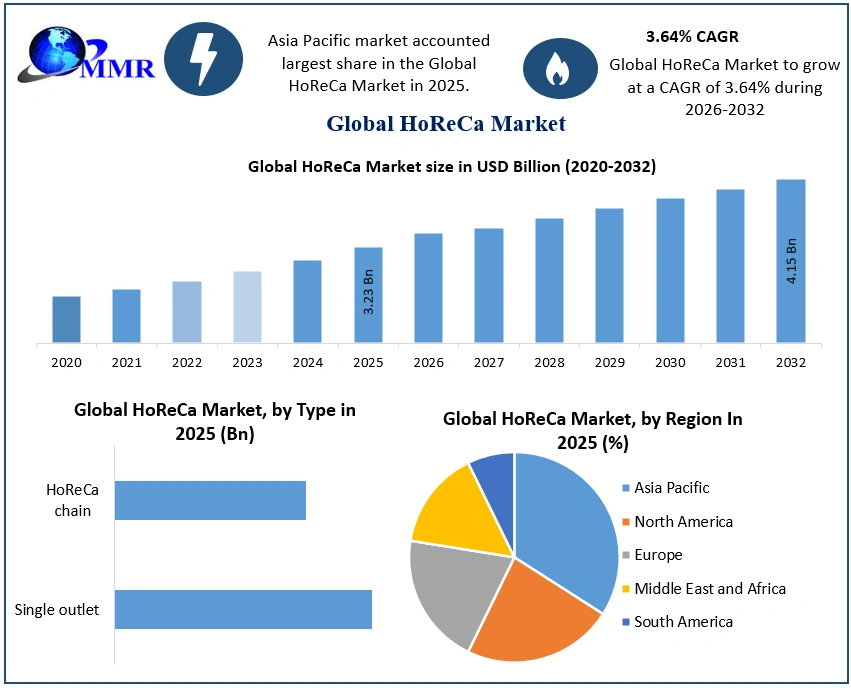
- The HoReCa Market was valued at USD 3.23 Trillion in 2025 and is expected to reach USD 4.15 Trillion by 2032, growing at a CAGR of 3.64%. This signals continued expansion despite rising operating costs and shifting consumer expectations.
- Independent and single-outlet establishments remain the market’s largest segment, controlling a substantial share of industry activity. Their dominance highlights consumer demand for differentiated and localized experiences.
- Hotels continue to be a major revenue engine as global tourism and business travel recover. This creates opportunities for integrated foodservice, catering, and premium hospitality offerings.
- AI-enabled operations, cloud kitchens, and digital ordering ecosystems are reshaping service models and profitability across the sector.
- Sustainability, health-conscious menus, and ingredient transparency are moving from niche initiatives to competitive requirements.
Why This Matters Now
The hospitality industry is facing a new competitive reality. Consumer spending is returning, but loyalty is becoming harder to secure. Operators must simultaneously manage labor costs, digital disruption, sustainability expectations, and evolving dining preferences.
For investors and executives, the HoReCa Market’s projected expansion to USD 4.15 Trillion is not simply a growth story. It is evidence that value is shifting toward businesses capable of combining operational efficiency with personalized customer experiences.
Market Overview
The global HoReCa Market continues to expand as travel, dining, and hospitality spending regain momentum. The market generated USD 3.23 Trillion in 2025 and is expected to approach USD 4.15 Trillion by 2032. The projected CAGR of 3.64% demonstrates a resilient industry supported by tourism recovery, urbanization, and rising demand for premium hospitality experiences.
What distinguishes this growth cycle is the changing source of demand. Consumers increasingly prioritize experience over transaction. Restaurants are becoming lifestyle destinations. Hotels are broadening their role beyond accommodation. Cafés are evolving into social and workspaces. These shifts are creating new revenue streams while raising expectations for service quality and personalization.
Key Trends Driving Growth
Digital technology is rapidly changing how hospitality businesses engage customers. AI-powered reservation systems, personalized promotions, predictive inventory management, and digital ordering platforms are improving efficiency while enhancing customer retention. Operators that deploy these tools effectively can protect margins even as labor and food costs rise.
Cloud kitchens continue to gain traction because they offer scalable growth with lower capital requirements. Their delivery-first model allows operators to expand geographic reach without investing heavily in physical infrastructure. This trend is altering competitive dynamics across urban markets.
Health and wellness trends are also influencing menu development. Consumers increasingly seek clean-label products, ingredient transparency, organic sourcing, and plant-based alternatives. These demands are reshaping procurement strategies and supplier relationships across the value chain.
Sustainability initiatives are becoming more visible throughout the industry. Businesses are adopting waste reduction programs, local sourcing strategies, and environmentally responsible operating practices to align with consumer expectations and regulatory pressures.
Get a free sample:https://www.maximizemarketresearch.com/request-sample/221480/
Segment Insights
- Dominant Segment: Single-outlet establishments accounted for 60.78% market share in 2025. Their ability to deliver personalized experiences, local relevance, and unique offerings continues to attract consumers seeking alternatives to standardized chain formats.
- Fastest-Growing Segment: The single-outlet segment is projected to grow at a 4.12% CAGR through 2032, supported by demand for boutique hospitality experiences and community-focused dining concepts.
- Hotels as Revenue Leaders: Hotels remain a primary revenue contributor as travel activity recovers. Their role as hospitality hubs strengthens opportunities for integrated foodservice and premium guest experiences.
- Cloud Kitchen Opportunity: Delivery-focused operations continue gaining momentum due to lower operating costs and scalable business models.
Regional Growth Story
Growth patterns differ significantly across regions. Mature hospitality markets are benefiting from premiumization, while emerging markets are fueled by urbanization and rising disposable incomes.
Asia-Pacific remains a critical growth engine due to expanding middle-class populations, increasing travel activity, and rapid digital adoption. Urban consumers are driving demand for both organized hospitality brands and innovative local operators. The region’s growing reliance on delivery ecosystems and mobile-first consumption patterns is accelerating market modernization.
Meanwhile, developed markets continue investing in automation, sustainability initiatives, and premium guest experiences to defend margins and maintain customer loyalty. These investments are raising competitive standards across the global industry.
Competitive Landscape
Competition is becoming increasingly complex. Traditional advantages such as location and brand recognition are no longer sufficient. Operators now compete on technology, customer experience, sustainability credentials, and omnichannel engagement.
The rise of independent operators signals that consumers are rewarding authenticity and differentiation. For large chains, this creates pressure to localize offerings while maintaining scale advantages. For smaller players, it validates premium pricing strategies built around unique experiences.
Investments in AI, cloud kitchens, and digital ordering systems indicate that future market leaders will be those capable of integrating operational efficiency with personalized service. Over the next 12–24 months, the sector is likely to see continued expansion of asset-light models, greater adoption of predictive analytics, and increased competition for customer data ownership.
Recent Developments
- Expansion of AI-driven guest management and operational systems across hospitality businesses.
- Continued growth of cloud kitchen and delivery-first business models.
- Increased investment in health-focused and clean-label menu innovation.
- Greater emphasis on sustainable sourcing and waste reduction initiatives.
- Rising corporate interest in HoReCa-focused product portfolios and B2B foodservice opportunities.
Strategic Implications
The next phase of growth will reward agility over scale alone. Operators must build capabilities in digital engagement, customer analytics, and operational automation while preserving service quality.
For suppliers, the market creates opportunities in sustainable ingredients, food technology, packaging innovation, and hospitality software solutions. For investors, businesses with strong omnichannel capabilities and differentiated customer experiences are likely to command premium valuations.
Future Outlook
The HoReCa Market is transitioning from a volume-driven industry to an experience-driven ecosystem. Growth will increasingly depend on a company’s ability to combine technology, personalization, sustainability, and operational efficiency.
The winners will build intelligent, experience-led hospitality platforms; the losers will remain trapped in price competition while consumer expectations continue to rise.
Analyst Perspective
“The HoReCa industry is entering a period where technology adoption and personalized experiences will become equally important as scale. Businesses that align digital capabilities with evolving consumer expectations will be best positioned to capture long-term value creation opportunities across the hospitality ecosystem.” — Siddhi Dole, Analyst
About Maximize Market Research
Maximize Market Research Pvt. Ltd. (MMR) is a global market research and consulting company that provides reliable, data-focused, and practical business insights. The firm serves a wide range of industries, including healthcare, pharmaceuticals, technology, automotive, electronics, chemicals, personal care, and consumer goods. Through market forecasts, competitive analysis, strategic consulting, and industry impact assessments, MMR helps organizations understand changing market conditions, identify growth opportunities, and make informed business decisions for long-term success.
2nd Floor, Navale IT Park Phase 3
Pune Banglore Highway, Narhe
Pune, Maharashtra 411041, India
+91 9607365656
sales@maximizemarketresearch.com
