Key Highlights
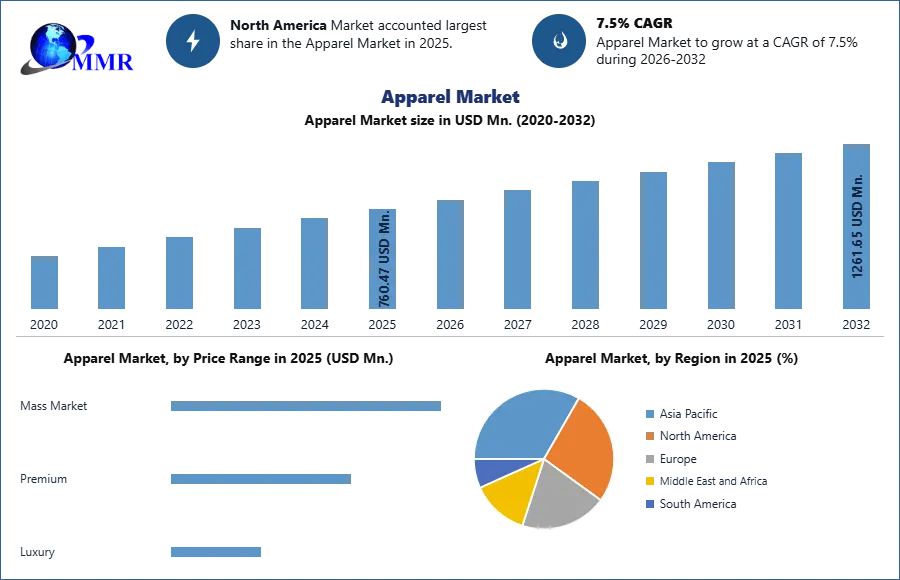
- Global Apparel Market size was valued at USD 760.47 billion in 2025.
- Market revenue is projected to reach nearly USD 1,261.65 billion by 2032.
- The market is expected to expand at a CAGR of 7.5% during 2025–2032.
- Digital commerce is accelerating customer acquisition and brand reach.
- Sustainability initiatives are influencing sourcing, manufacturing, and purchasing decisions.
- Athleisure, casualwear, and comfort-focused apparel continue to gain momentum.
- Emerging economies remain critical growth engines for apparel consumption.
- Competitive intensity is increasing as brands pursue omnichannel expansion and portfolio diversification.
Why This Matters Now
Fashion companies are facing a narrowing window to adapt. Consumer expectations are shifting faster than traditional supply chains can respond, while digital-native competitors continue to capture market share.
The Apparel Market is no longer defined by production scale alone. Success increasingly depends on speed, sustainability, personalization, and the ability to engage consumers across physical and digital channels simultaneously.
Market Overview
The Global Apparel Market was valued at USD 760.47 billion in 2025 and is expected to reach nearly USD 1,261.65 billion by 2032, growing at a CAGR of 7.5%.
The industry’s growth story is being shaped by a convergence of economic, technological, and cultural forces. Rising disposable incomes continue to expand apparel consumption globally. At the same time, social media, influencer marketing, and digital retail ecosystems are shortening fashion cycles and accelerating purchasing decisions.
For manufacturers and retailers, this growth translates into larger revenue pools but also higher operational complexity. Companies must balance inventory efficiency, trend responsiveness, sustainability commitments, and consumer expectations simultaneously.
Key Trends Driving Growth
E-commerce has moved from a supplementary sales channel to a strategic growth engine. Apparel brands are investing heavily in direct-to-consumer platforms, mobile commerce, digital fitting technologies, and data-driven personalization to improve conversion rates and customer retention.
Consumer behavior is also evolving. Demand is increasingly centered around comfort, versatility, and lifestyle-oriented apparel. Casualwear and athleisure have become mainstream categories, blurring the line between fashion and functionality.
Sustainability is becoming a competitive differentiator rather than a compliance requirement. Consumers are paying greater attention to material sourcing, ethical manufacturing, and circular fashion initiatives. This is prompting brands to redesign supply chains, introduce recycled materials, and improve transparency across operations.
Another notable shift is the growing influence of younger consumers. Gen Z and Millennial shoppers are driving demand for rapid product innovation, social engagement, and digitally connected shopping experiences. Their purchasing decisions increasingly reward brands that combine affordability, authenticity, and sustainability.
Get a free sample:https://www.maximizemarketresearch.com/request-sample/189623/
Segment Insights
- Dominant Segment: Casual and everyday apparel categories continue to generate the largest share of industry revenue due to broad consumer adoption and frequent replacement cycles.
- Fastest-Growing Segment: Athleisure and activewear segments are expanding rapidly as health consciousness, fitness participation, and hybrid lifestyles drive demand.
- Women’s apparel remains a major value contributor as fashion engagement and product diversity continue to expand.
- Online retail channels are gaining share as consumers increasingly favor convenience, wider product selection, and personalized shopping experiences.
- Sustainable apparel categories are attracting growing consumer interest, creating opportunities for premium pricing and brand differentiation.
Regional Growth Story
Asia-Pacific continues to command strategic importance within the global apparel ecosystem. Expanding middle-class populations, urbanization, and growing fashion awareness are generating substantial demand across both premium and value-oriented segments.
North America remains a major innovation hub where digital retail, personalization technologies, and sustainability initiatives are influencing global industry standards. Brands operating in the region are increasingly leveraging data analytics and artificial intelligence to optimize merchandising and customer engagement.
Europe continues to lead many sustainability and regulatory discussions affecting the apparel value chain. Manufacturers and retailers are responding by increasing investments in circular business models and environmentally responsible production practices.
Meanwhile, emerging markets across Latin America, the Middle East, and Africa present long-term growth opportunities as disposable incomes rise and organized retail infrastructure expands.
Competitive Landscape
Competition in the Apparel Market is intensifying on multiple fronts. Established global brands face pressure from digital-native challengers that can respond to trends faster and operate with leaner inventory models.
The industry’s competitive battleground has shifted from store count expansion toward ecosystem development. Companies are investing in omnichannel capabilities, supply chain digitization, customer analytics, and sustainability programs to strengthen market positioning.
Strategically, partnerships, acquisitions, and portfolio diversification increasingly signal a race to secure consumer loyalty rather than simply expand scale. Companies that acquire digital capabilities or sustainable product expertise are often positioning themselves for higher-margin growth opportunities.
Over the next 12–24 months, competitive advantages are likely to emerge from operational agility. Brands capable of forecasting demand accurately, shortening production cycles, and reducing inventory risk may outperform slower-moving competitors.
Recent Developments
- Growing investments in direct-to-consumer digital channels.
- Expansion of sustainability and circular fashion initiatives.
- Increased adoption of data analytics for demand forecasting.
- Greater use of digital marketing and influencer-led brand engagement.
- Rising focus on omnichannel retail strategies integrating online and offline experiences.
- Accelerated development of performance fabrics and innovative materials.
Strategic Implications
Executives should view apparel growth through the lens of capability building rather than volume expansion alone.
Three strategic priorities are emerging. First, supply chain agility must improve to match increasingly compressed fashion cycles. Second, digital engagement must become a core business function rather than a marketing extension. Third, sustainability investments should be linked directly to brand value creation and consumer trust.
Companies that successfully integrate these priorities can strengthen margins while capturing market share in a highly competitive environment.
Future Outlook
The Apparel Market’s growth trajectory remains supported by digital transformation, sustainability adoption, and expanding consumer spending worldwide.
The next phase of competition will be defined by who can combine speed, personalization, and responsible production at scale. Winners will build agile, data-driven fashion ecosystems; losers will remain trapped in slow-moving supply chains and increasingly commoditized product portfolios.
Analyst Perspective
“The apparel industry is entering a period where growth alone will not determine market leadership. Companies that align digital innovation, sustainability objectives, and consumer-centric business models will be best positioned to capture value in the years ahead.” — Siddhi Dole, Analyst
About Maximize Market Research
Maximize Market Research Pvt. Ltd. (MMR) is a global market research and consulting company that provides reliable, data-focused, and practical business insights. The firm serves a wide range of industries, including healthcare, pharmaceuticals, technology, automotive, electronics, chemicals, personal care, and consumer goods. Through market forecasts, competitive analysis, strategic consulting, and industry impact assessments, MMR helps organizations understand changing market conditions, identify growth opportunities, and make informed business decisions for long-term success.
2nd Floor, Navale IT Park Phase 3
Pune Banglore Highway, Narhe
Pune, Maharashtra 411041, India
+91 9607365656
sales@maximizemarketresearch.com
