Key Highlights
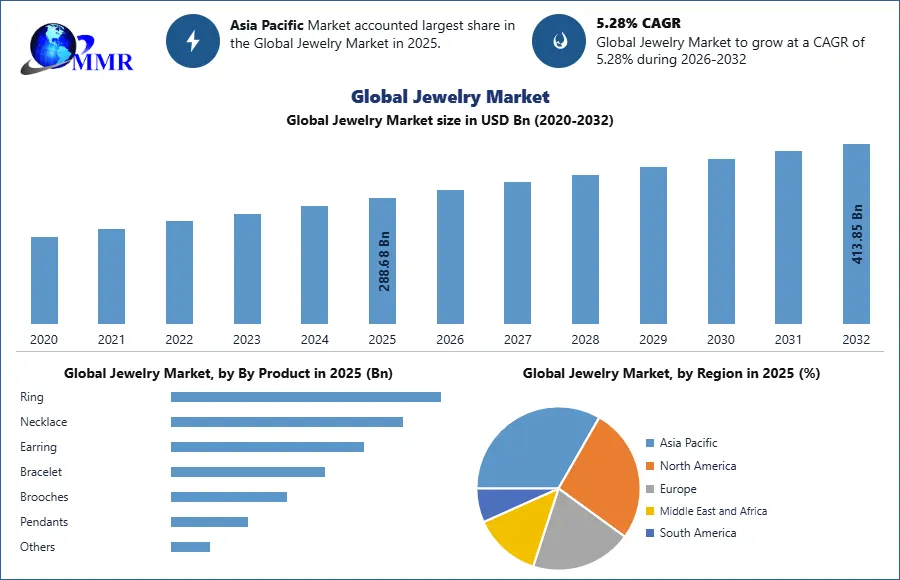
- Jewelry Market size was valued at USD 288.68 Billion in 2025.
- Market revenue is projected to reach nearly USD 413.85 Billion by 2032.
- The market is expected to grow at a CAGR of 5.28% from 2026 to 2032.
- Premiumization and branded jewelry continue to gain momentum globally.
- E-commerce and omnichannel retail are reshaping customer acquisition strategies.
- Demand for personalized and customized jewelry is creating new revenue streams.
- Sustainability and ethical sourcing are becoming competitive differentiators.
- Asia-Pacific remains a critical growth engine for global jewelry consumption.
Why This Matters Now
The jewelry industry is entering a decisive phase. Consumer spending is becoming more selective while expectations around design, authenticity, sustainability, and digital convenience continue to rise.
The market’s expansion from USD 288.68 billion in 2025 to nearly USD 413.85 billion by 2032 signals more than growth. It indicates a structural shift in how consumers discover, evaluate, purchase, and engage with jewelry brands. Companies that fail to modernize retail models risk losing relevance as digital-first competitors gain ground.
Market Overview
The Jewelry Market remains one of the world’s most resilient consumer sectors because it sits at the intersection of luxury, culture, gifting, investment, and self-expression. Demand continues to be supported by weddings, celebrations, gifting occasions, and rising discretionary spending.
However, the industry’s growth story is no longer driven solely by tradition. Consumers increasingly expect personalized products, transparent sourcing, digital engagement, and seamless purchasing experiences. This transition is pushing established brands and emerging players to rethink product development, distribution, and customer engagement strategies.
Market expansion at a CAGR of 5.28% creates opportunities across premium, fashion, and investment-oriented jewelry categories while intensifying competition among global and regional brands.
Key Trends Driving Growth
The strongest growth catalyst remains the global shift toward branded jewelry. Consumers are increasingly favoring recognized brands that provide quality assurance, certification, and consistent customer experiences.
Personalization is becoming a major purchasing trigger. Customized designs, engraving services, and made-to-order collections are helping companies improve margins while strengthening customer loyalty.
Digital transformation is changing market economics. Online discovery, virtual consultations, social commerce, and omnichannel shopping experiences are reducing dependence on traditional retail-only models.
Sustainability has moved from a marketing message to a purchasing criterion. Consumers are paying closer attention to ethical sourcing, responsible mining practices, recycled materials, and transparent supply chains.
Another notable trend is the growing acceptance of alternative offerings, including lab-grown diamonds and lightweight jewelry designs. These categories are expanding accessibility while attracting younger buyers seeking affordability and sustainability.
Get a free sample:https://www.maximizemarketresearch.com/request-sample/147820/
Segment Insights
- Dominant Segment: Gold Jewelry continues to maintain a leading position due to its cultural significance, investment value, and strong demand across weddings, gifting, and festive purchases. Gold remains a preferred store of wealth in several major consumer markets.
- Fastest-Growing Segment: Diamond jewelry is emerging as one of the fastest-growing categories, supported by increasing demand for certified products, contemporary designs, and growing acceptance among younger consumers. Interest in lab-grown diamonds is further expanding the addressable market.
- Omnichannel retail is becoming a critical distribution strategy as consumers combine online research with in-store purchasing experiences.
- Women’s jewelry remains the largest consumer segment, continuing to influence product innovation, design trends, and category growth.
Regional Growth Story
Asia-Pacific continues to anchor global jewelry demand. The region benefits from strong cultural affinity toward jewelry ownership, expanding middle-class populations, and rising disposable incomes.
India and China remain among the most influential consumption centers globally. Even amid fluctuations in precious metal prices, demand remains supported by weddings, festivals, gifting traditions, and wealth preservation behavior. Asia-Pacific accounted for the largest share of global jewelry revenues, reinforcing its strategic importance for manufacturers and retailers.
Emerging urban centers are also becoming increasingly important. Consumers in secondary cities are gaining access to organized retail networks, branded offerings, and digital purchasing channels, expanding the industry’s customer base.
Competitive Landscape
Competition is shifting from product availability to ecosystem control. Leading jewelry companies are investing aggressively in direct-to-consumer channels, omnichannel retail infrastructure, personalization technologies, and customer experience platforms.
Luxury houses continue to leverage heritage, craftsmanship, and exclusivity. At the same time, branded mass-market players are targeting aspirational consumers through accessible luxury positioning.
Regional champions are becoming increasingly formidable competitors. Their ability to localize designs, understand cultural preferences, and operate efficient distribution networks gives them advantages that global brands cannot easily replicate.
Over the next 12–24 months, competition is likely to intensify around digital engagement, sustainability credentials, customization capabilities, and premium customer experiences. Companies that control consumer relationships rather than merely product supply will be best positioned to capture market share.
Recent Developments
- Companies are expanding digital commerce capabilities and virtual customer engagement tools.
- Growing investment in customized and made-to-order jewelry collections is improving differentiation.
- Industry participants are increasing focus on sustainable sourcing and responsible production practices.
- Lab-grown diamond adoption continues to create new growth opportunities across value-conscious consumer segments.
- Direct-to-consumer retail strategies are gaining importance across both luxury and mass-market categories.
Strategic Implications
Executives should view jewelry as a consumer experience business rather than a product business. Growth increasingly depends on customer engagement, digital convenience, and trust rather than inventory alone.
Brands that invest in personalization can command premium pricing while improving customer retention. Sustainability initiatives are also becoming critical for attracting younger demographics and protecting brand equity.
Retailers that successfully integrate physical stores with digital channels will be positioned to capture higher-value customers and increase lifetime customer value.
Future Outlook
The next phase of market expansion will be defined by technology-enabled personalization, responsible sourcing, and omnichannel commerce.
As consumers become more informed and selective, market leaders will increasingly differentiate through transparency, design innovation, and customer experience rather than precious metal content alone.
The companies that build trusted digital-first brands will capture disproportionate growth; those relying solely on legacy retail models risk losing relevance in an increasingly competitive marketplace.
Analyst Perspective
“The jewelry industry is evolving from a tradition-led market into a consumer experience-driven industry. Companies that combine craftsmanship, digital engagement, sustainability, and personalization will define the next wave of competitive leadership.” — Siddhi Dole, Analyst
About Maximize Market Research
Maximize Market Research Pvt. Ltd. (MMR) is a global market research and consulting company that provides reliable, data-focused, and practical business insights. The firm serves a wide range of industries, including healthcare, pharmaceuticals, technology, automotive, electronics, chemicals, personal care, and consumer goods. Through market forecasts, competitive analysis, strategic consulting, and industry impact assessments, MMR helps organizations understand changing market conditions, identify growth opportunities, and make informed business decisions for long-term success.
2nd Floor, Navale IT Park Phase 3
Pune Banglore Highway, Narhe
Pune, Maharashtra 411041, India
+91 9607365656
sales@maximizemarketresearch.com
