Key Highlights
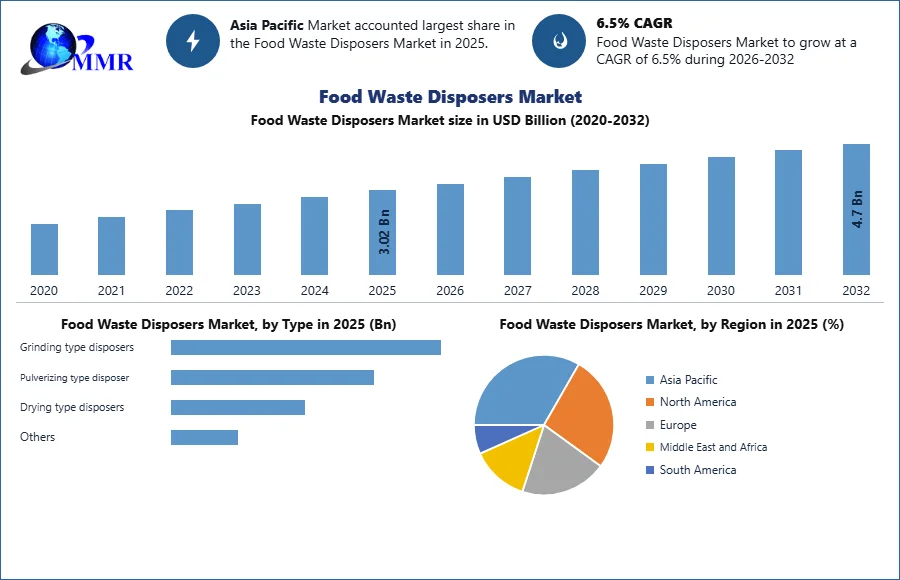
- The Food Waste Disposers Market was valued at USD 13.40 billion in 2025 and is expected to reach USD 19.89 billion by 2032, expanding at a CAGR of 5.8% from 2026 to 2032.
- North America dominated the market in 2025 due to established waste management infrastructure and strong adoption of disposal technologies.
- Residential applications represent a major demand area as households seek convenient and sustainable food waste management solutions.
- Sustainability initiatives and circular economy strategies are increasing interest in technologies that reduce landfill dependence.
- Smart waste management systems and improved infrastructure are creating opportunities for manufacturers and logistics ecosystem players.
Why This Matters Now
Food waste management is becoming a logistics challenge as cities, businesses, and households search for more efficient ways to handle growing waste volumes. The shift toward decentralized waste processing is creating new opportunities for equipment manufacturers, waste operators, infrastructure providers, and sustainability-focused investors.
For logistics and transportation stakeholders, food waste disposers represent a move away from traditional collection-heavy systems toward localized waste reduction. This transformation can influence waste transportation routes, collection frequency, processing requirements, and urban infrastructure planning.
Market Overview
The Food Waste Disposers Market includes systems that grind and process food waste at the point of generation, mainly in residential and commercial environments. The market reached USD 13.40 billion in 2025 and is projected to reach USD 19.89 billion by 2032.
Demand is increasing as governments, businesses, and consumers focus on waste reduction and environmental responsibility. Food waste disposers support more efficient waste handling by reducing the volume of organic waste requiring external transportation.
The market connects directly with broader logistics priorities. Lower waste volumes can affect collection networks, vehicle utilization, route planning, and municipal waste management operations.
Key Trends Driving Growth
Sustainability is the central force shaping the food waste disposal industry. Businesses and governments are adopting waste reduction strategies to support circular economy goals and improve resource management.
Urbanization is increasing pressure on waste infrastructure. Growing cities require systems that improve efficiency while reducing transportation burdens associated with traditional waste collection.
Smart waste management technologies are creating new opportunities. Connected devices, monitoring systems, and automated solutions can improve operational visibility and support data-driven waste management decisions.
Commercial adoption is gaining importance as restaurants, hotels, and institutional facilities seek efficient waste processing methods. These users require reliable systems that reduce operational complexity and improve sustainability performance.
E-commerce and digital procurement channels are also influencing equipment distribution. Manufacturers can reach broader customer segments through online sales platforms, creating new logistics requirements for equipment delivery and after-sales support.
Supply-chain efficiency is becoming a competitive factor. Companies must manage manufacturing, component sourcing, warehousing, and distribution networks while meeting demand for sustainable infrastructure solutions.
Request a Free Sample Copy or View Report Summary:
Segment Insights
- Dominant Segment: Residential Application — The residential segment represents a major market area as households increasingly adopt convenient food waste management solutions. Growing awareness of waste reduction supports demand for compact and efficient disposal systems.
- Fastest-Growing Segment: Commercial Application — Commercial users such as restaurants, hotels, and institutions are increasing adoption because waste management efficiency directly affects operating costs and sustainability targets.
- Technology Development — Manufacturers are focusing on improved motor efficiency, noise reduction, durability, and smarter waste processing capabilities to strengthen product value.
- Distribution Opportunities — Offline retail, direct sales, and online channels support market expansion by improving accessibility for households and businesses.
Regional Growth Story
North America dominated the Food Waste Disposers Market in 2025, supported by established residential adoption, infrastructure development, and consumer awareness around waste management.
The United States remains an important market due to strong household penetration and demand for efficient waste solutions. The region’s mature logistics networks and waste infrastructure create opportunities for advanced disposal technologies.
Europe is focusing on sustainability regulations, waste reduction programs, and circular economy initiatives. Countries such as Germany and the United Kingdom are emphasizing resource efficiency and improved waste management systems.
Asia Pacific is emerging as a significant opportunity area due to urban growth, rising environmental awareness, and infrastructure modernization. China, India, Japan, and South Korea are investing in improved urban systems, creating demand for efficient waste technologies.
Competitive Landscape
The competitive environment is moving beyond product manufacturing toward technology performance, sustainability value, and distribution strength. Companies are competing through energy-efficient designs, improved reliability, and solutions that align with changing waste management policies.
Players including Emerson Electric through its InSinkErator brand, Whirlpool Corporation, Waste King, and Franke are positioned across residential and commercial segments.
Competitive investments signal a broader industry shift. Companies improving product efficiency and integrating smarter technologies are strengthening their position in a market increasingly connected to sustainable infrastructure.
Manufacturers with strong supply chains can improve market reach through better production planning, inventory management, and distribution networks. Logistics efficiency will become increasingly important as demand expands across multiple regions.
Recent Developments
- Manufacturers continue developing advanced food waste disposal systems focused on efficiency, durability, and improved user experience.
- Companies are aligning product strategies with sustainability initiatives and circular economy objectives.
- Industry participants are expanding distribution capabilities to serve residential and commercial customers across global markets.
Strategic Implications
For waste management companies, food waste disposers create opportunities to redesign collection models and improve operational efficiency. Reduced organic waste volumes can influence transportation demand and route optimization strategies.
For manufacturers, supply-chain resilience is essential. Companies must manage raw material availability, production capacity, and distribution networks while responding to sustainability expectations.
Investors are increasingly evaluating waste technology companies based on innovation capability, environmental impact, and scalability. Businesses that combine technology with sustainable infrastructure solutions may gain stronger long-term advantages.
Future Outlook
The Food Waste Disposers Market is moving toward smarter, more decentralized waste management systems. Future leaders will be companies that integrate sustainability, automation, and efficient supply chains, while laggards that rely on traditional waste models without innovation risk losing competitiveness as urban waste strategies evolve.
Analyst Perspective
“The Food Waste Disposers Market is becoming increasingly connected with global sustainability goals and modern waste infrastructure development. Companies that improve technology, efficiency, and supply-chain capabilities will be better positioned as cities and businesses adopt smarter waste management approaches,” said Siddhi Dole, Research Analyst.
About Maximize Market Research
Maximize Market Research Pvt. Ltd. (MMR) is a global market research and consulting company that provides reliable, data-focused, and practical business insights. The firm serves a wide range of industries, including healthcare, pharmaceuticals, technology, automotive, electronics, chemicals, personal care, and consumer goods. Through market forecasts, competitive analysis, strategic consulting, and industry impact assessments, MMR helps organizations understand changing market conditions, identify growth opportunities, and make informed business decisions for long-term success.
2nd Floor, Navale IT Park Phase 3
Pune Banglore Highway, Narhe
Pune, Maharashtra 411041, India
+91 9607365656
sales@maximizemarketresearch.com
