Key Highlights
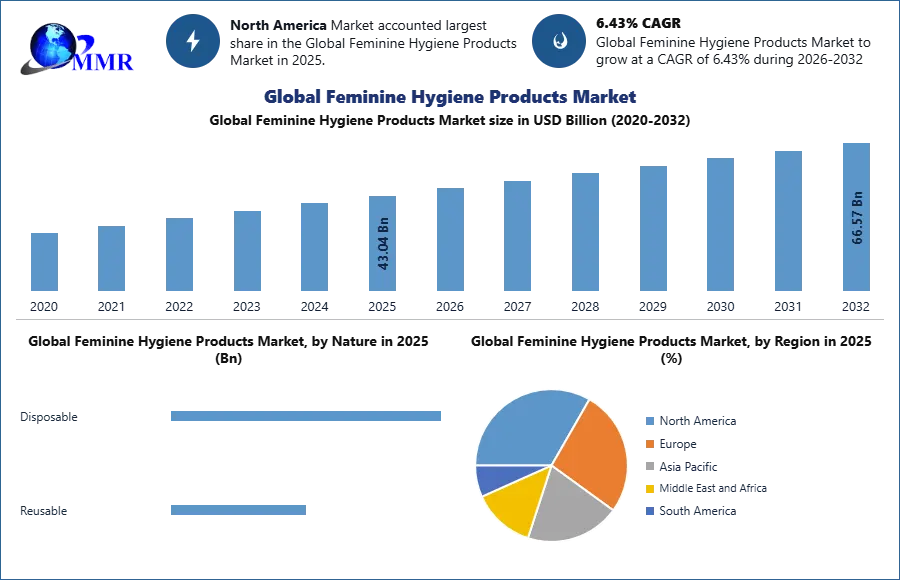
- The Feminine Hygiene Products Market was valued at USD 43.04 Billion in 2025 and is expected to reach USD 66.57 Billion by 2032, growing at a CAGR of 6.43%.
- Rising awareness of menstrual health is expanding category penetration across emerging markets.
- Governments and non-government organizations are accelerating adoption through education and accessibility programs.
- Online retail is emerging as a major growth engine due to convenience, privacy, and wider product selection.
- Sustainable products including menstrual cups and eco-friendly sanitary solutions are gaining momentum.
- Manufacturers are increasing investments in innovation, premiumization, and environmentally responsible product development.
Why This Matters Now
A category once driven primarily by necessity is becoming a strategic battleground for global consumer goods companies. The shift is no longer about basic menstrual protection. It is about health, sustainability, affordability, accessibility, and digital engagement.
For manufacturers, retailers, and investors, the market’s projected expansion to USD 66.57 Billion signals more than revenue growth. It signals a structural change in how consumers evaluate personal care products and how brands compete for long-term loyalty.
Market Overview
The Feminine Hygiene Products Market is entering a new phase of growth as awareness campaigns, public health initiatives, and changing consumer attitudes reduce long-standing barriers around menstrual health. The market was valued at USD 43.04 Billion in 2025 and is projected to reach USD 66.57 Billion by 2032 at a CAGR of 6.43%.
The business implication is clear. Demand growth is no longer limited to developed markets. Emerging economies are becoming critical expansion territories as education, income levels, and product accessibility improve. Governments are also playing a larger role by supporting menstrual hygiene programs that increase product adoption among younger populations and underserved communities.
At the same time, consumers are demanding products that align with broader wellness and sustainability goals. This is creating opportunities for both multinational brands and specialized challengers.
Key Trends Driving Growth
Health awareness is becoming one of the strongest demand catalysts in the market. Educational initiatives are encouraging women to adopt hygienic menstrual management practices, increasing category penetration across urban and rural populations.
Sustainability is reshaping product innovation. Reusable menstrual cups, biodegradable sanitary products, and environmentally responsible materials are attracting consumers seeking lower environmental impact. This trend is influencing product development priorities across major manufacturers.
Digital commerce is transforming purchase behavior. Online platforms provide privacy, convenience, subscription options, and access to a broader product portfolio. For consumers in markets where menstrual health remains a sensitive topic, digital channels remove friction from the purchasing process.
Premiumization is also gaining traction. Consumers increasingly evaluate products based on comfort, skin safety, absorbency, odor control, and material quality rather than price alone. This is creating space for differentiated offerings and premium pricing strategies.
Segment Insights
- Dominant Segment: Sanitary Napkins/Pads remain the largest product category due to affordability, accessibility, familiarity, and widespread consumer acceptance. Their leadership position continues to make them the primary revenue generator for manufacturers.
- Fastest-Growing Segment: Reusable Menstrual Cups are emerging as the fastest-growing category as consumers seek sustainable and cost-effective alternatives. Their growth signals a gradual shift from disposable-only consumption patterns toward long-term value and environmental responsibility.
- Distribution Leadership: Traditional retail channels continue to dominate due to product availability and consumer familiarity.
- Fastest-Growing Distribution Channel: Online retail is expanding rapidly as consumers increasingly prefer discreet purchasing experiences, product reviews, subscription models, and direct-to-consumer offerings.
Regional Growth Story
Asia-Pacific remains the market’s growth engine. Large populations, increasing awareness, urbanization, and government-backed menstrual health initiatives are expanding the addressable consumer base across the region.
India illustrates this transformation clearly. Government programs focused on menstrual hygiene awareness and access are driving adoption across both urban and rural populations. Increased use of sanitary products among younger women is creating a larger recurring consumer base while opening opportunities for premium and sustainable products.
Europe is witnessing strong demand for reusable and environmentally responsible products. Consumers are increasingly willing to experiment with alternatives that align with sustainability goals. Online purchasing is also becoming a preferred channel across several European markets.
North America remains a critical innovation hub where product differentiation, premium offerings, and brand-led awareness campaigns continue to drive value growth.
Competitive Landscape
Competition is shifting from scale alone to innovation, sustainability, and consumer engagement.
Major players are investing heavily in research and development to launch products with enhanced comfort, improved absorbency, odor management, and environmentally friendly materials. The emergence of organic sanitary products and sustainable alternatives demonstrates how companies are responding to evolving consumer expectations.
For market leaders, these investments serve as defensive strategies against emerging niche brands. For challengers, sustainability provides a pathway to differentiation without matching the marketing budgets of multinational competitors.
The competitive signal is significant. Companies that control both innovation pipelines and digital distribution channels are likely to strengthen market positions over the next 12–24 months. Meanwhile, brands that remain dependent on traditional products and legacy retail strategies risk losing relevance among younger consumers.
Recent Developments
- Major manufacturers are increasing investments in organic and environmentally responsible feminine hygiene products.
- Product development is increasingly focused on biodegradable, recyclable, and compostable materials.
- Online retail expansion continues to create new customer acquisition opportunities through direct-to-consumer models.
- Government-backed menstrual hygiene initiatives are expanding access and awareness in developing economies.
Strategic Implications
Three strategic priorities are emerging for industry participants.
First, sustainability can no longer be treated as a niche proposition. It is becoming a mainstream purchasing factor and a key differentiator.
Second, digital commerce is evolving from a supplementary channel into a primary growth driver. Companies that optimize online engagement, subscriptions, and consumer education will capture a disproportionate share of future demand.
Third, underserved populations represent one of the industry’s largest opportunities. Expanding access in rural and emerging markets could unlock millions of new consumers while strengthening brand loyalty at an early stage.
Future Outlook
The next phase of market growth will be defined by the convergence of health awareness, sustainability, and digital accessibility. Companies that invest in consumer education, eco-friendly innovation, and omnichannel distribution will be positioned to capture the market’s highest-growth opportunities.
The winners will build trusted wellness ecosystems around menstrual care; the losers will continue selling products while competitors build relationships.
Analyst Perspective
“The Feminine Hygiene Products Market is moving beyond product availability toward consumer empowerment, sustainability, and innovation. Companies that align with changing expectations around health, convenience, and environmental responsibility will define the next era of growth in this category.” — Siddhi Dole, Analyst
About Maximize Market Research
Maximize Market Research Pvt. Ltd. (MMR) is a global market research and consulting company that provides reliable, data-focused, and practical business insights. The firm serves a wide range of industries, including healthcare, pharmaceuticals, technology, automotive, electronics, chemicals, personal care, and consumer goods. Through market forecasts, competitive analysis, strategic consulting, and industry impact assessments, MMR helps organizations understand changing market conditions, identify growth opportunities, and make informed business decisions for long-term success.
2nd Floor, Navale IT Park Phase 3
Pune Banglore Highway, Narhe
Pune, Maharashtra 411041, India
+91 9607365656
sales@maximizemarketresearch.com
