Key Highlights
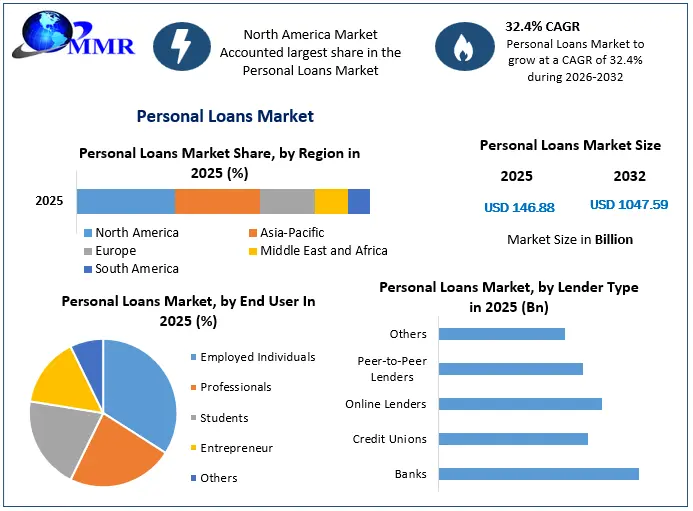
- Personal Loans Market size was valued at USD 146.88 billion in 2025 and is expected to reach USD 1,047.59 billion by 2032, growing at a CAGR of 32.4%.
- Fintech-led digital lending platforms are accelerating loan origination and approval processes.
- Medium-term loans emerged as the dominant loan tenure segment in 2025.
- Debt consolidation remained the leading application area for personal loans.
- Financial inclusion initiatives and digital identity infrastructure continue to expand borrower access.
- Competitive activity is increasingly focused on digital lending capabilities and embedded finance ecosystems.
Why This Matters Now
Consumer credit is moving faster than many traditional financial institutions anticipated. Digital lenders are compressing approval timelines from days to minutes, forcing banks to rethink distribution, underwriting, and customer acquisition strategies.
The Personal Loans Market is projected to expand from USD 146.88 billion in 2025 to USD 1,047.59 billion by 2032. That scale of growth signals more than rising credit demand. It indicates a structural shift in how consumers access financing, how lenders assess risk, and how financial products are delivered.
Market Overview
The Personal Loans Market has entered a period of accelerated transformation. Consumers increasingly expect frictionless borrowing experiences that mirror digital commerce. Financial institutions are responding by deploying automated underwriting systems, digital onboarding, and online distribution channels.
According to Maximize Market Research, fintech companies and financial institutions are major contributors to market expansion. Automated processing has reduced operational friction and shortened approval cycles. The business implication is straightforward: speed has become a competitive advantage rather than a customer-service feature.
Government-led financial inclusion programs and digital identity frameworks have further expanded access to credit. As more consumers enter formal financial systems, lenders gain access to larger addressable markets and richer borrower data.
Key Trends Driving Growth
Digital lending has become the market’s defining trend. Online application channels reduce customer acquisition costs while improving scalability. Institutions capable of processing large loan volumes through automated systems can expand without proportionate increases in operating expenses.
Financial inclusion is creating a new borrower base. Digital identity verification and simplified onboarding processes are lowering access barriers. For lenders, this expands revenue opportunities beyond traditional banking customers.
Consumer borrowing behavior is also evolving. Personal loans are increasingly being used for debt restructuring, education funding, home improvement projects, and immediate liquidity requirements. This diversification reduces dependence on any single use case and broadens market resilience.
Embedded finance is beginning to influence competitive positioning. As lending services become integrated into digital ecosystems, the battle shifts from branch networks to platform partnerships and customer experience.
Get a free sample:https://www.maximizemarketresearch.com/request-sample/210001/
Segment Insights
- Dominant Segment: Medium-Term Loans (1 to 5 Years)
- Medium-term loans held the largest market share in 2025.
- Their combination of affordability and repayment flexibility makes them suitable for education, home improvement, and general personal expenditures.
- The dominance of this segment suggests borrowers are prioritizing manageable repayment structures over both short-duration liquidity and long-term commitments.
- Short-Term Loans
- Ranked as the second-largest segment.
- Demand is supported by emergency funding needs and rapid access requirements.
- Fast disbursement remains a critical competitive factor in this category.
- Long-Term Loans
- Maintained a smaller share of the market.
- Typically used for large expenditures and debt consolidation needs.
- Lower monthly repayment obligations continue to attract specific borrower groups.
- Dominant Segment by Application: Debt Consolidation
- Debt consolidation led the market in 2025.
- Borrowers increasingly seek to combine multiple obligations into single repayment structures.
- This trend indicates growing consumer focus on financial management and repayment optimization.
- Home Improvement
- Strong demand was supported by increased spending on residential upgrades and renovations.
- The segment benefits from rising household investment priorities.
- Education
- Continued growth reflects increasing education costs and greater acceptance of borrowing for skill development and academic advancement.
Regional Growth Story
The market’s growth trajectory is closely linked to digital infrastructure development and financial inclusion initiatives. Regions with strong digital adoption rates are seeing faster loan penetration and broader borrower participation.
India’s digital transformation efforts have demonstrated how policy support can accelerate consumer finance expansion. Initiatives involving digital identity verification and streamlined access to financial services have improved lending efficiency and expanded credit accessibility.
For lenders, regional success increasingly depends on technology deployment rather than physical branch expansion. Markets with strong smartphone penetration and digital engagement offer the most attractive growth opportunities.
Competitive Landscape
Competition is shifting from balance-sheet strength to ecosystem strength. Traditional lenders still possess scale and funding advantages, but fintech firms are redefining customer expectations around convenience, speed, and accessibility.
FinBox’s launch of Partnership Lending Stack 2.0 signals the growing importance of embedded lending infrastructure. The move suggests future market leaders will increasingly operate through partnerships rather than standalone distribution models.
Barclays’ acquisition of Best Egg reflects a broader strategic trend. Large financial institutions are purchasing digital capabilities rather than building them from scratch. For competitors, this signals that digital origination platforms are becoming core strategic assets rather than optional growth initiatives.
ABN AMRO’s divestiture of its personal loan subsidiary highlights another emerging pattern: institutions are reevaluating portfolio composition and capital allocation. The implication is that scale alone will not determine success. Strategic focus and operational efficiency will matter more.
Over the next 12 to 24 months, competitive advantage is likely to concentrate among firms combining strong funding capabilities with advanced digital lending infrastructure.
Recent Developments
- FinBox launched Partnership Lending Stack 2.0 to streamline partnership-driven retail lending ecosystems.
- Ready Payday Loans acquired blockchain startup Omega 88 to strengthen digital lending infrastructure.
- Barclays agreed to acquire digital personal loan platform Best Egg for USD 800 million.
- ABN AMRO announced the divestiture of its personal loan subsidiary Alfam to Rabobank.
- Barclays US Consumer Bank completed the integration of Best Egg’s consumer lending platform.
Strategic Implications
The next phase of competition will focus on data, automation, and distribution. Institutions that continue relying on traditional origination models risk losing market share to technology-driven competitors.
Digital onboarding, automated underwriting, and ecosystem partnerships are becoming fundamental operating requirements. The market is rewarding lenders that reduce friction and improve approval speed without compromising risk controls.
Investment priorities are also changing. Capital is increasingly flowing toward technology platforms capable of scaling customer acquisition and loan servicing efficiently.
Future Outlook
The Personal Loans Market is positioned for substantial expansion through 2032 as digital lending, financial inclusion, and fintech innovation continue reshaping consumer finance.
Growth will not be determined solely by access to capital. It will be determined by access to customers, data, and digital ecosystems. Institutions that modernize lending infrastructure will capture disproportionate value, while those that delay transformation risk becoming funding providers for faster-moving competitors.
Analyst Perspective
“The Personal Loans Market is transitioning from a traditional lending model to a technology-driven financial ecosystem. The organizations that successfully combine digital capabilities, efficient underwriting, and customer-centric delivery will define the next decade of growth in consumer finance.” — Siddhi Dole, Analyst
About Maximize Market Research
Maximize Market Research Pvt. Ltd. (MMR) is a global market research and consulting company that provides reliable, data-focused, and practical business insights. The firm serves a wide range of industries, including healthcare, pharmaceuticals, technology, automotive, electronics, chemicals, personal care, and consumer goods. Through market forecasts, competitive analysis, strategic consulting, and industry impact assessments, MMR helps organizations understand changing market conditions, identify growth opportunities, and make informed business decisions for long-term success.
2nd Floor, Navale IT Park Phase 3
Pune Banglore Highway, Narhe
Pune, Maharashtra 411041, India
+91 9607365656
sales@maximizemarketresearch.com
