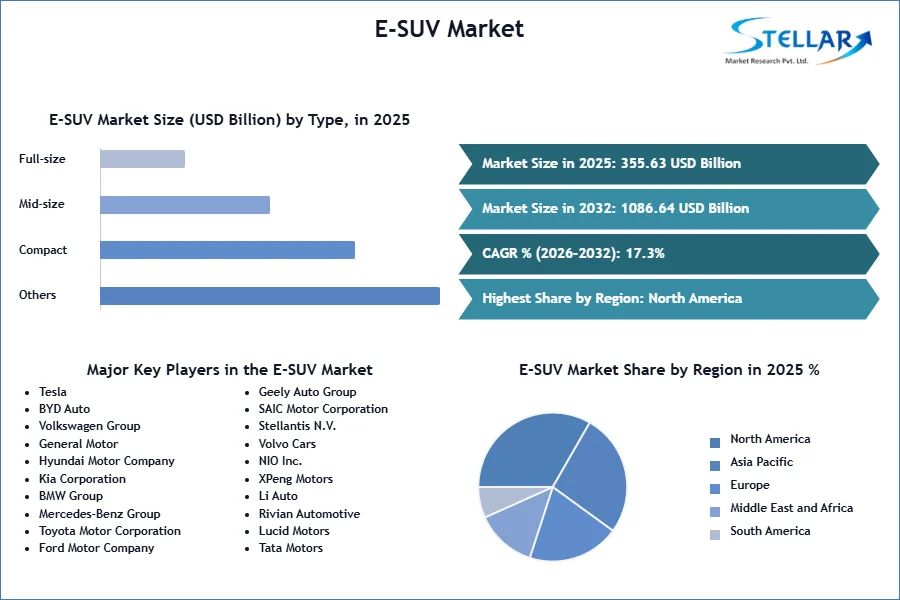
PUNE, June 23, 2026 — The E-SUV Market is entering a transformative growth phase as electric sport utility vehicles become the preferred choice for consumers seeking performance, sustainability, and practicality. According to the latest study by Stellar Market Research, the global E-SUV Market was valued at USD 355.63 billion in 2025 and is expected to reach USD 1,086.64 billion by 2032, expanding at a CAGR of 17.3% during the forecast period. The report highlights how declining battery costs, increasing charging infrastructure investments, and a shift toward affordable electric SUVs are redefining the global automotive landscape.
Market Opportunity Overview
Electric SUVs have evolved from premium niche vehicles into mainstream mobility solutions. The industry’s most significant transformation is the rapid emergence of compact and mid-size E-SUVs priced below USD 40,000, making electric mobility accessible to a wider consumer base.
As governments tighten emission standards and automakers accelerate electrification programs, E-SUVs are becoming the dominant growth engine of the EV ecosystem. China, Europe, Southeast Asia, and emerging economies are witnessing unprecedented demand as consumers increasingly prioritize vehicle range, digital connectivity, safety features, and sustainability.
The convergence of battery innovation, AI-enabled vehicle systems, and localized manufacturing is creating new opportunities for automakers, suppliers, infrastructure developers, and investors across the automotive value chain.
𝐃𝐨𝐰𝐧𝐥𝐨𝐚𝐝 𝐅𝐫𝐞𝐞 𝐏𝐃𝐅 𝐁𝐫𝐨𝐜𝐡𝐮𝐫𝐞: https://www.stellarmr.com/report/req_sample/e-suv-market/2898
Key Findings from the Report
- The global E-SUV Market was valued at USD 355.63 billion in 2025 and is forecast to surpass USD 1.08 trillion by 2032.
- Global EV sales expanded at a CAGR of approximately 32% between 2020 and 2025, supporting E-SUV demand growth.
- Battery Electric Vehicles (BEVs) remain the dominant propulsion segment due to regulatory incentives and lower operating costs.
- Compact and mid-size E-SUVs represent the fastest-growing category as affordability becomes a key purchase driver.
- Asia-Pacific, led by China, accounts for the largest share of production and sales, supported by strong manufacturing ecosystems.
- Emerging markets including Thailand, Vietnam, Indonesia, and Brazil are witnessing accelerating E-SUV adoption rates.
- Increasing investments in charging networks and battery supply chains continue to improve long-term investment attractiveness.
Market Drivers and Restraints
Key Drivers
Growing Government Support for EV Adoption
Tax incentives, subsidies, fuel economy mandates, and net-zero commitments are encouraging consumers and fleet operators to transition toward electric SUVs.
Declining Battery Costs
Advancements in lithium-ion battery technology and manufacturing scale are reducing vehicle costs and improving affordability across mass-market segments.
Consumer Preference for Larger Electric Vehicles
SUVs provide greater comfort, cargo capacity, and driving range, making them the preferred body style among EV buyers globally.
Key Restraints
Charging Infrastructure Gaps
Many regions continue to face charging availability challenges, particularly in rural and developing markets.
Supply Chain Volatility
Dependence on critical minerals such as lithium, nickel, and cobalt exposes manufacturers to pricing fluctuations and sourcing risks.
𝐃𝐨𝐰𝐧𝐥𝐨𝐚𝐝 𝐅𝐫𝐞𝐞 𝐏𝐃𝐅 𝐁𝐫𝐨𝐜𝐡𝐮𝐫𝐞: https://www.stellarmr.com/report/req_sample/e-suv-market/2898
Technology, Regulation, and Sustainability Trends
The E-SUV Market is increasingly shaped by software-defined vehicle architectures, AI-powered driver assistance systems, over-the-air updates, and next-generation battery platforms.
Government policies across Europe, China, North America, and Asia-Pacific continue to strengthen EV adoption through emissions regulations and electrification mandates. At the same time, automakers are pursuing sustainability goals through localized battery production, renewable energy integration, and circular economy initiatives focused on battery recycling.
Vehicle-to-grid technologies and smart charging ecosystems are also emerging as strategic enablers of future EV infrastructure.
Regional Insights
Asia-Pacific Leads Global Growth
Asia-Pacific remains the dominant region, with China accounting for more than 70% of global EV production. Strong domestic demand, vertically integrated supply chains, and aggressive government support continue to reinforce the region’s leadership.
Europe Maintains Strong Momentum
Germany, Norway, France, and the Netherlands continue to experience high electric vehicle penetration rates. European automakers are expanding E-SUV portfolios to meet stringent carbon reduction targets.
North America Advances Through Infrastructure Investments
The United States and Canada are expanding charging networks and battery manufacturing facilities, creating long-term growth opportunities despite policy uncertainties.
Emerging Markets Gain Traction
Countries including Thailand, Vietnam, Indonesia, Brazil, and India are becoming attractive growth destinations due to supportive policies, increasing consumer awareness, and affordable imported electric SUVs.
Recent Industry Developments
BYD (2026): Expanded global exports of affordable electric SUVs, strengthening market penetration across Southeast Asia and Latin America.
Tesla (2025): Continued global production expansion of the Model Y, maintaining leadership in the E-SUV segment despite intensifying competition.
Volkswagen Group (2025): Increased European EV market share through strong demand for ID.4 and ID.5 electric SUV models.
Stellantis (2025): Accelerated growth of compact electric SUVs including Jeep Avenger and Peugeot e-2008 across Europe.
SAIC Motor (2025): Expanded EV leadership in Thailand through increased deployment of MG electric SUV platforms.
Competitive Landscape
The E-SUV Market is highly competitive and characterized by aggressive investments in battery technology, charging partnerships, software integration, and localized manufacturing.
Key participants include BYD, Tesla, SAIC Motor, Volkswagen Group, Stellantis, BMW Group, Hyundai Motor Group, and Toyota Motor Corporation.
Leading companies are increasingly focusing on affordability, longer driving ranges, charging ecosystem integration, fleet electrification partnerships, and digital vehicle experiences.
Analyst Commentary
“The E-SUV segment is rapidly becoming the defining category of the global electric vehicle industry. The next phase of growth will be driven not only by premium innovation but also by the availability of affordable, technology-enabled SUVs that meet the needs of mainstream consumers across developed and emerging markets,” said a Senior Research Analyst at Stellar Market Research.
Future Outlook
Through 2032, the E-SUV Market is expected to benefit from sustained investment in battery production, charging infrastructure, and intelligent vehicle technologies. Competitive dynamics will increasingly favor manufacturers capable of delivering affordable vehicles with extended range, connected features, and lower lifecycle emissions.
As regulatory pressure intensifies and consumers continue shifting toward sustainable transportation solutions, E-SUVs are expected to remain at the center of global automotive electrification strategies.
About Stellar Market Research
Stellar Market Research is a global market research and business consulting firm delivering strategic intelligence across multiple industries. The company provides comprehensive market forecasts, competitive benchmarking, technology trend analysis, and investment insights to support business decision-making. With expertise spanning automotive, healthcare, chemicals, energy, consumer goods, industrial manufacturing, and advanced technologies, Stellar Market Research helps organizations identify emerging opportunities and navigate evolving market dynamics. Its research methodology combines primary interviews, secondary research, data analytics, and industry expertise to provide actionable insights for corporations, investors, policymakers, and stakeholders worldwide.
Media Contact
Stellar Market Research
Website: Stellar Market Research
Email: sales@stellarmr.com
