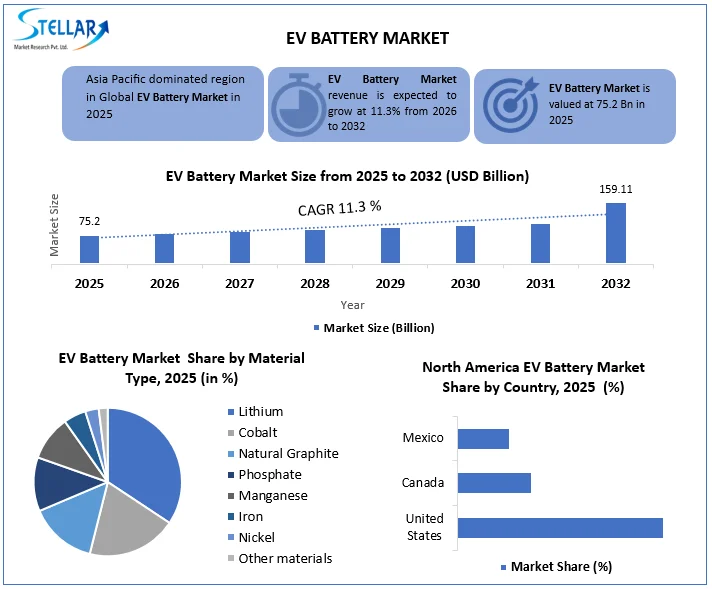
PUNE, June 23, 2026 – The Electric Vehicle (EV) Battery Market is entering a new phase of expansion driven by large-scale battery manufacturing investments, supply chain localization, and accelerating electric vehicle adoption worldwide. According to the latest Stellar Market Research analysis, the market is experiencing strong momentum as governments, automakers, and battery manufacturers intensify efforts to secure critical mineral supplies and expand production capacity to meet growing demand for electric mobility.
Market Overview and Strategic Opportunity
The global automotive industry is undergoing its most significant transformation in decades, with battery technology emerging as the defining competitive differentiator. While electric vehicle adoption continues to rise, the strategic focus has shifted from vehicle manufacturing alone to battery ecosystem development, including raw material sourcing, cell manufacturing, battery recycling, and advanced energy storage technologies.
The electric vehicle (EV) battery market is benefiting from a surge in gigafactory construction, vertical integration strategies, and investments in lithium iron phosphate (LFP), nickel manganese cobalt (NMC), and emerging solid-state battery technologies. As battery costs decline and energy density improves, EV batteries are becoming more affordable, efficient, and sustainable, creating substantial opportunities for automakers, battery suppliers, investors, and policymakers.
Growing demand for longer driving ranges, faster charging capabilities, and enhanced battery safety is accelerating innovation across the entire value chain. The industry is also witnessing a transition toward regionalized manufacturing hubs to reduce supply chain risks and strengthen energy security.
𝐃𝐨𝐰𝐧𝐥𝐨𝐚𝐝 𝐅𝐫𝐞𝐞 𝐏𝐃𝐅 𝐁𝐫𝐨𝐜𝐡𝐮𝐫𝐞: https://www.stellarmr.com/report/req_sample/electric-vehicle-battery-market/2899
Key Findings from the Report
The electric vehicle (EV) battery market is projected to register strong double-digit growth through the forecast period, supported by rising global EV sales.
Lithium-ion batteries continue to dominate the market due to high energy density, declining costs, and widespread commercial adoption.
Battery Electric Vehicles (BEVs) represent the largest demand-generating vehicle segment globally.
Asia-Pacific remains the leading regional market, driven by China’s extensive battery manufacturing ecosystem and EV production leadership.
Europe is emerging as one of the fastest-growing regions due to aggressive decarbonization policies and local battery manufacturing investments.
Increasing investments in battery recycling and circular economy initiatives are creating new revenue streams across the industry.
Government incentives and stricter emission regulations continue to strengthen long-term investor confidence in EV battery infrastructure.
Market Drivers and Restraints
Key Drivers
Rapid Growth in Electric Vehicle Adoption
Government incentives, consumer awareness, and stringent emission regulations are driving higher EV sales, directly increasing battery demand.
Expansion of Gigafactory Capacity
Battery manufacturers are investing billions of dollars in large-scale production facilities to meet anticipated demand and improve supply chain resilience.
Technological Advancements in Battery Chemistry
Continuous innovation in battery materials, energy density, charging speeds, and battery management systems is enhancing product performance and competitiveness.
Key Restraints
Critical Mineral Supply Constraints
Dependence on lithium, cobalt, nickel, and rare earth materials creates supply chain vulnerabilities and pricing volatility.
High Capital Investment Requirements
Battery manufacturing facilities require significant upfront investments, creating barriers for new market entrants.
Technology, Regulation, and Sustainability Trends
Technology innovation remains a defining characteristic of the EV battery market. Solid-state batteries, silicon-anode technologies, advanced thermal management systems, and AI-powered battery monitoring platforms are expected to improve performance and lifecycle economics.
Regulatory frameworks across North America, Europe, China, India, and other regions increasingly support local battery manufacturing and supply chain diversification. Policies promoting battery recycling, responsible sourcing, and carbon footprint reduction are influencing procurement strategies throughout the industry.
Sustainability has become a major competitive factor as manufacturers invest in renewable-powered production facilities, second-life battery applications, and closed-loop recycling systems designed to reduce environmental impact.
𝐃𝐨𝐰𝐧𝐥𝐨𝐚𝐝 𝐅𝐫𝐞𝐞 𝐏𝐃𝐅 𝐁𝐫𝐨𝐜𝐡𝐮𝐫𝐞: https://www.stellarmr.com/report/req_sample/electric-vehicle-battery-market/2899
Regional Insights
Asia-Pacific Leads Global Production
Asia-Pacific remains the dominant region due to China’s integrated battery manufacturing ecosystem, strong government support, and leadership in EV production. South Korea and Japan continue to play critical roles in advanced battery technology development and exports.
Europe Emerges as a Strategic Growth Hub
Germany, France, Sweden, and other European countries are accelerating investments in domestic battery manufacturing to support regional automotive electrification goals and reduce import dependence.
North America Expands Manufacturing Footprint
The United States and Canada are experiencing significant growth in battery production investments supported by industrial policy initiatives and automaker commitments to domestic sourcing.
Emerging Markets Gain Importance
India, Southeast Asia, and Latin America are increasingly attracting battery investments as EV adoption expands and governments introduce supportive manufacturing incentives.
Recent Industry Developments
CATL (2025): Expanded international battery manufacturing investments and accelerated commercialization of advanced fast-charging battery technologies, strengthening global supply capabilities.
LG Energy Solution (2025): Announced additional capacity expansion projects supporting long-term EV battery demand across North America and Europe.
Samsung SDI (2025): Advanced next-generation battery development programs focused on higher energy density and improved safety performance.
Panasonic Energy (2025): Increased investment in high-capacity cylindrical battery production to support growing electric vehicle demand globally.
BYD (2025): Expanded Blade Battery deployment across multiple vehicle platforms, enhancing battery safety and cost competitiveness in key global markets.
Competitive Landscape
The electric vehicle (EV) battery market is characterized by intense competition among global battery manufacturers and technology innovators. Major participants include CATL, LG Energy Solution, Panasonic Energy, Samsung SDI, BYD, SK On, CALB, EVE Energy, Gotion High-Tech, and Northvolt.
Leading companies are focusing on capacity expansion, strategic partnerships with automakers, battery chemistry innovation, vertical integration, and recycling investments to strengthen competitive positioning. Strategic collaborations between battery manufacturers and automotive OEMs are becoming increasingly important for securing long-term supply agreements and accelerating technology development.
Analyst Commentary
“The next phase of EV battery market growth will be defined not only by production scale but by technological differentiation, supply chain resilience, and sustainability performance. Companies that successfully combine innovation with localized manufacturing capabilities are expected to gain significant competitive advantages over the forecast period,” said a Senior Research Analyst at Stellar Market Research.
Future Outlook
The electric vehicle (EV) battery market is expected to remain one of the fastest-growing segments within the broader energy transition ecosystem through 2032. Continued investment in manufacturing capacity, battery innovation, recycling infrastructure, and supply chain localization will support long-term growth.
As governments pursue net-zero objectives and automakers accelerate electrification strategies, battery demand is expected to expand across passenger vehicles, commercial fleets, and energy storage applications. The convergence of technology advancement, regulatory support, and sustainability initiatives is likely to create substantial opportunities for investors, manufacturers, and supply chain participants worldwide.
About Stellar Market Research
Stellar Market Research is a global market research and business consulting firm providing actionable intelligence across diverse industries. The company delivers comprehensive market forecasts, competitive analysis, technology assessments, and strategic consulting services that support informed business decision-making. Leveraging rigorous primary and secondary research methodologies, Stellar Market Research helps organizations identify emerging opportunities, evaluate market risks, and develop growth strategies. Its expertise spans automotive, healthcare, energy, chemicals, consumer goods, advanced manufacturing, and technology sectors, enabling clients to navigate rapidly evolving global markets with confidence.
Media Contact
Stellar Market Research
Website: http://stellarmr.com/
Email: sales@stellarmr.com
