Radioactive Waste and Nuclear Waste Management Market Advances with Long-Term Disposal Infrastructure and Emerging Reactor Technologies
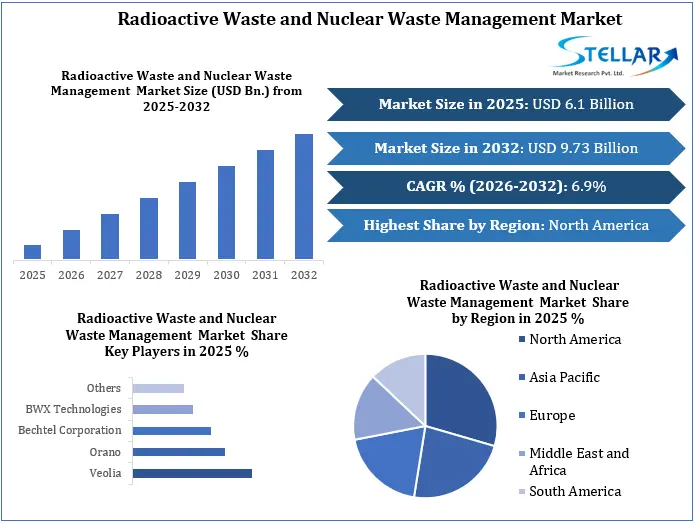
PUNE, India, June 23, 2026 — The Radioactive Waste and Nuclear Waste Management Market, according to the latest study from Stellar Market Research, is projected to grow from USD 6.1 billion in 2025 to USD 9.73 billion by 2032, registering a CAGR of 6.9% during the forecast period. The industry is undergoing a strategic transformation driven by nuclear capacity expansion, small modular reactor (SMR) deployment, and increasing investments in secure long-term disposal infrastructure.
Nuclear Energy Renaissance Reshapes Waste Management Requirements
As governments pursue decarbonization targets and energy security objectives, nuclear power is regaining momentum worldwide. This resurgence is creating new challenges related to spent fuel storage, radioactive material transportation, waste treatment, and geological disposal.
Growing reactor fleets, life-extension projects, and decommissioning activities are generating higher volumes of low-, intermediate-, and high-level waste, prompting utilities and governments to invest heavily in modern waste management systems.
Advanced technologies such as vitrification, waste conditioning, robotics, AI-enabled monitoring systems, and fuel recycling are transforming operational efficiency while strengthening regulatory compliance and environmental safety.
Download Free PDF Brochure: https://www.stellarmr.com/report/req_sample/radioactive-waste-and-nuclear-waste-management-market/2927
Key Findings from the Report
The market is expected to reach USD 9.73 billion by 2032, growing at a CAGR of 6.9%.
Low-Level Waste (LLW) accounts for approximately 52% of global market demand.
Nuclear power plants contribute nearly 68% of radioactive waste generation.
Storage solutions represent the largest management method segment with 34% market share.
High-Level Waste (HLW) is projected to witness the fastest growth due to rising spent fuel volumes.
Asia-Pacific is emerging as a major investment destination owing to nuclear expansion programs in China and India.
Increasing reactor decommissioning activities are creating long-term service opportunities.
Market Drivers and Challenges
Expansion of Nuclear Capacity
Growing electricity demand and net-zero commitments are encouraging countries to expand nuclear power generation, directly increasing the need for sophisticated waste handling systems.
Rising Medical and Industrial Applications
Cancer diagnostics, isotope production, and industrial testing applications are generating additional radioactive waste streams that require specialized management.
Aging Reactor Fleet and Decommissioning Activities
Older facilities across North America and Europe are entering decommissioning phases, creating demand for treatment, transportation, and disposal services.
Key Restraints
Despite strong growth prospects, high infrastructure costs and stringent regulatory frameworks continue to pose challenges. Public opposition to permanent repositories and transportation concerns also affect project timelines.
Technology, Regulation, and Sustainability Trends
Small Modular Reactors are reshaping future waste profiles and creating opportunities for advanced treatment technologies.
AI-assisted monitoring platforms and robotic sorting systems are improving safety and reducing operational costs.
Governments are increasingly supporting nuclear power as a low-carbon energy source, integrating waste management planning into broader decarbonization strategies. ESG considerations and environmental compliance are also becoming central to investment decisions.
Regional Insights
North America remains a leading market due to its large installed nuclear base and extensive decommissioning programs.
Europe continues to invest heavily in geological repositories and long-term disposal infrastructure.
Asia-Pacific represents the fastest emerging region, supported by reactor construction projects in China and India’s ambitious nuclear expansion plans.
Countries such as the UAE and Brazil are also strengthening their nuclear infrastructure to address rising electricity demand.
Recent Industry Developments
Nuclear Decommissioning Authority (2025): Invested up to £9.5 million in the Auto-SAS robotics project to automate radioactive waste sorting, reducing future storage costs.
Sellafield Ltd (2025): Awarded a £4.6 billion high-hazard risk reduction framework supporting long-term waste retrieval and treatment programs.
Deep Fission (2026): Announced plans for an IPO valuing the company at approximately USD 1.66 billion to accelerate underground SMR development.
U.S. Department of Energy (2026): Initiated proposals linking advanced reactor deployment with geological waste repository programs.
AI Research Consortium (2025): Introduced AI-supported regulatory and decision-making platforms for nuclear waste management applications.
Competitive Landscape
Leading companies including Orano, Holtec International, Veolia, Westinghouse Electric Company, BWX Technologies, EnergySolutions, Jacobs Solutions, Fluor Corporation, Studsvik AB, and Perma-Fix Environmental Services are strengthening their market positions through technological innovation, waste processing capabilities, strategic partnerships, and infrastructure investments.
Long-term contracts, nuclear site remediation projects, and advanced storage technologies remain key competitive differentiators.
Download Free PDF Brochure: https://www.stellarmr.com/report/req_sample/radioactive-waste-and-nuclear-waste-management-market/2927
Analyst Commentary
“The accelerating deployment of nuclear power and small modular reactors is fundamentally changing the economics of radioactive waste management. Future competitiveness will increasingly depend on advanced treatment technologies, automation capabilities, and secure long-term disposal solutions,” said a Senior Research Analyst at Stellar Market Research.
Future Outlook
Through 2032, the market is expected to benefit from expanding nuclear energy programs, increasing decommissioning activities, and stronger government support for low-carbon energy systems.
Artificial intelligence, robotics, and next-generation waste treatment technologies are likely to enhance operational efficiency while improving regulatory compliance. Competition will intensify as established players and technology innovators pursue opportunities across storage, recycling, transportation, and disposal infrastructure.
About Stellar Market Research
Stellar Market Research is a global market research and consulting company delivering strategic intelligence across industries including energy, healthcare, automotive, chemicals, aerospace, consumer goods, and information technology. The company provides actionable insights, competitive assessments, and customized consulting solutions to help organizations identify growth opportunities and navigate evolving market dynamics. Combining primary research with advanced analytics, Stellar Market Research supports business leaders, investors, and policymakers with reliable data-driven intelligence for informed decision-making.
Media Contact
Stellar Market Research
Website: http://stellarmr.com/
Email: sales@stellarmr.com
