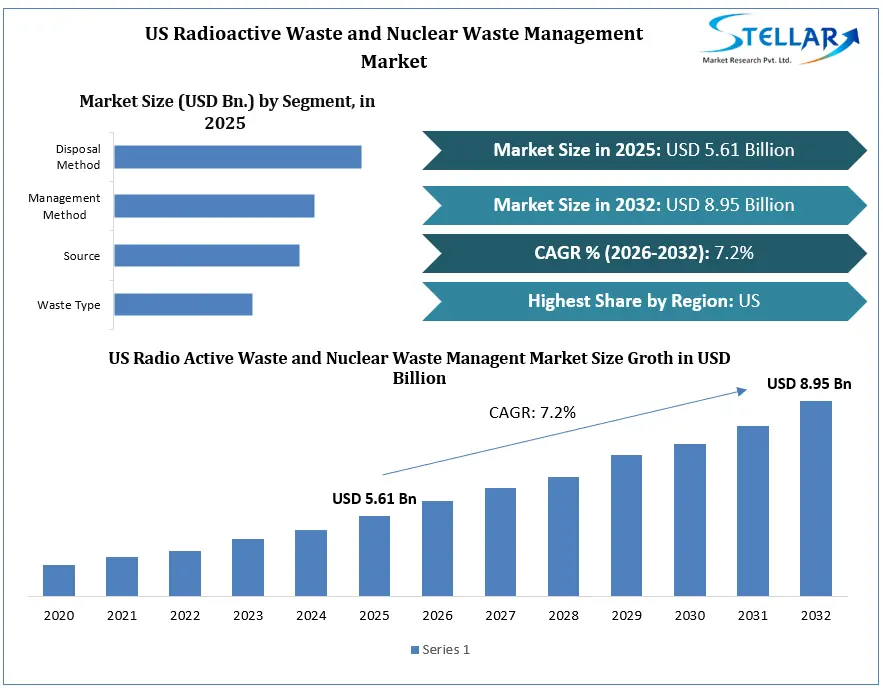
Rising decommissioning activities, spent fuel accumulation, and advanced waste treatment technologies are projected to drive the market from USD 5.61 billion in 2025 to USD 8.95 billion by 2032, expanding at a CAGR of 7.2%.
PUNE, India, June 23, 2026
According to the latest US Radioactive Waste and Nuclear Waste Management Market analysis by Stellar Market Research, growing reactor decommissioning projects, expanding spent fuel inventories, and increased investments in long-term storage infrastructure are reshaping the industry’s outlook. The market is projected to grow steadily through 2032 as utilities and government agencies intensify efforts to ensure safe treatment, transportation, storage, and disposal of radioactive materials.
Market Opportunity Overview
The United States nuclear industry is entering a new phase where waste management infrastructure is becoming as strategically important as power generation itself. The increase in aging reactor retirements and continued operation of existing facilities are creating sustained demand for specialized waste treatment, transportation, and interim storage services.
Growing interest in advanced reactors and small modular reactors (SMRs) is also increasing the importance of developing scalable waste solutions. Technology innovations such as vitrification, advanced conditioning, recycling, and deep geological disposal are transforming how radioactive materials are managed.
Download Free PDF Brochure: https://www.stellarmr.com/report/req_sample/us-radioactive-waste-and-nuclear-waste-management-market/2928
Key Findings from the Report
The market is expected to increase from USD 5.61 billion in 2025 to USD 8.95 billion by 2032, registering a CAGR of 7.2%.
2025 serves as the base year, while the forecast period extends from 2026 to 2032.
Low-Level Waste (LLW) accounted for approximately 52% of the market and represented the dominant waste category.
High-Level Waste (HLW) is anticipated to witness the fastest growth due to rising spent nuclear fuel inventories.
Nuclear power plants contributed around 68% of waste generation, making them the largest source segment.
Storage activities captured nearly 34% of the market, reflecting increased reliance on interim storage facilities.
The Southern United States remained the leading regional market, while the Western region emerged as the fastest-growing area.
Market Drivers and Restraints
Key Drivers
Expansion of nuclear waste volumes
Ongoing reactor operations and plant decommissioning are generating increasing quantities of radioactive waste requiring safe management.
Technological advancements
Innovations in vitrification, compaction, conditioning, and waste stabilization are improving operational efficiency and reducing environmental risks.
Government-led remediation programs
Large-scale federal cleanup projects continue to stimulate demand for waste treatment and disposal services.
Key Restraints
Limited permanent disposal facilities
The absence of fully operational long-term repositories continues to create storage challenges.
Complex regulatory requirements
Strict compliance standards and licensing procedures increase project costs and development timelines.
Technology, Regulation, and Sustainability Trends
Artificial intelligence and advanced decision-support platforms are beginning to support regulatory compliance and operational monitoring in nuclear waste management systems. Researchers are exploring AI-based retrieval-augmented frameworks to improve safety assessments and documentation processes.
Meanwhile, policymakers are increasingly focusing on geological disposal, waste recycling, and improved classification frameworks aimed at reducing long-term cleanup costs. Recent federal discussions around repository development and waste categorization reforms could significantly influence future investments.
Environmental sustainability goals are also encouraging technologies that reduce waste volumes and recover usable materials from spent nuclear fuel.
Regional Insights
The Southern United States, including Texas, Tennessee, and South Carolina, continues to dominate due to its concentration of reactors, disposal facilities, and federal cleanup programs.
The Western United States, particularly Utah and Washington, represents the fastest-growing region. Increased investments in remediation projects, interim storage infrastructure, and advanced treatment technologies are supporting growth across the region.
Recent Industry Developments
EnergySolutions (2025): Successfully processed and permanently disposed of 1,000 gallons of mixed low-level radioactive waste from the Hanford Site, strengthening the nation’s cleanup capabilities.
Amentum, BWXT Technical Services Group, and Fluor (2024): Secured a USD 45 billion Department of Energy contract for Hanford radioactive waste cleanup, reinforcing long-term infrastructure investment.
Department of Energy (2026): Initiated efforts encouraging states to participate in future geological repository programs as part of broader nuclear expansion strategies.
Deep Isolation (2026): Demonstrated the feasibility of deep borehole disposal technology for high-level radioactive waste, potentially expanding future disposal alternatives.
Bechtel (2025): Advanced vitrification operations at the Hanford Waste Treatment and Immobilization Plant, enabling radioactive waste to be converted into stable glass forms for safer storage.
Competitive Landscape
Major participants operating in the market include:
Holtec International
EnergySolutions
Amentum
Bechtel Corporation
BWX Technologies
Waste Control Specialists
NAC International
Jacobs Solutions
Fluor Corporation
Perma-Fix Environmental Services
Westinghouse Electric Company
NorthStar Group Services
Industry participants are focusing on dry cask storage systems, decommissioning services, radioactive waste processing, transportation capabilities, and strategic partnerships with federal agencies.
Download Free PDF Brochure: https://www.stellarmr.com/report/req_sample/us-radioactive-waste-and-nuclear-waste-management-market/2928
Analyst Commentary
“The growing convergence of reactor decommissioning, advanced reactor deployment, and stricter environmental requirements is making radioactive waste management a critical pillar of the US nuclear value chain. Companies capable of delivering integrated storage, treatment, and remediation solutions are expected to benefit from sustained long-term investments,” said a Senior Research Analyst at Stellar Market Research.
Future Outlook
Through 2032, increasing waste inventories and rising investment in nuclear infrastructure are expected to support consistent market expansion. Technologies such as vitrification, advanced recycling, AI-enabled monitoring, and deep geological disposal are likely to reshape operational practices.
Government initiatives, modernization of regulatory frameworks, and growing interest in next-generation nuclear technologies will further strengthen opportunities for specialized service providers and engineering companies.
About Stellar Market Research
Stellar Market Research is a global market research and business consulting firm delivering strategic intelligence across industries including energy, healthcare, chemicals, manufacturing, technology, and consumer goods. The company provides comprehensive market assessments, competitive benchmarking, trend analysis, and growth forecasting to help organizations identify emerging opportunities and formulate data-driven strategies. Through rigorous methodologies and extensive industry expertise, Stellar Market Research supports corporations, investors, and policymakers in navigating evolving business environments and making informed decisions that drive sustainable growth.
Media Contact
Stellar Market Research
Website: www.stellarmr.com
Email: sales@stellarmr.com
