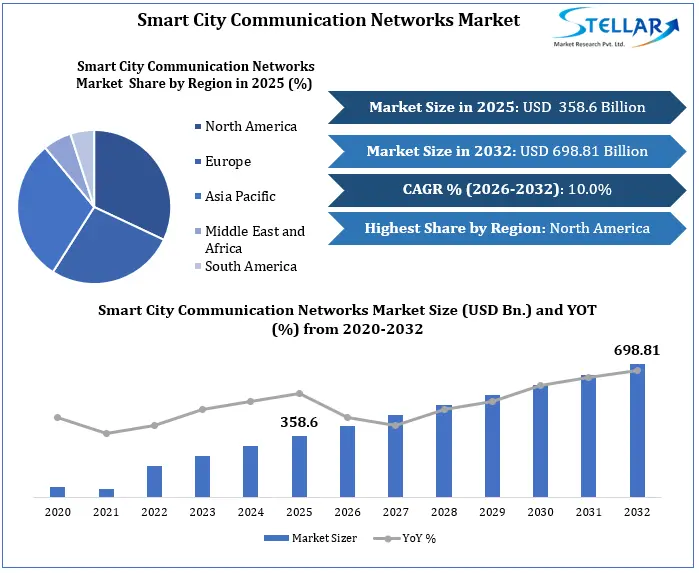
Smart City Communication Networks Market projected to grow from USD 358.6 billion in 2025 to USD 698.81 billion by 2032 at a CAGR of 10.0%, driven by 5G deployment, IoT integration, and intelligent urban infrastructure.
PUNE, India, June 23, 2026 – The Smart City Communication Networks Market, according to a new study by Stellar Market Research, is entering a period of accelerated transformation as governments, telecom operators, and infrastructure developers increase investments in digital urban ecosystems. The market was valued at USD 358.6 billion in 2025 and is expected to reach USD 698.81 billion by 2032, expanding at a CAGR of 10.0% during the forecast period.
AI, 5G, and Edge Computing Reshape Urban Connectivity
The next phase of smart city development is increasingly dependent on resilient and intelligent communication infrastructure. Cities are adopting integrated networks capable of supporting connected transportation, AI-enabled public safety systems, digital governance platforms, and smart utility management.
The convergence of 5G, fiber-optic infrastructure, IoT platforms, and edge computing is enabling municipalities to process vast volumes of data in real time while improving operational efficiency. Demand is shifting away from conventional broadband architectures toward low-latency, software-defined, and cloud-managed communication networks.
The market is also benefiting from increased public-sector investments aimed at building digitally connected and sustainable urban environments.
Download Free PDF Brochure: https://www.stellarmr.com/report/req_sample/smart-city-communication-networks-market/2933
Key Findings from the Report
The global Smart City Communication Networks Market is projected to expand from USD 358.6 billion in 2025 to USD 698.81 billion by 2032.
The market is expected to register a CAGR of 10.0% during 2026–2032.
Optical fiber accounted for approximately 28% of market revenue in 2025 and represented the dominant communication technology segment.
Cellular networks are emerging as the fastest-growing segment due to rapid 5G deployment worldwide.
Intelligent Transportation Systems represented nearly 30% of application demand.
Government and municipal authorities accounted for about 38% of end-user spending.
North America held the leading market share, while Asia-Pacific emerged as the fastest-growing regional market.
Market Drivers and Restraints
Drivers
Expansion of 5G Infrastructure
Rapid deployment of 5G networks is creating demand for high-speed communication systems capable of supporting connected mobility, surveillance, and digital public services.
Growing Adoption of Smart Mobility Solutions
Urban authorities are investing heavily in intelligent transportation systems, AI-powered traffic management, and connected emergency response platforms.
Increasing Smart Utility Investments
The expansion of smart grids, intelligent metering, and digital water infrastructure is strengthening demand for secure communication frameworks.
Restraints
High Infrastructure Deployment Costs
Large-scale fiber and 5G installations require substantial capital investment, particularly in developing economies.
Cybersecurity and Data Privacy Challenges
Rising interconnectivity increases vulnerability to cyber threats and requires robust network security architectures.
Technology, Regulation, and Sustainability Trends
Artificial intelligence is becoming an essential component of network management through predictive maintenance and automated traffic optimization. Edge computing architectures are enabling faster local data processing and lower latency.
Governments worldwide are introducing digital transformation programs and smart city initiatives that support telecom modernization and connected infrastructure deployment.
Sustainability objectives are also influencing network investments, with energy-efficient communication systems and smart mobility platforms helping cities reduce congestion and carbon emissions.
Regional Insights
North America Leads Global Adoption
North America maintained its leadership position in 2025 due to strong telecom infrastructure, rapid 5G deployment, and extensive smart city investments across the United States and Canada.
Asia-Pacific Emerges as High-Growth Region
China, India, Japan, and South Korea are witnessing significant investments in digital infrastructure. Accelerating urbanization and government-backed smart city programs are expected to support above-average growth across the region.
Europe continues to benefit from sustainable city initiatives and advanced fiber networks, while the Middle East is gaining momentum through smart city megaprojects and digital governance investments.
Recent Industry Developments
Ericsson (2025): Expanded its India footprint through major 4G and 5G contracts linked to Vodafone Idea’s network modernization strategy, supporting large-scale urban connectivity deployment.
Bharti Airtel and Ericsson (2025): Strengthened their partnership to deploy Ericsson’s 5G Core solutions, accelerating India’s transition toward standalone 5G architecture.
Huawei Technologies (2025): Introduced CloudMatrix 384 AI infrastructure and advanced 5G-Advanced capabilities, reinforcing AI-driven communication networks.
Nokia and NTT DATA (2024): Expanded their global private 5G partnership to support smart city and public safety infrastructure deployments.
Qualcomm (2025): Introduced the X85 modem and next-generation fixed wireless access platform, enhancing AI-enabled connectivity capabilities.
Competitive Landscape
The market remains highly competitive, with leading companies focusing on product innovation, 5G expansion, AI integration, and strategic partnerships.
Major participants include:
Cisco Systems
Ericsson
Huawei Technologies
Nokia
IBM
NEC Corporation
Honeywell International
Hitachi Ltd.
Companies are increasingly investing in private wireless networks, edge computing platforms, and AI-powered network management solutions to strengthen their market positioning.
Download Free PDF Brochure: https://www.stellarmr.com/report/req_sample/smart-city-communication-networks-market/2933
Analyst Commentary
“The evolution of smart cities is increasingly being defined by intelligent communication infrastructure rather than isolated digital projects. The combination of AI, edge computing, and advanced 5G connectivity is creating new opportunities for governments and telecom providers to deliver efficient, secure, and sustainable urban ecosystems,” said a Senior Research Analyst at Stellar Market Research.
Future Outlook
Through 2032, the Smart City Communication Networks Market is expected to witness sustained investments driven by digital transformation initiatives, rising urban populations, and expanding adoption of IoT-enabled services.
Private 5G networks, AI-based network management, and edge computing are likely to redefine communication architectures. Regulatory support, sustainability objectives, and increasing collaboration between telecom providers and municipal authorities are expected to intensify competition and create new growth opportunities across developed and emerging markets.
About Stellar Market Research
Stellar Market Research is a global market research and business consulting company delivering strategic intelligence across diverse industries. The company provides data-driven insights, competitive benchmarking, technology analysis, and growth forecasts to support business decision-making. Its comprehensive research methodology combines primary interviews, secondary research, and advanced analytics to help organizations identify opportunities and navigate changing market dynamics. Stellar Market Research serves clients worldwide with actionable insights that support investment planning, market entry strategies, and long-term business growth.
Media Contact
Stellar Market Research
Website: Stellar Market Research – Global Research Reports & Consulting
Email: sales@stellarmr.com
