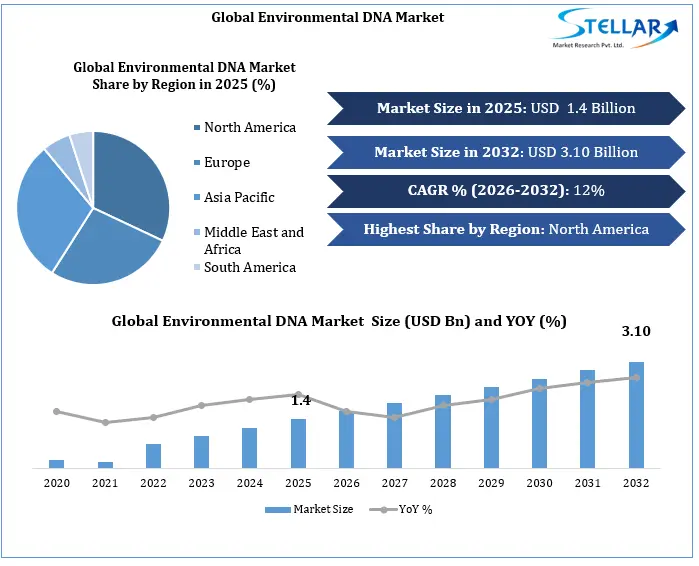
Environmental DNA Market is projected to grow at a CAGR of 12.0% during 2025–2032, as advanced sequencing technologies, AI-powered analytics, and biodiversity regulations transform ecological monitoring worldwide.
PUNE, India, June 23, 2026 — The Environmental DNA Market, according to a new study by Stellar Market Research, is witnessing strong momentum and is expected to expand at a CAGR of 12.0% during the forecast period (2025–2032). The Environmental DNA Market was valued at USD 1.4 billion in 2025 and is forecast to reach USD 3.10 billion by 2032. Increasing demand for non-invasive species detection, biodiversity conservation programs, and AI-enabled ecosystem monitoring is positioning environmental DNA technologies as a strategic component of modern environmental management.
Market Opportunity Overview
Environmental DNA (eDNA) technologies are emerging as one of the most important tools supporting biodiversity conservation, environmental compliance, and ecosystem restoration. Governments and corporations are facing mounting pressure to demonstrate measurable sustainability outcomes and monitor environmental impact with greater precision.
Unlike conventional field surveys, eDNA technologies enable rapid identification of organisms from trace genetic material present in water, soil, sediment, and air. Improvements in sequencing platforms, AI-based analytics, and bioinformatics are transforming environmental assessments into scalable, data-driven operations.
Growing investment in nature-positive infrastructure, offshore wind developments, aquaculture, and ecosystem restoration projects is creating substantial opportunities for eDNA solution providers. The market is forecast to maintain a 12.0% CAGR through 2032, supported by increasing global biodiversity initiatives.
Download Free PDF Brochure: https://www.stellarmr.com/report/req_sample/global-environmental-dna-market/2936
Key Findings from the Report
Base Year: 2025
Forecast Period: 2025–2032
Market expected to register a CAGR of 12.0% during the forecast period.
Water samples represented the dominant sample segment.
qPCR technology accounted for the largest market share owing to high sensitivity and cost efficiency.
Biodiversity monitoring emerged as the leading application area.
Government environmental agencies remained the major end users.
North America held the leading regional position, while Asia-Pacific is projected to register the fastest growth.
Market Drivers and Restraints
Drivers
Rising Biodiversity Protection Regulations
Governments worldwide are implementing stricter environmental assessment frameworks, increasing the adoption of molecular monitoring technologies and supporting double-digit market growth.
Advancements in Sequencing Technologies
Improved PCR, next-generation sequencing, metagenomics, and AI-powered analytics are enhancing species detection accuracy and reducing operational costs.
Growing Demand for Non-Invasive Monitoring
Industries including aquaculture, offshore energy, water utilities, and infrastructure development increasingly require rapid ecological assessments without disturbing habitats, creating new revenue opportunities for eDNA providers.
Restraints
Lack of Standardized Methodologies
Variations in sample collection and analytical procedures continue to challenge regulatory acceptance and industry-wide standardization.
Contamination Risks and Data Interpretation Complexity
False positives and inconsistent datasets remain technical barriers that could slow adoption among end users.
Technology, Regulation, and Sustainability Trends
Artificial intelligence, cloud-based bioinformatics platforms, and automated sampling systems are reshaping the eDNA landscape. Airborne eDNA analysis and autonomous monitoring devices are expanding applications beyond aquatic ecosystems into terrestrial biodiversity monitoring.
Increasing ESG reporting requirements and global biodiversity commitments are strengthening demand for verifiable ecological data. International conservation programs and ecosystem restoration initiatives are accelerating technology deployment and creating long-term opportunities for market participants.
Regional Insights
North America Leads Market Development
North America maintains its leadership position owing to advanced genomics infrastructure, supportive environmental regulations, and strong investments in biodiversity monitoring. The United States and Canada remain key contributors to market revenues.
Asia-Pacific Emerges as the Fastest-Growing Region
Asia-Pacific is expected to witness the highest growth rate during the forecast period. China, India, Australia, Japan, and Singapore are increasing investments in environmental conservation, water quality monitoring, and ecological restoration projects, making the region a major growth engine for the industry.
Europe Strengthens Sustainability Leadership
European countries are integrating eDNA technologies into habitat protection programs, climate adaptation strategies, and environmental impact assessments, supporting sustainable development objectives.
Recent Industry Developments
UNESCO (2025): Launched Phase II of the eDNA Expeditions program, targeting 2,500 marine samples across 25 protected areas and significantly expanding biodiversity monitoring capabilities.
Integrated DNA Technologies and Elegen (2025): Established a strategic partnership to commercialize long and complex DNA synthesis capabilities, enhancing genomics workflows.
McLane Research Laboratories (2025): Introduced the SuPR high-volume autonomous sampler capable of processing up to 2,000 liters per sample, improving eDNA collection efficiency.
Applied Genomics and DigyCorp (2025): Formed a strategic collaboration integrating AI and digital twin technologies with eDNA-driven environmental monitoring.
SGS (2026): Expanded its environmental DNA services portfolio in the United Kingdom, supporting biodiversity assessment requirements across multiple industries.
Competitive Landscape
The Environmental DNA Market is moderately fragmented, with leading players emphasizing technological innovation, strategic partnerships, and product portfolio expansion.
Major participants include:
NatureMetrics
eDNAtec
EnviroDNA
Stantec
Eurofins Genomics
Bureau Veritas
Agilent Technologies
Illumina
PacBio
Smith-Root
Companies are increasingly investing in AI-enabled analytics, advanced sequencing technologies, and automated sampling systems to strengthen their competitive positioning and capture emerging opportunities.
Download Free PDF Brochure: https://www.stellarmr.com/report/req_sample/global-environmental-dna-market/2936
Analyst Commentary
“Environmental DNA technologies are transitioning from research tools to critical infrastructure for biodiversity intelligence. The convergence of AI, genomics, and sustainability reporting will redefine how industries monitor ecological impact and support nature-positive growth strategies,” said a Senior Research Analyst at Stellar Market Research.
Future Outlook
The Environmental DNA Market is expected to maintain a robust 13.5% CAGR through 2032, driven by expanding biodiversity disclosure requirements, AI-enabled ecological analytics, offshore wind investments, aquaculture expansion, and increasing standardization of eDNA methodologies.
As sustainability reporting evolves, environmental DNA solutions are expected to become indispensable components of environmental compliance, ecosystem restoration, and nature-positive development strategies worldwide.
About Stellar Market Research
Stellar Market Research is a global market research and business consulting firm providing actionable intelligence across healthcare, chemicals, energy, information technology, consumer goods, industrial sectors, and emerging technologies. Through rigorous primary and secondary research methodologies, the company delivers strategic insights, competitive benchmarking, market forecasts, and consulting services that enable organizations to identify growth opportunities and formulate effective business strategies. Its research portfolio supports corporate executives, investors, policymakers, and technology innovators with reliable, data-driven market intelligence and long-term strategic guidance.
Media Contact
Stellar Market Research
Website: Stellar Market Research – Global Research Reports & Consulting
Email: sales@stellarmr.com
