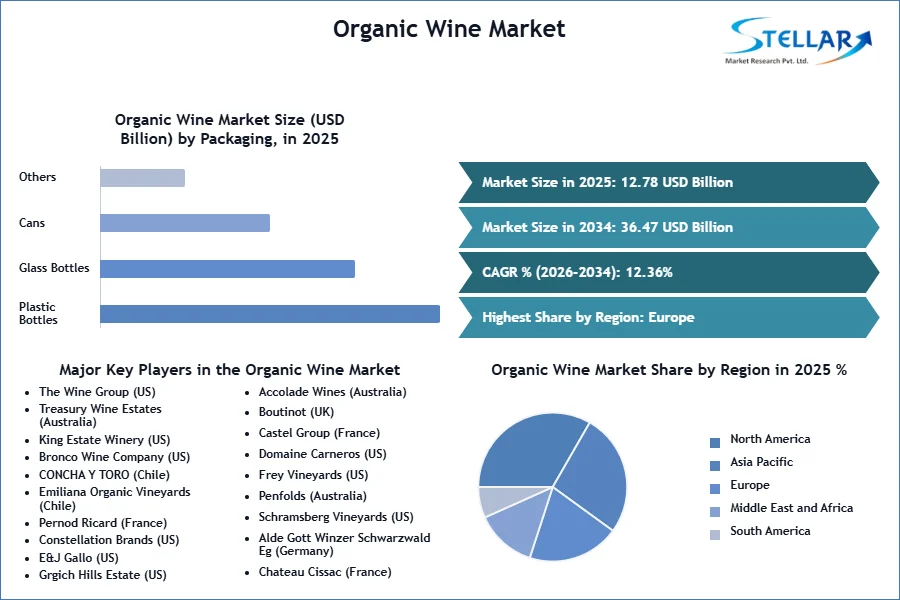
PUNE, June 23, 2026 – The Organic Wine Market is witnessing accelerated global growth as environmentally conscious consumers increasingly favor sustainable, clean-label, and chemical-free alcoholic beverages. According to a recent study by Stellar Market Research, the market is experiencing strong momentum driven by premiumization trends, expanding organic vineyard acreage, and growing regulatory support for sustainable agriculture across major wine-producing regions.
As wine producers face mounting pressure to reduce environmental impact while maintaining product quality, organic wine has emerged as a strategic growth category attracting investments from vineyards, beverage companies, distributors, and institutional investors worldwide.
Market Opportunity Overview
The global wine industry is undergoing a structural transformation. What was once considered a niche category is rapidly becoming mainstream as consumers seek transparency regarding ingredients, production methods, and sustainability credentials.
Organic wine producers are benefiting from a convergence of consumer trends, including health-conscious purchasing, demand for natural products, and increasing willingness to pay premium prices for environmentally responsible beverages. Retailers and hospitality operators are simultaneously expanding organic offerings to meet changing consumer expectations.
Beyond consumer demand, sustainability commitments from wineries and stricter environmental regulations are encouraging investments in organic farming techniques, regenerative agriculture, water conservation, and carbon-reduction initiatives. These developments are creating long-term growth opportunities across the entire organic wine value chain.
𝐃𝐨𝐰𝐧𝐥𝐨𝐚𝐝 𝐅𝐫𝐞𝐞 𝐏𝐃𝐅 𝐁𝐫𝐨𝐜𝐡𝐮𝐫𝐞: https://www.stellarmr.com/report/req_sample/organic-wine-market/2480
Key Findings from the Report
The Organic Wine Market is projected to register steady growth throughout the forecast period, supported by increasing global demand for sustainable alcoholic beverages.
Organic red wine continues to represent the dominant product segment due to its established consumer preference and premium positioning.
Organic white wine is expected to emerge as one of the fastest-growing categories driven by younger consumers and expanding product innovation.
Europe remains the leading regional market owing to strong organic farming infrastructure and favorable regulatory frameworks.
Asia-Pacific is emerging as the fastest-growing region due to rising disposable incomes and growing awareness of premium organic beverages.
Online retail channels are becoming increasingly important distribution platforms, expanding consumer access to organic wine brands.
Investors are showing growing interest in sustainable wineries and certified organic vineyard development projects.
Market Drivers and Restraints
Key Drivers
Rising Demand for Sustainable and Clean-Label Products
Consumers increasingly prioritize products produced without synthetic pesticides, herbicides, or chemical additives. This shift is driving higher demand for certified organic wines across developed and emerging markets.
Premiumization of Alcoholic Beverages
Wine consumers are demonstrating greater willingness to pay premium prices for products perceived as healthier, authentic, and environmentally responsible.
Expansion of Organic Agriculture
Government support programs and sustainability initiatives are encouraging vineyards to transition from conventional farming to organic cultivation methods, increasing production capacity globally.
Key Restraints
Higher Production Costs
Organic vineyard management typically requires greater labor intensity, certification expenses, and specialized cultivation practices, resulting in elevated production costs.
Climate and Yield Variability
Organic vineyards may face greater exposure to weather-related risks, pests, and disease pressures, potentially affecting yields and supply consistency.
Technology, Regulation, and Sustainability Trends
Sustainability remains the defining trend across the Organic Wine Market. Producers are increasingly implementing regenerative agriculture, precision viticulture, water management systems, and biodiversity conservation programs.
Advanced vineyard monitoring technologies, including drone surveillance, satellite imaging, and AI-powered crop analytics, are improving vineyard productivity while maintaining organic certification standards.
Regulatory bodies across Europe, North America, and Asia-Pacific continue strengthening organic certification requirements and labeling transparency. These developments are increasing consumer confidence while creating higher entry barriers for non-certified producers.
Environmental, Social, and Governance (ESG) considerations are also influencing investment decisions, with institutional investors increasingly supporting wineries that demonstrate measurable sustainability outcomes.
𝐃𝐨𝐰𝐧𝐥𝐨𝐚𝐝 𝐅𝐫𝐞𝐞 𝐏𝐃𝐅 𝐁𝐫𝐨𝐜𝐡𝐮𝐫𝐞: https://www.stellarmr.com/report/req_sample/organic-wine-market/2480
Regional Insights
Europe Leads Global Demand
Europe continues to dominate the Organic Wine Market, supported by strong consumer awareness, extensive organic vineyard acreage, and established wine cultures. Countries such as France, Italy, Spain, and Germany remain major contributors to global organic wine production and consumption.
North America Shows Strong Premium Growth
The United States and Canada continue to experience rising demand for premium organic beverages, supported by growing consumer focus on sustainability and health-conscious lifestyles.
Asia-Pacific Emerges as a High-Growth Region
China, Japan, South Korea, and India are becoming increasingly important markets as rising middle-class populations seek premium imported and locally produced organic wines. Expanding e-commerce penetration is further supporting regional market growth.
Latin America Expands Production Capacity
Countries such as Argentina and Chile are increasing investments in organic vineyard development to capitalize on growing export opportunities.
Recent Industry Developments
Treasury Wine Estates (2025): Expanded sustainability-focused vineyard programs aimed at reducing carbon emissions and improving water efficiency across key wine-producing regions.
Familia Torres (2025): Increased investment in regenerative agriculture initiatives to strengthen organic production capabilities and climate resilience.
Bonterra Organic Estates (2025): Introduced new premium organic wine offerings targeting environmentally conscious consumers and premium retail channels.
E. & J. Gallo Winery (2024): Expanded certified sustainable and organic wine portfolios to address growing global demand for clean-label alcoholic beverages.
Castel Frères (2024): Enhanced organic vineyard development initiatives to support long-term production growth and sustainability objectives.
Competitive Landscape
The Organic Wine Market is characterized by increasing competition among established wine producers and specialized organic wineries. Leading participants are focusing on vineyard expansion, certification programs, premium product launches, sustainability initiatives, and direct-to-consumer distribution strategies.
Major market participants include Bonterra Organic Estates, Treasury Wine Estates, Familia Torres, Castel Frères, King Estate Winery, Grgich Hills Estate, and several regional organic wine producers.
Strategic priorities across the industry include portfolio diversification, sustainable agriculture investments, carbon reduction initiatives, and premium brand development.
Analyst Commentary
“The Organic Wine Market is transitioning from a specialty segment into a strategically important category within the global alcoholic beverage industry. Sustainability credentials, transparent sourcing, and premium positioning are becoming powerful differentiators that influence purchasing decisions across both mature and emerging wine markets,” said a Senior Research Analyst at Stellar Market Research.
Future Outlook
The future of the Organic Wine Market will be shaped by consumer demand for sustainability, premiumization trends, evolving regulatory standards, and technological innovation in vineyard management.
Investments in regenerative agriculture, organic certification, digital vineyard monitoring, and sustainable packaging are expected to accelerate throughout the forecast period. As global consumers increasingly prioritize environmental responsibility and product transparency, organic wine producers that successfully combine sustainability with premium quality are expected to capture significant market share.
About Stellar Market Research
Stellar Market Research is a global market research and business consulting firm providing strategic intelligence across multiple industries. The company delivers comprehensive market assessments, competitive analysis, forecasting solutions, and customized consulting services that help organizations identify opportunities and navigate evolving business environments. Through rigorous research methodologies and data-driven insights, Stellar Market Research supports informed decision-making for corporations, investors, and policymakers worldwide.
Media Contact
Stellar Market Research
Website: http://stellarmr.com/
Email: sales@stellarmr.com
