Market Overview
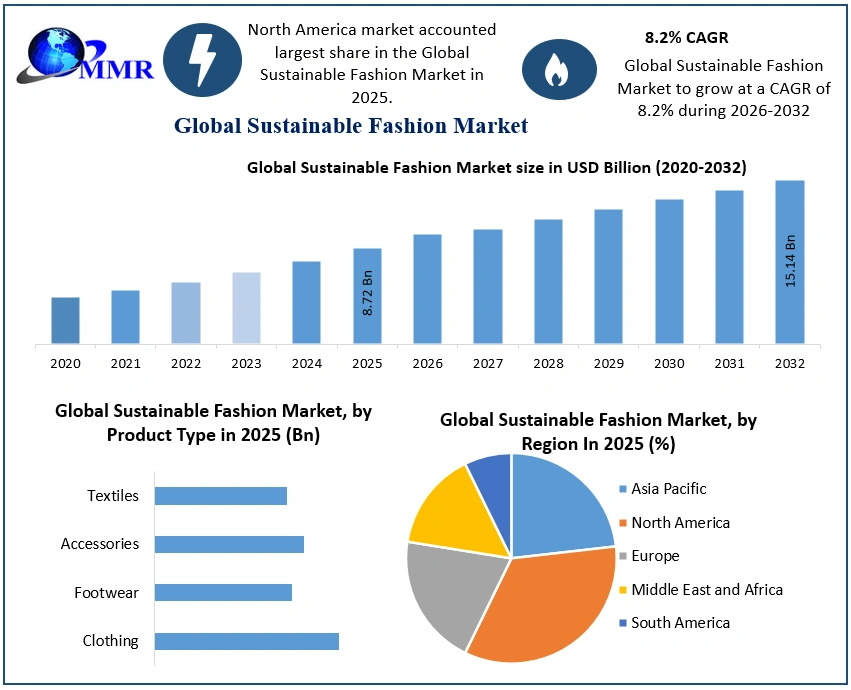
The Sustainable Fashion Market is evolving into one of the most significant structural shifts in the global apparel industry. What began as a niche movement has become a mainstream business strategy influencing sourcing, manufacturing, distribution, and consumer engagement.
The market’s growth is supported by increasing environmental awareness, rising concern about textile waste, demand for responsible production practices, and growing interest in ethical consumption. These forces are changing how consumers evaluate fashion purchases and how companies allocate investment capital.
The conversation has moved beyond product design. Sustainability now influences supply chain architecture, material selection, packaging strategies, retail operations, and corporate governance frameworks.
Key Trends Driving Growth
Consumer awareness remains one of the most powerful growth catalysts. Shoppers increasingly seek products that align with personal values regarding environmental protection, ethical labor practices, and responsible resource use. This changes the competitive landscape by rewarding transparency rather than marketing claims alone.
Circular economy adoption is gaining momentum across the industry. Companies are introducing resale programs, repair services, recycling initiatives, and take-back schemes designed to extend product lifecycles. These models create new revenue streams while addressing sustainability objectives.
Material innovation continues to reshape product development strategies. Fashion companies are exploring environmentally responsible fabrics, recycled inputs, and lower-impact manufacturing methods. Innovation in materials is becoming both a sustainability tool and a source of competitive differentiation.
Digital technology is playing a larger role in sustainability management. Companies are using technology to improve traceability, monitor supply chains, communicate sustainability credentials, and engage consumers more effectively. The result is greater visibility across increasingly complex global operations.
Transparency has become a strategic asset. Consumers, regulators, and investors increasingly expect evidence-based sustainability commitments. Brands that provide verifiable information about sourcing and production practices are strengthening trust and long-term customer relationships.
Request a Free Sample Copy or View Report Summary
Segment Insights
- Dominant Segment: Sustainable apparel remains a central component of market activity, supported by growing consumer demand for environmentally responsible clothing options.
- Fastest-Growing Segment: Circular fashion initiatives, including resale, recycling, and product life-extension programs, are emerging as key growth opportunities across the industry.
- Sustainable materials continue to attract attention as manufacturers seek alternatives that reduce environmental impact while maintaining product quality.
- Ethical sourcing initiatives are becoming increasingly important as brands seek to strengthen supply chain accountability.
- Technology-enabled transparency solutions are gaining adoption as companies respond to stakeholder demands for traceability and reporting.
Regional Growth Story
Europe continues to play a leading role in sustainable fashion adoption due to strong regulatory frameworks, consumer awareness, and corporate sustainability commitments. The region’s influence extends beyond consumption patterns into global sourcing and manufacturing standards.
North America remains an important market as consumers increasingly incorporate sustainability considerations into purchasing decisions. Brands operating in the region are investing in circular economy programs, sustainable materials, and supply chain transparency initiatives.
Asia-Pacific is becoming a critical area of opportunity as both manufacturing and consumer markets evolve. The region’s growing importance creates opportunities for sustainable innovation at scale while also increasing expectations around responsible production practices.
Regional competition is increasingly centered on who can build the most credible sustainability ecosystem rather than simply who can launch the most sustainable product line.
Competitive Landscape
Competition is shifting from sustainability messaging to sustainability execution.
Leading companies are investing in responsible sourcing programs, circular business models, sustainable materials partnerships, and supply chain visibility technologies. These investments signal that sustainability is becoming embedded within core business strategy rather than remaining a standalone initiative.
For competitors, the implications are significant. Companies that fail to demonstrate measurable progress may face growing challenges in customer acquisition, investor engagement, and regulatory compliance.
The next 12–24 months are likely to bring intensified competition around transparency, traceability, and circularity. Brands capable of converting sustainability commitments into operational advantages may strengthen market positions while reducing long-term business risks.
Partnership activity across material innovation, recycling infrastructure, and supply chain management also signals growing industry recognition that sustainability challenges cannot be solved independently. Collaboration is becoming a strategic necessity rather than an optional initiative.
Recent Developments
- Increased adoption of circular economy strategies across fashion value chains.
- Rising investment in sustainable materials and environmentally responsible production processes.
- Greater emphasis on ethical sourcing and supply chain accountability.
- Expansion of transparency and traceability initiatives supported by digital technologies.
- Growing integration of sustainability objectives into long-term corporate strategies.
Strategic Implications
The Sustainable Fashion Market demonstrates that environmental responsibility and commercial growth are becoming increasingly interconnected.
Executives must balance profitability, innovation, compliance, and consumer expectations simultaneously. This requires investment in materials research, supply chain modernization, circular business models, and sustainability reporting capabilities.
For investors, the market highlights opportunities linked to sustainable materials, recycling infrastructure, traceability technologies, and circular economy platforms. These areas are becoming increasingly important components of the fashion industry’s future growth architecture.
Organizations that treat sustainability as a business transformation agenda rather than a branding exercise are likely to achieve stronger long-term outcomes.
Future Outlook
The Sustainable Fashion Market is expected to remain one of the most influential forces shaping the future of the apparel industry. Environmental awareness, regulatory developments, technological innovation, and changing consumer expectations will continue driving transformation across the value chain.
The next phase of industry competition will focus on scalability. The challenge is no longer proving that sustainable fashion can exist. The challenge is delivering sustainability at commercial scale while maintaining profitability and consumer appeal.
The winners will build transparent, circular, and resilient fashion ecosystems; the losers will remain tied to legacy models increasingly challenged by consumers, regulators, and investors.
Analyst Perspective
“The Sustainable Fashion Market is transitioning from an alternative category to a strategic priority across the global fashion industry. Companies that integrate sustainability into sourcing, product development, supply chain management, and customer engagement will be better positioned to capture long-term growth opportunities while strengthening resilience against future market disruptions.” — Siddhi Dole, Analyst
About Maximize Market Research
Maximize Market Research Pvt. Ltd. (MMR) is a global market research and consulting company that provides reliable, data-focused, and practical business insights. The firm serves a wide range of industries, including healthcare, pharmaceuticals, technology, automotive, electronics, chemicals, personal care, and consumer goods. Through market forecasts, competitive analysis, strategic consulting, and industry impact assessments, MMR helps organizations understand changing market conditions, identify growth opportunities, and make informed business decisions for long-term success.
2nd Floor, Navale IT Park Phase 3
Pune Banglore Highway, Narhe
Pune, Maharashtra 411041, India
+91 9607365656
sales@maximizemarketresearch.com
