Key Highlights
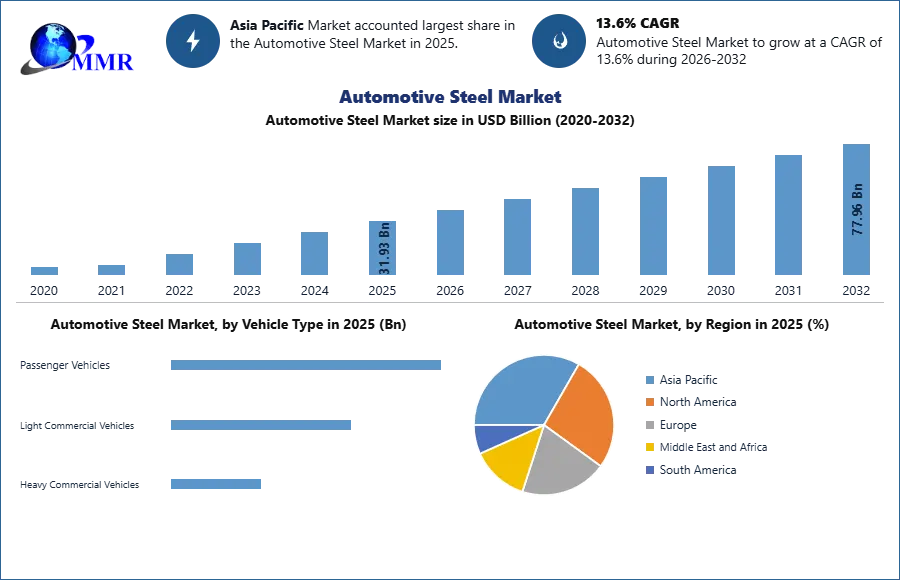
- Automotive Steel Market was valued at USD 31.93 Billion in 2025.
- Market revenue is expected to reach USD 77.96 Billion by 2032.
- The market is projected to grow at a CAGR of 13.6% from 2026 to 2032.
- EV production expansion is increasing demand for lightweight and high-strength steel solutions.
- OEMs are balancing safety, emissions compliance, affordability, and manufacturing efficiency through advanced steel adoption.
- Supply-chain localization and sustainability initiatives are reshaping automotive material sourcing strategies.
- Advanced high-strength steel is becoming a critical enabler of next-generation mobility platforms.
Why This Matters Now
The automotive industry is redesigning the vehicle from the ground up. Electrification, emissions regulation, software-defined architectures, and cost pressures are forcing manufacturers to rethink every component, including the materials that form the vehicle structure.
Against this backdrop, the Automotive Steel Market was valued at USD 31.93 Billion in 2025 and is expected to reach USD 77.96 Billion by 2032, growing at a CAGR of 13.6%. The scale of this expansion signals that steel remains central to future mobility despite growing competition from aluminum and composite materials. For OEMs, suppliers, investors, and fleet operators, the market’s trajectory highlights where manufacturing investment and material innovation are heading next.
Market Overview
Automotive steel is no longer competing solely on cost. The industry now demands materials that improve crash performance, reduce vehicle weight, support battery integration, and contribute to sustainability objectives.
The shift toward electric vehicles has intensified this requirement. Battery packs add significant weight to vehicles, forcing manufacturers to seek stronger and lighter structural materials. Advanced steel grades are increasingly being selected to balance vehicle range, safety performance, manufacturing scalability, and affordability.
At the same time, governments across major automotive markets are tightening emissions regulations and encouraging lower-carbon manufacturing. These policies are pushing automakers and steel producers toward cleaner production methods and higher material efficiency.
The result is a market evolving from a commodity-driven sector into a strategic technology segment within the global transportation ecosystem.
Key Trends Driving Growth
Vehicle electrification remains the most important structural driver. EV manufacturers require materials capable of supporting battery systems while maintaining crashworthiness and optimizing energy efficiency. Automotive steel producers are responding with advanced high-strength steel solutions that enable thinner and lighter vehicle structures.
The transition toward software-defined vehicles is also influencing material demand. Modern vehicle architectures integrate larger battery systems, sophisticated electronics, sensor arrays, and connectivity hardware. These additions increase structural requirements and create opportunities for specialized steel applications.
Sustainability has emerged as another competitive factor. Automakers are under pressure to reduce lifecycle emissions across manufacturing operations. Steel suppliers investing in lower-carbon production technologies are strengthening their position within global automotive supply chains.
Supply-chain resilience is becoming equally important. Recent disruptions have encouraged OEMs to diversify sourcing strategies, localize production networks, and secure long-term material availability. Automotive steel producers with regional manufacturing footprints are benefiting from these procurement shifts.
Meanwhile, growing investments in commercial vehicles, fleet modernization, and transportation infrastructure continue to support long-term demand for durable and cost-efficient automotive materials.
Get a free sample report:https://www.maximizemarketresearch.com/request-sample/22955/
Segment Insights
- Dominant Segment: Not specified in the source report.
- Fastest-Growing Segment: Not specified in the source report.
- Advanced high-strength steel continues to gain strategic importance as automakers pursue vehicle lightweighting without compromising safety.
- Structural and body-in-white applications remain major areas of steel utilization due to stringent crash-performance requirements.
- EV platform development is creating new opportunities for specialized steel grades designed for battery protection and structural reinforcement.
- Sustainability-focused steel manufacturing processes are becoming increasingly important purchasing criteria for automotive OEMs.
Regional Growth Story
China remains a critical force in global automotive manufacturing. The country’s leadership in EV production, battery manufacturing, and transportation electrification creates substantial demand for advanced automotive materials. Steel suppliers capable of supporting large-scale EV production are likely to benefit from continued investment activity.
The United States is witnessing renewed manufacturing momentum through domestic production initiatives and supply-chain localization efforts. Automotive manufacturers are expanding investments in electric vehicle production facilities, creating long-term demand for advanced steel solutions.
Germany continues to play a pivotal role in material innovation. Premium vehicle manufacturers require lightweight structures, advanced safety performance, and manufacturing precision, all of which support demand for specialized automotive steel products.
Japan and South Korea remain influential due to their strong positions in automotive engineering, manufacturing technology, and export-oriented vehicle production. Their focus on efficiency, safety, and advanced mobility technologies sustains demand for high-performance steel grades.
India is emerging as an increasingly important automotive manufacturing hub. Rising vehicle production, infrastructure development, and growing domestic demand are expanding opportunities for steel suppliers serving both passenger and commercial vehicle segments.
Across regions, the common theme is clear: vehicle electrification and manufacturing modernization are strengthening the strategic role of advanced steel in future transportation systems.
Competitive Landscape
Competition in the Automotive Steel Market is increasingly defined by technological capability rather than production volume alone.
Steel manufacturers are investing in advanced high-strength steel portfolios to align with automaker requirements for lightweight, safe, and cost-effective vehicles. This shift signals that future competitive advantage will come from engineering expertise and application-specific solutions rather than commodity production.
Automotive OEMs are seeking closer collaboration with material suppliers during vehicle development cycles. These partnerships enable faster product innovation and help manufacturers optimize performance, manufacturing efficiency, and sustainability targets simultaneously.
The competitive landscape also reflects broader supply-chain restructuring. Companies with regional manufacturing capabilities, diversified sourcing networks, and low-carbon production initiatives are improving their attractiveness to global automotive customers.
As EV adoption accelerates, material suppliers that can support battery-electric vehicle architectures at scale are likely to gain stronger pricing power and deeper integration within automotive production ecosystems.
The industry’s direction suggests a gradual movement toward value-added materials, strategic partnerships, and technology-led differentiation.
Recent Developments
- OEMs continue increasing investments in electric vehicle platforms requiring lightweight structural materials.
- Automotive manufacturers are intensifying sustainability initiatives across vehicle production and supply chains.
- Demand for advanced high-strength steel solutions is rising alongside vehicle safety and efficiency requirements.
- Regional manufacturing expansion strategies are strengthening supply-chain resilience.
- Material innovation efforts are accelerating as automakers pursue emissions reduction and cost optimization objectives.
Strategic Implications
For automotive manufacturers, material strategy is becoming a competitive decision rather than a procurement decision. Vehicle range, safety performance, manufacturing economics, and sustainability targets increasingly depend on advanced material selection.
For steel producers, the opportunity lies in moving beyond traditional supply relationships. Companies capable of delivering engineering support, advanced product portfolios, and sustainability credentials are likely to capture greater value within automotive supply chains.
Investors should monitor the intersection of electrification and materials innovation. The growth trajectory of automotive steel highlights how legacy industries can become critical enablers of next-generation mobility.
Fleet operators also stand to benefit. Lightweight and durable vehicle structures contribute to operational efficiency, lower lifecycle costs, and improved vehicle performance across commercial transportation applications.
Future Outlook
The Automotive Steel Market is expected to grow from USD 31.93 Billion in 2025 to USD 77.96 Billion by 2032 at a CAGR of 13.6%, reflecting its continuing importance in vehicle manufacturing. The market’s expansion signals sustained demand for advanced materials that can support electrification, safety requirements, and manufacturing efficiency simultaneously.
The next phase of competition will not be defined by who produces the most steel, but by who delivers the smartest materials for electric, connected, and increasingly intelligent vehicles. Companies that align material innovation with the future architecture of mobility will shape the next generation of transportation, while those tied to conventional production models risk losing relevance as automotive platforms evolve.
Analyst Perspective
“The Automotive Steel Market is entering a period where material innovation becomes a strategic differentiator for both steel producers and vehicle manufacturers. As electrification, sustainability requirements, and advanced mobility technologies reshape transportation, demand for high-performance automotive steel solutions is expected to accelerate significantly across global markets.” — Tejaswini Kakade
About Maximize Market Research
Maximize Market Research Pvt. Ltd. (MMR) is a global market research and consulting company that provides reliable, data-focused, and practical business insights. The firm serves a wide range of industries, including healthcare, pharmaceuticals, technology, automotive, electronics, chemicals, personal care, and consumer goods. Through market forecasts, competitive analysis, strategic consulting, and industry impact assessments, MMR helps organizations understand changing market conditions, identify growth opportunities, and make informed business decisions for long-term success.
Contact Us:
2nd Floor, Navale IT Park Phase 3
Pune Banglore Highway, Narhe
Pune, Maharashtra 411041, India
+91 9607365656
sales@maximizemarketresearch.com
