Key Highlights
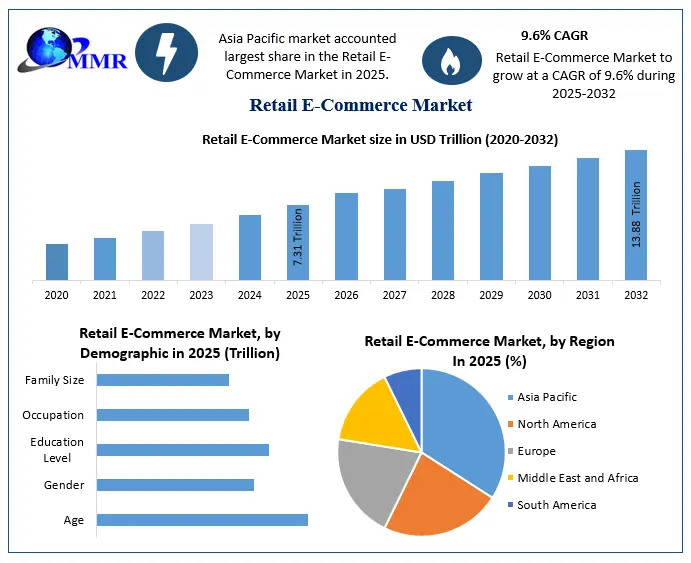
- Retail E-Commerce Market size reached USD 7.31 trillion in 2025.
- Market revenue is expected to reach USD 13.88 trillion by 2032.
- The market is projected to expand at a 9.6% CAGR from 2026 to 2032.
- Mobile-first shopping and digital payment adoption continue to accelerate online purchasing.
- AI-powered personalization is becoming a major competitive differentiator.
- Faster fulfillment models are reshaping customer expectations globally.
- Omnichannel retail strategies are becoming essential for market leadership.
- Emerging economies are contributing significantly to new customer acquisition.
Why This Matters Now
Retail executives face a narrowing window to adapt. Consumer expectations are changing faster than traditional retail operating models can respond. The companies investing today in digital infrastructure, fulfillment speed, and AI-enabled customer engagement are positioning themselves to capture a disproportionate share of future spending.
The Retail E-Commerce Market has moved beyond a simple channel shift. It is becoming the primary battleground for customer loyalty, pricing power, and long-term growth. Every percentage point of market expansion now carries strategic implications for retailers, brands, logistics providers, and technology vendors.
Market Overview
The Retail E-Commerce Market was valued at USD 7.31 trillion in 2025 and is forecast to reach USD 13.88 trillion by 2032, growing at a CAGR of 9.6% during the forecast period.
The growth story is no longer defined solely by online shopping adoption. The market is increasingly driven by the quality of digital experiences. Consumers expect seamless purchasing journeys, personalized recommendations, real-time inventory visibility, flexible payment options, and rapid delivery.
As digital commerce matures, competition is shifting from customer acquisition toward customer retention. Businesses that can combine convenience, trust, and fulfillment efficiency are gaining sustainable advantages over competitors that rely solely on pricing.
The result is a market where operational excellence is becoming as important as product assortment.
Key Trends Driving Growth
Mobile commerce continues to reshape purchasing behavior. Smartphones have become the primary gateway for product discovery, comparison, and transactions. This shift is pushing retailers to optimize applications, checkout processes, and customer engagement strategies for mobile-first experiences.
Artificial intelligence is becoming deeply embedded across the e-commerce value chain. Retailers are deploying AI to improve product recommendations, automate customer service, forecast demand, and enhance marketing efficiency. These capabilities are helping companies increase conversion rates while reducing acquisition costs.
Digital payment ecosystems are reducing transaction friction. The expansion of digital wallets, real-time payment systems, and embedded finance solutions is enabling smoother purchasing experiences and encouraging higher online spending.
Another major trend is the rise of rapid fulfillment models. Consumers increasingly expect shorter delivery windows, creating demand for localized inventory networks and advanced logistics capabilities. Retailers that can deliver speed without sacrificing profitability are strengthening customer loyalty.
Omnichannel integration is also accelerating. Physical stores are evolving into fulfillment hubs, pickup locations, and customer experience centers, creating stronger links between online and offline retail operations.
Download a Sample Report for Detailed Industry Trends and Growth Analysis
Segment Insights
- Dominant Segment: The market’s leading segment continues to benefit from strong consumer adoption, extensive product availability, and established digital infrastructure.
- Fastest-Growing Segment: Emerging high-convenience commerce formats are recording accelerated growth as consumers prioritize speed and flexibility in purchasing.
- Mobile-driven transactions are increasing their contribution to overall retail e-commerce revenue.
- Digital payment-enabled purchases continue gaining momentum across developed and emerging markets.
- Personalized shopping experiences are improving customer engagement and repeat purchasing behavior.
- Marketplace ecosystems remain central to customer acquisition and seller expansion strategies.
Regional Growth Story
Regional growth patterns are increasingly influenced by digital infrastructure maturity and consumer connectivity.
Developed markets continue to focus on improving customer experience through AI, automation, and fulfillment optimization. Retailers in these regions are investing heavily in personalization technologies and same-day delivery capabilities to maintain competitive advantages.
Emerging economies are contributing significant new customer volumes. Expanding internet penetration, increasing smartphone adoption, and growing trust in digital payments are creating large pools of first-time online shoppers.
Asia-Pacific remains one of the most influential growth engines due to its scale, mobile commerce adoption, and rapidly evolving digital ecosystems. Retailers operating in the region are often setting benchmarks for innovation in customer engagement and delivery models.
Competitive Landscape
Competition is becoming increasingly intense as global platforms, regional marketplaces, and direct-to-consumer brands compete for consumer attention.
Leading companies are expanding beyond traditional online retail models. Investments in artificial intelligence, logistics networks, fulfillment automation, and customer data platforms indicate a broader shift toward ecosystem-based competition.
Partnerships between retailers, payment providers, logistics companies, and technology firms signal a market where collaboration is becoming a strategic necessity. The objective is no longer simply selling products online; it is controlling larger portions of the customer journey.
For rivals, this means barriers to entry are rising. Companies with superior data capabilities and fulfillment infrastructure will likely widen their competitive advantage over the next 12–24 months.
The competitive signal is clear: future leaders will be defined by operational speed, customer intelligence, and ecosystem strength rather than product assortment alone.
Recent Developments
- Retailers are increasing investments in AI-driven personalization platforms.
- Digital payment innovations continue improving checkout efficiency and transaction security.
- Companies are expanding fulfillment networks to support faster delivery expectations.
- Omnichannel strategies are becoming central to customer acquisition and retention efforts.
- Marketplace operators are enhancing seller support capabilities to strengthen platform ecosystems.
- Logistics modernization remains a major investment priority across the industry.
Strategic Implications
Retailers must rethink how value is created and delivered.
The traditional advantage of product selection is becoming less meaningful as digital marketplaces increase consumer choice. Differentiation increasingly comes from customer experience, fulfillment speed, personalization quality, and ecosystem integration.
Executives should focus on building resilient supply chains, leveraging AI for operational efficiency, and developing omnichannel capabilities that connect physical and digital touchpoints.
Companies that delay transformation risk losing relevance as consumer expectations continue to rise.
Future Outlook
The Retail E-Commerce Market is entering a scale-driven growth cycle supported by digital payments, mobile commerce, AI-powered engagement, and advanced logistics capabilities.
As competition intensifies, winning strategies will increasingly depend on data intelligence, fulfillment performance, and customer lifetime value optimization. The next phase of market expansion will reward businesses that can combine technological innovation with operational excellence.
By 2032, the gap between market leaders and laggards is likely to widen significantly—those that master customer experience and fulfillment speed will capture growth, while those that fail to adapt will compete on shrinking margins.
Analyst Perspective
“Retail e-commerce is evolving from a convenience channel into the foundation of modern retail strategy. The next wave of growth will be driven by technology-enabled customer experiences, intelligent commerce platforms, and increasingly sophisticated fulfillment ecosystems. Organizations that invest early in these capabilities will be best positioned to capture long-term value.” — Siddhi Dole, Analyst
About Maximize Market Research
Maximize Market Research Pvt. Ltd. (MMR) is a global market research and consulting company that provides reliable, data-focused, and practical business insights. The firm serves a wide range of industries, including healthcare, pharmaceuticals, technology, automotive, electronics, chemicals, personal care, and consumer goods. Through market forecasts, competitive analysis, strategic consulting, and industry impact assessments, MMR helps organizations understand changing market conditions, identify growth opportunities, and make informed business decisions for long-term success.
Contact Us
2nd Floor, Navale IT Park Phase 3
Pune Banglore Highway, Narhe
Pune, Maharashtra 411041, India
+91 9607365656
sales@maximizemarketresearch.com
