Key Highlights
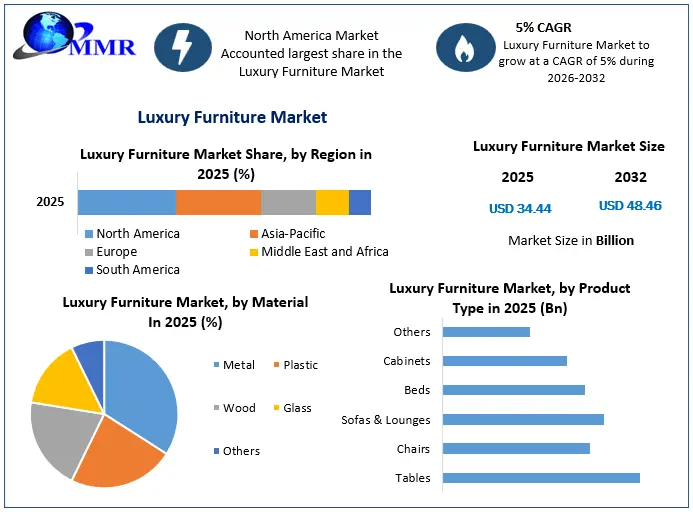
- Global Luxury Furniture Market valued at USD 34.44 Billion in 2025.
- Market expected to reach USD 48.46 Billion by 2032.
- Revenue projected to grow at a 5% CAGR from 2026 to 2032.
- Increasing spending on premium residential interiors is accelerating demand.
- Customization and personalization are becoming key purchasing criteria.
- Sustainability is emerging as a competitive differentiator among luxury brands.
- Digital channels are reshaping customer discovery and purchasing journeys.
- Premium hospitality and commercial projects continue to support industry growth.
Why This Matters Now
Luxury consumers are changing faster than many furniture manufacturers anticipated. Affluent buyers no longer view furniture as a functional purchase. They see it as a statement of identity, craftsmanship, and lifestyle.
The market’s projected expansion from USD 34.44 Billion in 2025 to USD 48.46 Billion by 2032 signals more than rising sales. It indicates a structural shift toward premium living environments. Companies that understand this transition can capture higher margins. Those relying solely on traditional retail models may struggle to remain competitive.
Market Overview
The luxury furniture Market Size industry sits at the intersection of design, craftsmanship, and consumer aspiration. Demand is increasingly driven by homeowners seeking unique interiors that combine aesthetics, comfort, and exclusivity.
The market’s growth trajectory demonstrates how premiumization continues to influence purchasing decisions across global consumer segments. Luxury furniture is benefiting from rising disposable incomes, urban wealth creation, and expanding investments in residential renovation.
Manufacturers are responding by introducing collections that blend timeless craftsmanship with modern functionality. This evolution is broadening market appeal while strengthening pricing power.
Key Trends Driving Growth
Personalization has become a defining feature of the luxury furniture market. Consumers increasingly seek customized products tailored to individual preferences, room dimensions, and design aesthetics.
Sustainability is moving from niche demand to mainstream expectation. Luxury buyers are paying closer attention to sourcing practices, material selection, and environmental impact. This shift is encouraging manufacturers to adopt responsible production processes.
Digital engagement is also transforming purchasing behavior. Consumers increasingly begin their luxury furniture journey online, exploring collections, comparing designs, and interacting with brands before visiting physical showrooms.
Technology integration is creating additional opportunities. Smart furniture solutions that combine design sophistication with practical functionality are attracting modern consumers seeking convenience without compromising aesthetics.
Premium hospitality developments, luxury residential projects, and high-end commercial spaces continue to generate demand for designer furnishings. These projects provide manufacturers with opportunities to secure large-volume contracts while enhancing brand visibility.
Segment Insights
- Dominant Segment: The report identifies the leading segment contributing the highest share of global market revenue.
- Fastest-Growing Segment: The report highlights the segment expected to expand at the strongest growth rate during the forecast period.
- Residential applications remain a significant demand driver for luxury furniture products.
- Demand for customized and handcrafted furniture continues to support premium pricing strategies.
- Expanding interest in contemporary and multifunctional designs is encouraging portfolio diversification.
Regional Growth Story
Regional growth patterns reveal different pathways to expansion.
Developed markets continue to benefit from established luxury consumption habits, mature retail infrastructure, and strong demand for premium interior products. Competition in these regions increasingly centers on innovation, sustainability, and exclusive customer experiences.
Emerging markets are creating new opportunities as wealth creation accelerates and urban populations expand. Rising numbers of affluent consumers are investing in luxury home furnishings as a symbol of status and personal expression.
This combination of mature-market stability and emerging-market growth creates a diversified opportunity landscape for manufacturers and investors alike.
Explore detailed analysis, insights, and growth opportunities
Competitive Landscape
Competition in the luxury furniture industry is intensifying as brands seek differentiation beyond design alone.
Investments in customization capabilities indicate that manufacturers recognize the growing importance of individualized consumer experiences. Companies that scale personalization efficiently may gain a meaningful advantage over rivals dependent on standardized product lines.
Partnerships with designers, architects, and premium real-estate developers signal a broader shift toward ecosystem-driven growth strategies. These collaborations strengthen brand visibility while creating direct access to high-value customer segments.
Over the next 12 to 24 months, market leaders are likely to increase investments in digital platforms, sustainable materials, and premium customer engagement. Rivals that fail to modernize distribution and product development strategies risk losing relevance among younger luxury consumers.
Recent Developments
- Expansion of luxury furniture portfolios across residential and commercial applications.
- Increased investment in sustainable and responsibly sourced materials.
- Greater adoption of omnichannel retail strategies.
- Rising focus on customized and made-to-order furniture solutions.
- Strategic collaborations aimed at strengthening premium brand positioning.
Strategic Implications
The luxury furniture market is becoming increasingly experience-driven.
Manufacturers must balance craftsmanship with scalability. Consumers expect exclusivity, but they also demand shorter delivery times and seamless purchasing experiences. This creates pressure on supply chains and production models.
Retailers have an opportunity to transform showrooms into immersive brand experiences rather than traditional sales spaces. Meanwhile, suppliers capable of delivering premium sustainable materials stand to benefit from changing procurement priorities.
The most significant implication is that luxury furniture is evolving from a product category into a lifestyle category. Brands that understand this shift can unlock stronger customer loyalty and higher lifetime value.
Future Outlook
Growth opportunities will increasingly emerge from personalization, sustainability, and digital engagement.
As luxury consumers become more informed and selective, manufacturers will need to demonstrate value beyond craftsmanship alone. Design excellence, environmental responsibility, and seamless customer experiences will become equally important competitive factors.
The next generation of industry leaders will be those that combine heritage with innovation, while companies that fail to adapt may discover that prestige alone is no longer enough to secure market leadership.
By 2032, the winners will be brands that transform luxury furniture into a complete lifestyle experience, while losers will remain trapped selling products in a market increasingly driven by experiences.
Analyst Perspective
“The luxury furniture market continues to evolve as consumers place greater emphasis on personalization, premium living experiences, and sustainability. Companies that align innovation with these changing expectations are expected to be best positioned for long-term growth.” — Siddhi Dole, Analyst
Contact :
MAXIMIZE MARKET RESEARCH PVT. LTD.
2nd Floor, Navale IT Park Phase 3
Pune Banglore Highway, Narhe
Pune, Maharashtra 411041, India
+91 9607365656
sales@maximizemarketresearch.com
