Key Highlights
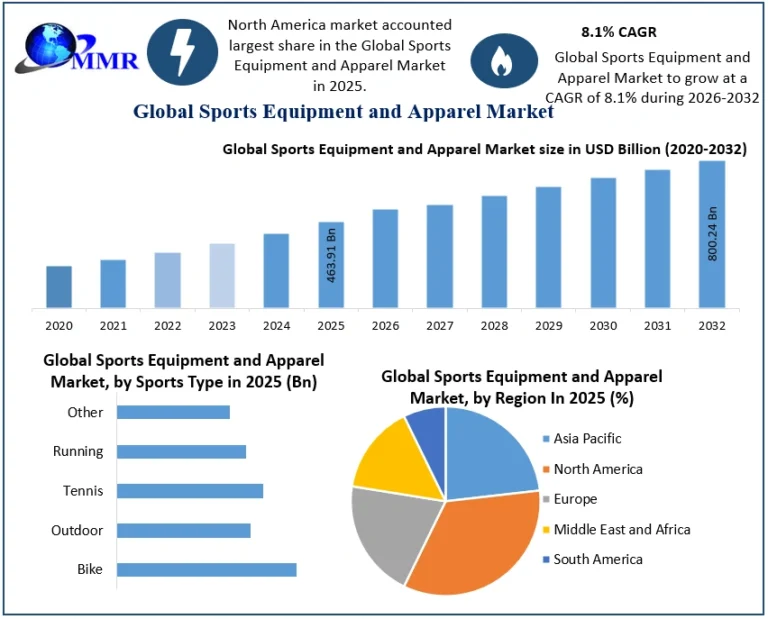
- Global Sports Equipment and Apparel Market was valued at USD 463.91 billion in 2025.
- Market revenue is projected to reach USD 800.24 billion by 2032.
- The market is expected to grow at a CAGR of 8.1% between 2026 and 2032.
- Rising participation in fitness, recreational sports, and outdoor activities is expanding demand.
- Athleisure continues to blur the line between sportswear and everyday fashion.
- Online retail channels are reshaping purchasing behavior and brand engagement.
- Sustainability and eco-friendly materials are becoming competitive differentiators.
- Manufacturers are investing in innovation, digital commerce, and performance-enhancing products.
Why This Matters Now
Consumer spending patterns are shifting faster than many sporting goods companies anticipated. Fitness is no longer confined to gyms, and sportswear is no longer limited to athletic activity.
The Sports Equipment and Apparel Market is now competing for a larger share of everyday consumer wallets. Companies that fail to adapt to digital retail, sustainability demands, and lifestyle-driven purchasing risk losing relevance in a market moving toward USD 800 billion.
Market Overview
The Sports Equipment and Apparel Market was valued at USD 463.91 billion in 2025 and is expected to reach USD 800.24 billion by 2032, growing at a CAGR of 8.1% during the forecast period. Every percentage point of growth represents billions of dollars in additional revenue opportunities for manufacturers, retailers, and sporting brands.
The market is being reshaped by a convergence of health awareness, sports participation, fashion trends, and digital commerce. Consumers increasingly view sports apparel and equipment as lifestyle products rather than occasional purchases. This shift expands purchase frequency and raises customer lifetime value.
What was once a seasonal industry has evolved into a year-round consumer category supported by fitness culture, outdoor recreation, and wellness-focused lifestyles.
Key Trends Driving Growth
Fitness has become a mainstream consumer priority. Individuals are investing more in training equipment, performance apparel, and specialized sporting products to support healthier lifestyles. This expands demand beyond professional athletes to everyday consumers.
Athleisure remains one of the industry’s most powerful growth engines. Consumers increasingly seek apparel that transitions seamlessly between workouts, work environments, travel, and casual settings. The result is stronger demand for versatile, premium-priced sportswear products.
Digital retail continues to alter buying behavior. Online platforms enable brands to engage directly with consumers, accelerate product launches, and collect valuable customer insights. The growth of e-commerce also reduces dependence on traditional retail networks.
Sustainability is moving from a marketing message to a purchasing criterion. Consumers increasingly evaluate products based on material sourcing, environmental impact, and brand responsibility. This is encouraging investments in recycled fabrics, eco-friendly manufacturing, and circular product strategies.
Celebrity endorsements and influencer-led campaigns remain influential demand drivers. Sports personalities and social media creators increasingly shape purchasing decisions, particularly among younger demographics.
Request a Sample Copy to Evaluate Market Potential and Future Growth Trends
Segment Insights
- Dominant Segment: Sports Apparel
- Sports apparel remains a major revenue contributor as consumers increasingly incorporate athletic wear into everyday wardrobes.
- The category benefits from both performance-focused and fashion-driven demand.
- Fastest-Growing Segment: Online Retail Distribution
- Online channels continue gaining traction as consumers prioritize convenience, product variety, and direct-to-consumer purchasing experiences.
- Brands are increasing digital investments to strengthen customer acquisition and retention.
- Fitness equipment demand is supported by growing participation in personal wellness activities.
- Outdoor and recreational sports categories continue benefiting from increased interest in active lifestyles.
- Running, cycling, and fitness-related activities remain key demand generators across product categories.
Regional Growth Story
North America continues to represent a major market opportunity due to high consumer spending on fitness, sports participation, and premium athletic products. Established sporting cultures and strong brand presence support market leadership.
Europe maintains strong demand driven by outdoor recreation, professional sports ecosystems, and sustainability-focused consumer behavior. Brands operating in the region are increasingly leveraging eco-conscious product innovation.
Asia-Pacific is emerging as a critical growth engine. Expanding middle-class populations, increasing health awareness, urbanization, and growing participation in organized sports are creating substantial opportunities for global and regional brands.
The strategic importance of emerging markets is increasing as companies seek growth beyond mature economies.
Competitive Landscape
Competition is intensifying as brands compete simultaneously on performance, fashion, sustainability, and digital engagement.
Leading companies are expanding product portfolios, strengthening direct-to-consumer capabilities, and investing in technology-enabled product development. The competitive battle is increasingly shifting from shelf space to digital ecosystems and customer communities.
The rise of athleisure signals that traditional category boundaries are disappearing. Apparel companies are entering performance markets, while sporting goods manufacturers are expanding lifestyle offerings. This convergence is likely to increase competitive pressure over the next 12–24 months.
For rivals, this means differentiation will depend less on product availability and more on brand identity, sustainability credentials, and consumer engagement capabilities.
Recent Developments
- Growing adoption of sustainable materials in sportswear manufacturing.
- Increased investment in e-commerce and direct-to-consumer channels.
- Expansion of fitness-oriented product portfolios.
- Stronger use of celebrity endorsements and influencer partnerships.
- Continued innovation in performance-enhancing apparel and sporting equipment.
Strategic Implications
The next phase of market growth will be determined by consumer lifestyle integration rather than traditional sports participation alone.
Brands that combine performance, fashion, sustainability, and digital convenience will be positioned to capture disproportionate market share. Companies relying solely on legacy retail models face increasing pressure as online channels gain influence.
Investment priorities are shifting toward digital commerce, consumer analytics, sustainable manufacturing, and product innovation. These capabilities are becoming strategic necessities rather than optional growth initiatives.
Future Outlook
The Sports Equipment and Apparel Market is expected to expand from USD 463.91 billion in 2025 to nearly USD 800.24 billion by 2032, creating substantial opportunities across apparel, equipment, and digital retail ecosystems.
Growth will increasingly come from consumers who view fitness and wellness as everyday priorities rather than occasional activities. The convergence of health consciousness, athleisure, sustainability, and e-commerce will continue to redefine competitive dynamics.
The winners will build lifestyle ecosystems around consumers; the losers will continue selling products without owning the relationship.
Analyst Perspective
“The Sports Equipment and Apparel Market is entering a period where consumer identity, wellness, and digital engagement are becoming as important as product performance. Companies that successfully align innovation, sustainability, and omnichannel retail strategies will be best positioned to capture the next wave of growth.” — Siddhi Dole, Analyst
About Maximize Market Research
Maximize Market Research Pvt. Ltd. (MMR) is a global market research and consulting company that provides reliable, data-focused, and practical business insights. The firm serves a wide range of industries, including healthcare, pharmaceuticals, technology, automotive, electronics, chemicals, personal care, and consumer goods. Through market forecasts, competitive analysis, strategic consulting, and industry impact assessments, MMR helps organizations understand changing market conditions, identify growth opportunities, and make informed business decisions for long-term success.
Contact Us
2nd Floor, Navale IT Park Phase 3
Pune Banglore Highway, Narhe
Pune, Maharashtra 411041, India
+91 9607365656
sales@maximizemarketresearch.com
