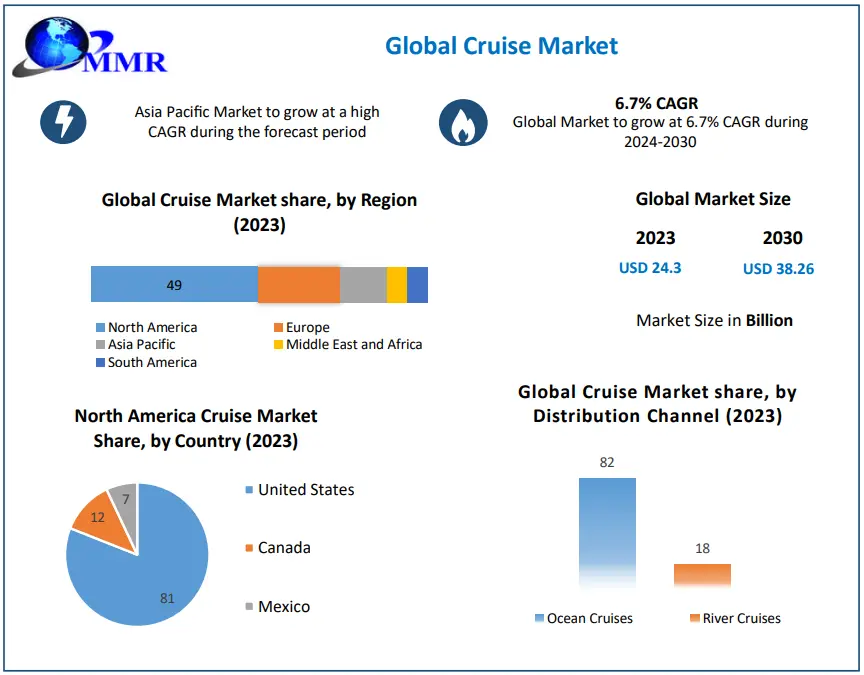
Key Highlights
- Cruise Market valued at USD 19.41 Billion in 2025
- Expected to reach USD 33.21 Billion by 2032
- Forecast CAGR of 7.97% from 2026 to 2032
- Ocean cruises remain the dominant revenue segment
- River cruises emerge as the fastest-growing category
- Fleet modernization and sustainability investments accelerate
- Digital guest experiences and onboard connectivity become competitive differentiators
- Infrastructure expansion supports new deployment opportunities
- Premium and experience-driven travel boosts passenger demand
Why This Matters Now
Cruise operators are entering a new investment cycle as passenger demand, fleet upgrades, and sustainability requirements converge. Companies that modernize vessels, improve fuel efficiency, and enhance digital experiences are gaining pricing power and stronger booking visibility.
For investors, suppliers, shipbuilders, port authorities, and transportation strategists, the market’s next growth phase is increasingly linked to technology adoption, environmental compliance, and premium travel demand rather than simple capacity expansion.
Market Overview
The Cruise Market was valued at USD 19.41 Billion in 2025 and is expected to reach USD 33.21 Billion by 2032, growing at a CAGR of 7.97% during the forecast period.
The industry is benefiting from a structural shift toward experience-based travel. Consumers increasingly view cruises as integrated vacation platforms that combine transportation, accommodation, dining, entertainment, and destination access within a single package.
This change is driving higher passenger volumes and encouraging operators to invest in larger ships, upgraded amenities, and advanced onboard technologies. The result is a market moving beyond recovery toward long-term expansion.
For transportation stakeholders, cruise vessels are evolving into sophisticated mobility ecosystems where operational efficiency, passenger experience, and sustainability increasingly determine competitive advantage.
Key Trends Driving Growth
Fleet modernization is becoming a primary competitive strategy. Cruise operators are deploying newer vessels equipped with advanced propulsion systems, improved energy efficiency, and enhanced passenger amenities.
Sustainability is moving from a compliance issue to a growth strategy. Operators are investing in cleaner technologies and fuel-efficient designs to reduce emissions while meeting tightening environmental standards. These investments support long-term operating margins while improving brand positioning among environmentally conscious travelers.
Digital transformation is also reshaping customer expectations. Advanced connectivity, mobile-based services, personalized onboard experiences, and integrated booking platforms are becoming standard offerings. Companies that successfully digitize the guest journey are strengthening customer retention and increasing onboard spending.
Infrastructure development continues to create new growth corridors. Expanded port facilities, additional homeports, and improved passenger terminals are increasing accessibility and enabling cruise operators to serve new markets.
The rise of experiential travel remains another major catalyst. Travelers increasingly prioritize unique experiences, cultural immersion, and convenience. Cruise operators are responding through destination-focused itineraries, wellness programs, premium dining, and customized excursions.
Request Market Sample Data Covering Demand Analysis and Competitive Trends
Segment Insights
- Dominant Segment: Ocean Cruises
- Ocean cruises account for the largest market share.
- Demand is supported by all-inclusive vacation packages and access to multiple destinations through a single journey.
- Larger vessels allow operators to scale entertainment, dining, and hospitality offerings while improving profitability.
- Fastest-Growing Segment: River Cruises
- River cruises are projected to record the fastest growth.
- Travelers increasingly prefer smaller ships, destination immersion, and access to city centers and cultural attractions.
- Operators benefit from growing demand for personalized and slower-paced travel experiences.
- By Vessel Strategy
- Premium and luxury offerings continue gaining traction.
- Operators are expanding specialized itineraries and experiential packages to attract higher-spending travelers.
- Technology Focus
- Smart ship technologies, enhanced connectivity, and digital service platforms are becoming key differentiators.
- Investments increasingly target operational efficiency alongside customer satisfaction.
Regional Growth Story
North America continues to represent one of the most influential cruise markets. Strong consumer spending on travel, established cruise infrastructure, and the presence of major operators support sustained growth.
Europe remains a critical market due to extensive cruise routes and strong demand for Mediterranean, Northern European, and river cruise experiences. Investments in modern vessels and destination-focused travel products continue to attract repeat travelers.
Asia-Pacific is emerging as a major expansion region. Growing middle-class populations, rising disposable incomes, and improving port infrastructure are creating new demand. Cruise operators are tailoring itineraries and onboard experiences to regional preferences to capture first-time passengers.
Markets such as China, Japan, India, South Korea, and Singapore are becoming increasingly important to future deployment strategies. Infrastructure investments and expanding tourism ecosystems strengthen the region’s long-term outlook.
Competitive Landscape
The competitive environment is shifting toward scale, operational efficiency, and experience differentiation.
Major operators are focusing on fleet modernization rather than simply increasing vessel numbers. This signals a strategic emphasis on yield optimization, sustainability performance, and customer retention.
Investments in larger and technologically advanced ships provide greater pricing flexibility while improving onboard revenue opportunities. Operators capable of combining premium experiences with efficient operations are positioned to strengthen market share.
Competition is increasingly driven by digital engagement, itinerary innovation, sustainability credentials, and service quality. These factors are becoming more influential than traditional capacity metrics.
For suppliers, the transition creates opportunities in marine technology, shipbuilding, digital systems, connectivity solutions, energy management, and port infrastructure.
Recent Developments
- Fleet modernization programs continue across major cruise operators.
- Investments in fuel-efficient and environmentally sustainable vessels are accelerating.
- Digital passenger engagement platforms are expanding across fleets.
- Port infrastructure upgrades are supporting larger ship deployments.
- Premium and experience-focused itineraries are gaining strategic importance.
- Cruise companies are enhancing onboard entertainment, wellness, and dining offerings to increase passenger spending.
Strategic Implications
The Cruise Market increasingly resembles a technology-enabled transportation and hospitality ecosystem.
Operators investing in sustainability gain advantages in regulatory compliance, operating efficiency, and customer perception. Those delaying modernization may face rising operational costs and weaker competitive positioning.
Infrastructure developers benefit from increasing demand for upgraded ports and passenger facilities. Shipbuilders and marine technology suppliers gain opportunities as fleet renewal cycles accelerate.
The market also highlights growing convergence between transportation, tourism, digital services, and environmental innovation. Companies capable of integrating these capabilities are likely to capture disproportionate value.
Future Outlook
The next phase of growth will be defined by sustainable fleet investments, digital passenger experiences, infrastructure expansion, and premium travel demand. Market leaders will be those that transform ships into highly efficient, technology-enabled travel ecosystems while laggards remain constrained by aging fleets and limited innovation.
Analyst Perspective
“The Cruise Market is entering a period where operational efficiency, sustainability investments, and differentiated passenger experiences will determine competitive success. Companies that modernize fleets, embrace digital technologies, and align with changing traveler expectations will be best positioned to capture future growth opportunities.” — Tejaswini Kakade
About Maximize Market Research
Maximize Market Research Pvt. Ltd. (MMR) is a global market research and consulting company that provides reliable, data-focused, and practical business insights. The firm serves a wide range of industries, including healthcare, pharmaceuticals, technology, automotive, electronics, chemicals, personal care, and consumer goods. Through market forecasts, competitive analysis, strategic consulting, and industry impact assessments, MMR helps organizations understand changing market conditions, identify growth opportunities, and make informed business decisions for long-term success.
Contact Us
2nd Floor, Navale IT Park Phase 3
Pune Banglore Highway, Narhe
Pune, Maharashtra 411041, India
+91 9607365656
sales@maximizemarketresearch.com
