Key Highlights
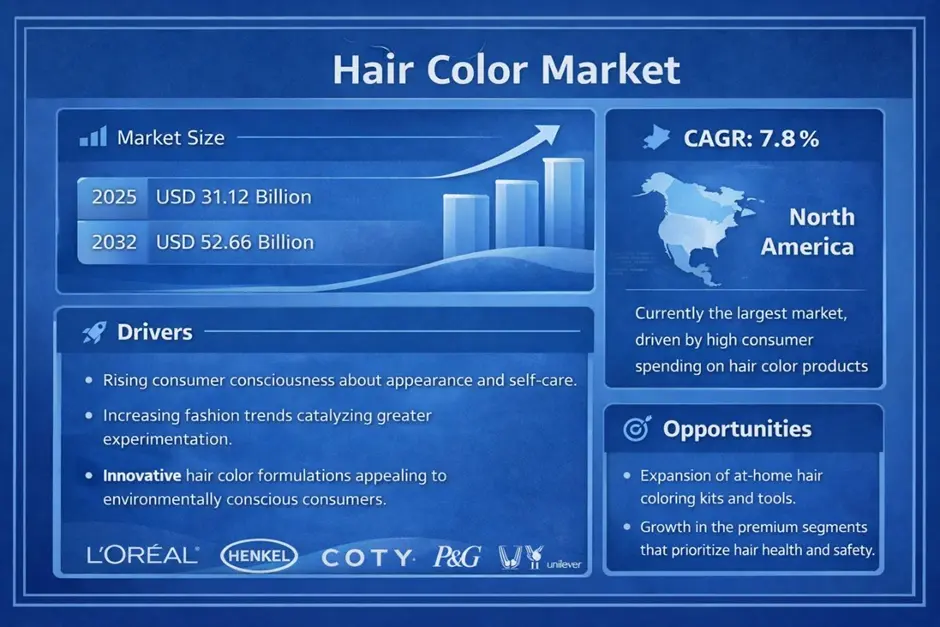
- The Hair Color Market was valued at USD 31.12 billion in 2025 and is expected to reach USD 52.66 billion by 2032, growing at a CAGR of 7.8%.
- Permanent hair color remains the dominant segment due to demand for long-lasting color and gray coverage.
- Demi-permanent hair color is emerging as a high-growth category as consumers seek lower-damage alternatives.
- North America remains the largest regional market, supported by premiumization and strong salon infrastructure.
- Consumer demand is shifting toward ammonia-free, natural, vegan, and low-peroxide formulations.
- E-commerce continues to alter purchasing behavior, with home delivery and direct-to-consumer channels gaining traction.
- Industry competition is moving toward premium positioning, professional-grade performance, and portfolio expansion.
Why This Matters Now
Beauty categories rarely stay static. Hair color is changing faster than many executives expected.
Consumers no longer view hair color as a maintenance product. They increasingly treat it as a form of self-expression, identity, and personal wellness. That shift is forcing manufacturers, retailers, salons, and ingredient suppliers to rethink product development, distribution, and brand positioning.
The implications are significant. A market expected to expand from USD 31.12 billion in 2025 to USD 52.66 billion by 2032 signals sustained demand, but growth is concentrating around brands that can deliver personalization, cleaner formulations, and seamless digital experiences. Every percentage point of growth increasingly depends on innovation rather than distribution alone.
Market Overview
The global Hair Color Market is entering a new phase of expansion. Growth is being fueled by rising demand across both salon-based and at-home applications, supported by increasing consumer attention to grooming and appearance. The market is also benefiting from product innovation focused on natural ingredients, sustainability, and reduced chemical exposure.
The business model itself is changing. Traditional mass-market color products remain important, but value creation is shifting toward premium formulations, personalized solutions, and professional-grade products available through both salons and digital channels. That transition is raising barriers for competitors that rely primarily on price-based competition.
Key Trends Driving Growth
Health-conscious purchasing behavior is becoming a defining force across the category. Consumers increasingly seek ammonia-free, natural, vegan, and low-peroxide products. This is not simply a formulation trend. It is reshaping product portfolios, ingredient sourcing strategies, and marketing investments.
Temporary and semi-permanent color solutions are gaining momentum among younger consumers. Millennials and Gen Z increasingly favor flexibility over permanence, creating demand for products that allow experimentation without long-term commitment. This trend expands usage frequency and introduces new product development opportunities.
Digital commerce continues to influence buying behavior. A growing share of consumers prefer retailers that offer home delivery of hair coloring products. At the same time, salons and beauty supply stores are expanding digital capabilities, creating hybrid purchasing journeys that combine online convenience with professional expertise.
Premiumization is another major growth engine. Consumers are increasingly willing to spend more on a single high-quality color treatment rather than multiple lower-value products. This shift is supporting stronger margins for brands capable of delivering differentiated performance and outcomes.
Explore detailed analysis, insights, and growth opportunities
Segment Insights
- Dominant Segment: Permanent Hair Color
- Permanent hair color holds the largest market share.
- Demand is driven by long-lasting results and effective gray hair coverage.
- Premium and customized color treatments continue to strengthen the segment’s leadership position.
- Fastest-Growing Segment: Demi-Permanent Hair Color
- Consumers increasingly favor less damaging alternatives.
- The category appeals to users seeking vibrant color without the commitment of permanent solutions.
- Growth signals rising demand for balance between performance and hair health.
- Temporary and semi-permanent solutions continue to gain popularity among younger demographics.
- Personalized color treatments are creating opportunities for premium offerings.
- At-home professional-quality products are expanding the addressable consumer base.
Regional Growth Story
North America remains the largest market for hair color products globally. Strong consumer spending on beauty products, established salon networks, and high penetration of premium brands continue to support market leadership. The popularity of at-home coloring kits further strengthens regional demand.
Europe remains an important market driven by established beauty consumption patterns and premium product adoption. Meanwhile, Asia-Pacific is emerging as one of the most dynamic growth regions as beauty consciousness rises and consumers increasingly embrace color experimentation.
For multinational brands, regional growth strategies increasingly require localization. Product preferences, color trends, and purchasing channels vary significantly across markets, making one-size-fits-all approaches less effective.
Competitive Landscape
Competition is shifting from product breadth to product relevance.
A major signal came in June 2025 when L’Oréal agreed to acquire Color Wow. The transaction expands L’Oréal’s presence in premium and professional hair care while strengthening its position in high-performance formulations. The broader implication is clear: scale alone is no longer enough. Market leaders are acquiring innovation platforms that can accelerate premium growth and strengthen salon relationships.
Revlon’s introduction of 8.18 Immersive Nude Blonde demonstrates a parallel competitive strategy. Rather than competing on color selection alone, manufacturers are increasingly integrating advanced cosmetic science and haircare benefits into color products. This raises consumer expectations and pressures rivals to invest more aggressively in R&D.
Over the next 12–24 months, competitive advantage is likely to depend on three factors: premium positioning, clean formulation innovation, and digital consumer engagement. Companies unable to compete across all three dimensions may face increasing margin pressure.
Recent Developments
- June 2025: L’Oréal agreed to acquire Color Wow, strengthening its professional and premium hair portfolio.
- January 2025: Revlon launched 8.18 Immersive Nude Blonde within its Revlonissimo Colorsmetique range, combining advanced color performance with haircare benefits.
- Expansion of digital sales channels continues across salons and beauty retailers.
- Industry investment remains focused on natural, vegan, and low-peroxide formulations.
Strategic Implications
Executives should view the Hair Color Market as a convergence point between beauty, wellness, and digital commerce.
Growth opportunities increasingly sit at the intersection of personalization and clean beauty. Consumers are rewarding brands that combine professional-grade performance with ingredient transparency. Companies that continue to treat hair color as a commodity risk losing relevance.
Channel strategy is equally important. Digital convenience is becoming a baseline expectation, while salons remain critical influence centers for premium adoption. The winners will integrate both environments rather than choose between them.
Future Outlook
The next stage of market growth will be defined less by color selection and more by formulation quality, personalization, and consumer trust.
As natural ingredients, premium treatments, and digital engagement become standard expectations, companies that innovate around consumer lifestyles will capture disproportionate value. Those that fail to evolve beyond traditional dye products may find themselves competing in a shrinking pool of low-margin demand.
By 2032, the winners will be brands that combine science, sustainability, and personalization; the losers will be those still selling color when consumers are buying identity.
Analyst Perspective
“The Hair Color Market is moving beyond conventional beauty routines toward personalized, premium, and health-conscious solutions. Companies that align product innovation with evolving consumer expectations around sustainability, convenience, and performance will be best positioned to capture the next wave of industry growth.” — Siddhi Dole, Analyst
About Maximize Market Research
Maximize Market Research Pvt. Ltd. (MMR) is a global market research and consulting company that provides reliable, data-focused, and practical business insights. The firm serves a wide range of industries, including healthcare, pharmaceuticals, technology, automotive, electronics, chemicals, personal care, and consumer goods. Through market forecasts, competitive analysis, strategic consulting, and industry impact assessments, MMR helps organizations understand changing market conditions, identify growth opportunities, and make informed business decisions for long-term success.
Contact Us :
2nd Floor, Navale IT Park Phase 3
Pune Banglore Highway, Narhe
Pune, Maharashtra 411041, India
+91 9607365656
sales@maximizemarketresearch.com
