Key Highlights
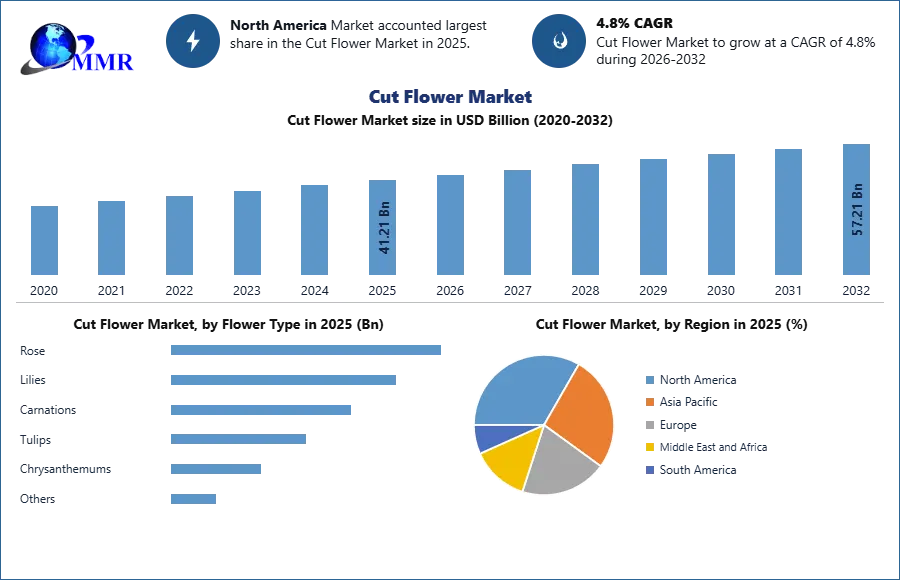
- Global Cut Flower Market valued at USD 41.21 billion in 2025.
- Market projected to reach USD 57.21 billion by 2032.
- Expected CAGR of 4.8% during 2026–2032.
- Rising global flower trade continues to expand international demand.
- Weddings, festivals, and corporate events remain major consumption drivers.
- Premium flower varieties are gaining traction across developed and emerging markets.
- Sustainability and environmentally responsible cultivation are becoming competitive differentiators.
- Technology-enabled cultivation and logistics are improving quality and shelf life.
Why This Matters Now
The flower business is becoming a global supply-chain story rather than a seasonal retail category. Demand is rising across weddings, hospitality, festivals, corporate events, and premium gifting at the same time growers face pressure to improve freshness, sustainability, and profitability.
The market’s projected rise from USD 41.21 billion in 2025 to USD 57.21 billion by 2032 signals a significant expansion opportunity for producers, exporters, distributors, and retailers. For industry participants, growth is no longer about producing more flowers. It is about delivering premium quality faster and more sustainably.
Market Overview
The Cut Flower Market is entering a new phase of commercialization. Traditional floral demand remains strong, but growth is increasingly supported by premiumization, digital commerce, and global trade expansion.
Roses, lilies, carnations, orchids, tulips, and gerberas continue to dominate consumer purchases because they combine visual appeal with longer vase life. Their popularity creates stable demand across gifting, decoration, hospitality, and event applications.
International flower shipments continue to expand as importing countries seek reliable year-round supplies. This has strengthened the role of major exporting hubs and reinforced the importance of efficient logistics networks.
The result is a market where cultivation expertise alone is no longer enough. Supply chain performance, sustainability credentials, and product differentiation increasingly determine competitive success.
Key Trends Driving Growth
Global flower trade remains one of the market’s strongest growth engines. International exports increased in 2025, supported by demand from Europe, North America, and Asia. This creates opportunities for growers that can meet quality and delivery expectations consistently.
Event-driven demand continues to support large-scale consumption. Weddings, festivals, corporate gatherings, and hospitality venues require fresh floral arrangements throughout the year, providing recurring revenue streams for suppliers.
Premiumization is reshaping purchasing behavior. Consumers are increasingly willing to spend more on premium bouquets, rare flower varieties, and customized arrangements. This shift is expanding margins for producers capable of delivering differentiated products.
Sustainability has moved from a niche consideration to a purchasing criterion. Buyers increasingly favor environmentally responsible cultivation practices, reduced waste, and more efficient transportation methods.
Technology adoption is also influencing market economics. Advanced cultivation techniques, improved cold-chain systems, and logistics optimization are helping suppliers extend shelf life and reduce spoilage.
Request Your Sample Report to Explore Future Industry Potential
Segment Insights
- Dominant Segment: Roses
- Roses remain the leading flower category due to their universal appeal and year-round demand.
- Their strong presence across gifting, weddings, hospitality, and decorative applications supports sustained market leadership.
- Fastest-Growing Segment: Premium Floral Varieties
- Demand for distinctive flowers, designer arrangements, and high-value floral products continues to rise.
- Consumers increasingly seek personalization and premium aesthetics, creating growth opportunities beyond traditional offerings.
- Application Trends
- Commercial consumption remains a major revenue generator.
- Hospitality, corporate spaces, event organizers, and floral retailers continue to drive bulk purchasing.
- Distribution Trends
- Digital ordering and modern retail channels are expanding accessibility.
- Convenience-driven purchasing is supporting higher transaction volumes across urban markets.
Regional Growth Story
Europe remains a critical center of the global flower trade. The region’s established import infrastructure, mature consumer base, and strong floral culture continue to support substantial demand.
The Netherlands maintains its strategic role as a global trading hub. Its extensive logistics capabilities and export infrastructure make it a key gateway for international flower distribution.
Asia is emerging as a major growth engine. Rising disposable incomes, urbanization, and increasing spending on celebrations and gifting are expanding floral consumption across the region.
North America continues to generate strong demand through retail, hospitality, corporate events, and personal gifting segments. The region’s preference for premium floral products supports higher-value transactions.
Competitive Landscape
Competition is shifting from production scale toward supply-chain excellence and premium positioning.
Leading companies are focusing on quality enhancement, sustainable cultivation, logistics optimization, and product diversification. These investments signal an industry preparing for higher customer expectations rather than simply larger volumes.
For rivals, the message is clear: operational efficiency and premium product offerings will increasingly determine market share. Companies that fail to modernize logistics or invest in sustainability may struggle to compete as buyers place greater emphasis on freshness, transparency, and environmental responsibility.
Over the next 12–24 months, competitive advantages are likely to emerge from technology-enabled cultivation, stronger export networks, and differentiated premium flower portfolios.
Recent Developments
- Increased international flower trade activity supported stronger export volumes in major producing countries.
- Continued investment in advanced cultivation technologies improved flower quality and longevity.
- Sustainability initiatives gained traction across production and distribution networks.
- Premium floral products expanded their presence in both developed and emerging markets.
- Logistics and cold-chain improvements enhanced product freshness across long-distance trade routes.
Strategic Implications
The industry’s next growth cycle will reward businesses that combine premium products with operational efficiency.
Growers should focus on high-value flower varieties, sustainable production methods, and export readiness. Distributors must prioritize cold-chain investments and delivery reliability.
Retailers have opportunities to capture higher margins through premium arrangements, customization, and digital sales channels. Companies that integrate these capabilities will be better positioned to benefit from changing consumer expectations.
Future Outlook
The Cut Flower Market is expected to maintain steady expansion through 2032 as premiumization, sustainability, technology adoption, and global trade continue to reshape industry economics.
The projected increase to USD 57.21 billion by 2032 creates substantial opportunities across the value chain. The winners will build premium brands, resilient supply chains, and sustainable operations; the losers will remain trapped in commodity-style competition where margins continue to narrow.
Analyst Perspective
“The cut flower industry is evolving beyond traditional gifting and decoration. Premiumization, sustainability, and global trade expansion are creating new opportunities for growers, exporters, and retailers. Companies that invest in quality, logistics, and environmentally responsible practices will be best positioned to capture long-term growth.” — Siddhi Dole, Analyst
About Maximize Market Research
Maximize Market Research Pvt. Ltd. (MMR) is a global market research and consulting company that provides reliable, data-focused, and practical business insights. The firm serves a wide range of industries, including healthcare, pharmaceuticals, technology, automotive, electronics, chemicals, personal care, and consumer goods. Through market forecasts, competitive analysis, strategic consulting, and industry impact assessments, MMR helps organizations understand changing market conditions, identify growth opportunities, and make informed business decisions for long-term success.
Contact Us
2nd Floor, Navale IT Park Phase 3
Pune Banglore Highway, Narhe
Pune, Maharashtra 411041, India
+91 9607365656
sales@maximizemarketresearch.com
