Key Highlights
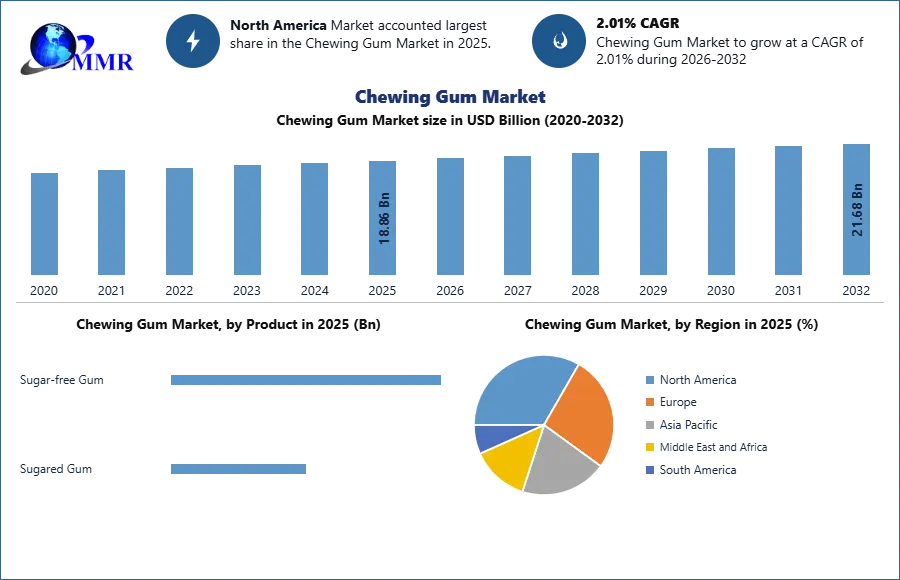
- Chewing Gum Market valued at USD 18.86 Billion in 2025.
- Market expected to reach USD 21.68 Billion by 2032.
- Forecast CAGR stands at 2.01% from 2026 to 2032.
- Sugar-free gum remains both the dominant and fastest-growing segment.
- North America leads global consumption and revenue generation.
- Asia-Pacific is emerging as the fastest-growing regional market.
- Functional gums are expanding the category beyond traditional confectionery.
- Clean-label formulations and sustainability initiatives are influencing product development.
Why This Matters Now
The chewing gum business is facing a strategic crossroads. Consumer expectations have shifted faster than many legacy confectionery categories can adapt.
A market valued at USD 18.86 Billion in 2025 is forecast to reach USD 21.68 Billion by 2032, growing at a CAGR of 2.01%. That growth rate may appear modest, but it signals a deeper transformation. Revenue is increasingly concentrating in health-oriented, functional, and premium segments rather than traditional sugar-based products. Every percentage point of share gained in these categories now carries disproportionate profit implications.
Market Overview
The global Chewing Gum Market is evolving from an impulse-purchase confectionery category into a wellness-adjacent consumer product market. Oral health awareness, calorie-conscious consumption, and demand for convenient functional products are redefining purchasing decisions.
Consumers increasingly view gum as a practical tool for fresh breath, dental care, smoking cessation, energy enhancement, and nutritional supplementation. That shift changes competitive dynamics. Brands are no longer competing only on flavor. They are competing on functionality, ingredient transparency, and health outcomes.
The result is a category that looks increasingly similar to consumer wellness products rather than traditional confectionery.
Key Trends Driving Growth
Health and wellness have become the industry’s primary growth engine. Sugar-free products account for nearly 58–60% of market share globally, supported by growing awareness of oral hygiene and lower-calorie consumption. The business implication is clear: future category growth is being driven by health positioning rather than indulgence.
Functional gum is creating entirely new demand pools. Products infused with vitamins, probiotics, nicotine, energy ingredients, and wellness-focused additives are attracting consumers seeking convenient delivery formats. This expands category relevance beyond traditional chewing occasions.
Flavor innovation remains critical. Manufacturers are investing in long-lasting flavor technologies, hybrid flavor combinations, and multilayer gum formats. This signals intensifying competition for consumer attention in a mature category where differentiation is increasingly difficult.
Clean-label demand is gaining momentum across developed markets. Consumers are scrutinizing artificial sweeteners, synthetic ingredients, and manufacturing processes more closely than ever. As a result, natural ingredients and simplified formulations are becoming competitive advantages.
Sustainability is also moving from a niche concern to a mainstream business priority. Biodegradable gum alternatives and eco-friendly formulations are creating new opportunities for manufacturers willing to invest in product redesign and material innovation.
Digital commerce is contributing to market accessibility. Online platforms increasingly support premium, niche, and functional gum products that may struggle to secure shelf space in traditional retail channels. This lowers barriers for innovation-focused entrants.
𝐃𝐨𝐰𝐧𝐥𝐨𝐚𝐝 𝐏𝐃𝐅 𝐁𝐫𝐨𝐜𝐡𝐮𝐫𝐞 @https://www.maximizemarketresearch.com/request-sample/27775/
Segment Insights
- Dominant Segment: Sugar-Free Gum
- Accounted for more than 55–60% of the global market.
- Growth supported by oral-care benefits, reduced calorie content, and dentist-endorsed ingredients such as xylitol.
- Strong performance across supermarkets, pharmacies, and online channels.
- Fastest-Growing Segment: Sugar-Free Gum
- Benefiting from preventive health trends and sugar-reduction initiatives.
- Enhanced by innovations including whitening benefits, vitamin-infused formulations, natural sweeteners, and long-lasting flavor technologies.
- Continues to outperform traditional sugar-containing alternatives.
- Sugar-containing gum remains relevant in developing markets due to affordability and established consumer habits.
- However, increasing awareness of sugar-related health concerns continues to pressure long-term growth prospects.
Regional Growth Story
North America remains the largest regional market, accounting for approximately 33–35% of global share. Strong consumer adoption of sugar-free and functional gum products continues to support leadership. The implication for manufacturers is that premium innovation remains essential for maintaining share in mature markets.
Europe holds roughly 27–29% of market share and benefits from growing demand for natural, premium, and clean-label products. Regulatory focus on ingredients and sustainability is accelerating product reformulation efforts.
Asia-Pacific represents the industry’s most significant growth opportunity. With approximately 26–28% market share and the fastest growth outlook, the region is benefiting from rising disposable incomes, urbanization, and increasing interest in health-focused products. Countries such as India, China, Indonesia, and Vietnam are becoming critical expansion targets for global manufacturers.
For investors and category leaders, Asia-Pacific increasingly represents the difference between incremental growth and meaningful market expansion.
Competitive Landscape
The market remains highly concentrated among major multinational players including Mars Wrigley, Mondelez International, Perfetti Van Melle, Lotte Confectionery, and Cloetta. Together, leading manufacturers command a substantial share of global sales through scale, distribution reach, and brand strength.
What matters strategically is not merely who leads today, but how they are competing.
Industry leaders are directing investment toward sugar-free formulations, functional products, flavor technology, and sustainability initiatives. This signals where future profit pools are expected to emerge. Companies that continue relying on traditional confectionery positioning risk gradual share erosion.
Competitive activity also suggests that the next 12–24 months will focus on wellness-oriented innovation, clean-label claims, and premium product differentiation. Rivals unable to match R&D intensity may find themselves competing primarily on price, a difficult position in a category facing input-cost pressures.
Regional players are pursuing localized flavors and value-focused offerings, creating competitive pressure in emerging markets where consumer preferences remain highly diverse.
Recent Developments
- Expansion of sugar-free product portfolios across major manufacturers.
- Increased investment in functional gum categories including nicotine, vitamin, probiotic, and energy gum.
- Growing adoption of clean-label formulations using natural ingredients.
- Development of biodegradable and environmentally conscious gum alternatives.
- Continued innovation in flavor delivery systems and long-lasting taste technologies.
Strategic Implications
The industry’s future will be determined by how effectively companies reposition gum as a wellness product rather than a confectionery item.
Manufacturers must balance three priorities simultaneously: health-focused innovation, sustainability commitments, and premium consumer experiences. Failure in any one area could limit competitiveness as consumer expectations continue to evolve.
Distribution strategy is also changing. Pharmacies, e-commerce platforms, and health-focused retail channels are becoming increasingly important alongside traditional convenience-store networks. Companies that diversify channel exposure will likely capture higher-value consumer segments.
Future Outlook
The Chewing Gum Market is expected to reach USD 21.68 Billion by 2032, supported by health-conscious consumption patterns, sugar-free adoption, functional product innovation, and rising demand across emerging markets.
Growth will not be distributed evenly. The strongest gains will accrue to companies that successfully combine wellness benefits, clean-label credentials, and sustainability into compelling consumer propositions. Those that continue competing solely as traditional confectionery brands risk being left behind as the category’s value migrates toward functional and health-oriented products.
Analyst Perspective
“The next phase of growth in the chewing gum industry will be defined less by traditional confectionery consumption and more by wellness-driven innovation. Companies that align product development with health, functionality, and sustainability trends will be best positioned to capture long-term value creation opportunities.” — Siddhi Dole
About Maximize Market Research
Maximize Market Research Pvt. Ltd. (MMR) is a global market research and consulting company that provides reliable, data-focused, and practical business insights. The firm serves a wide range of industries, including healthcare, pharmaceuticals, technology, automotive, electronics, chemicals, personal care, and consumer goods. Through market forecasts, competitive analysis, strategic consulting, and industry impact assessments, MMR helps organizations understand changing market conditions, identify growth opportunities, and make informed business decisions for long-term success.
2nd Floor, Navale IT Park Phase 3
Pune Banglore Highway, Narhe
Pune, Maharashtra 411041, India
+91 9607365656
sales@maximizemarketresearch.com
