Key Highlights
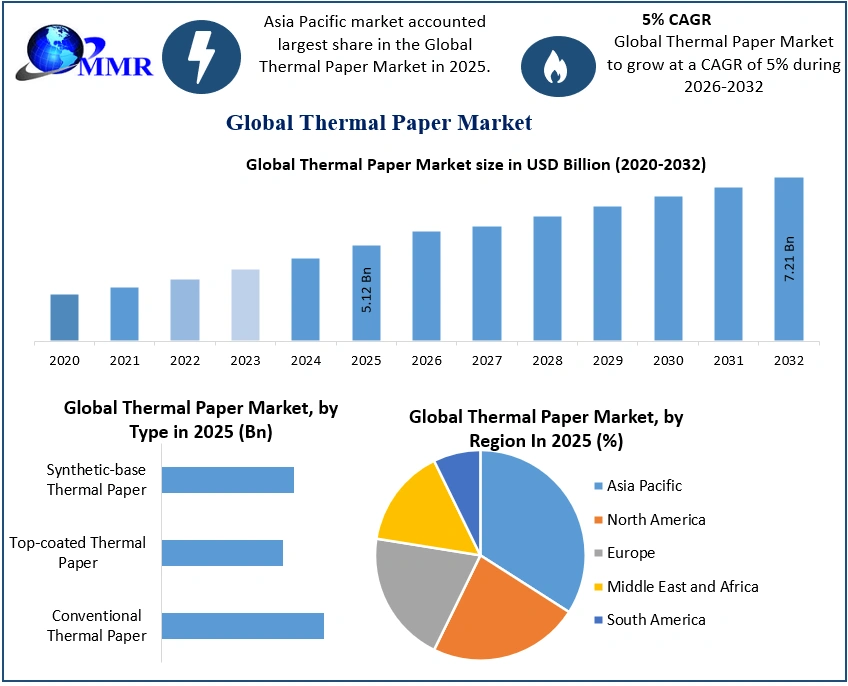
- The Thermal Paper Market was valued at USD 5.12 Billion in 2025 and is expected to reach USD 7.21 Billion by 2032, growing at a CAGR of 5%.
- Retail automation and expanding transaction volumes continue to support demand for thermal paper products.
- E-commerce growth is increasing consumption of thermal labels and shipping documentation.
- Food and beverage supply chains are creating new opportunities through traceability and labeling requirements.
- Asia-Pacific remains a critical growth engine due to manufacturing expansion and retail modernization.
- Competitive activity is increasingly centered on localized production, supply chain control, and product innovation.
Why This Matters Now
The thermal paper business faces a paradox. Digital transactions are expanding globally, yet demand for physical transaction records, labels, and logistics documentation continues to rise.
For FMCG and food and beverage companies, this matters because thermal paper sits at the intersection of retail operations, inventory visibility, compliance, and customer experience. The market’s projected rise from USD 5.12 billion in 2025 to USD 7.21 billion by 2032 signals that physical information tracking remains a critical layer of modern commerce. Every percentage point of growth translates into stronger demand across retail checkout systems, warehouse operations, food labeling, and distribution networks.
Market Overview
The Thermal Paper Market is entering a new phase driven less by traditional receipt printing and more by the operational requirements of modern commerce.
Retailers, logistics operators, food processors, and packaging companies increasingly depend on thermal paper for rapid, low-maintenance printing. Thermal technology eliminates the need for ink and ribbons, reducing operational complexity while supporting high-volume printing environments. This efficiency has made thermal paper a preferred medium for receipts, shipping labels, inventory tags, tickets, and product identification.
The market’s expansion reflects a broader shift in global supply chains. As e-commerce networks grow and fulfillment operations become more sophisticated, businesses require faster and more reliable labeling systems. Thermal paper has become a foundational component of that infrastructure.
Key Trends Driving Growth
Retail digitization continues to increase transaction volumes across supermarkets, convenience stores, restaurants, and organized retail chains. While consumers increasingly pay electronically, businesses still require printed receipts and operational documentation. That combination sustains demand despite ongoing digital transformation.
E-commerce is creating a second growth engine. Every package moving through a fulfillment network requires labels, tracking information, and inventory identification. Thermal paper’s speed and cost advantages make it a preferred solution for these applications.
Food and beverage companies are also increasing thermal paper usage through labeling requirements. Expiry dates, batch identification, storage instructions, and traceability systems have become more important as regulatory scrutiny and consumer expectations rise. Thermal printing supports rapid label generation while maintaining operational efficiency.
Technology innovation remains another catalyst. Improved thermal printing performance, enhanced image durability, and specialized applications are expanding use cases beyond traditional receipts. These developments are helping suppliers defend market relevance in an increasingly digital environment.
𝐃𝐨𝐰𝐧𝐥𝐨𝐚𝐝 𝐏𝐃𝐅 𝐁𝐫𝐨𝐜𝐡𝐮𝐫𝐞 @https://www.maximizemarketresearch.com/request-sample/54813/
Segment Insights
- Dominant Segment: Point-of-Sale (POS) applications remain the largest segment, accounting for the majority of market demand. Growth is tied directly to retail expansion, supermarket penetration, and increasing deployment of modern checkout systems.
- Fastest-Growing Segment: Tags and Labels represent the fastest-growing application category. The acceleration of e-commerce, warehousing, and inventory management is increasing demand for thermal labeling solutions across supply chains.
- Direct Thermal technology continues to dominate because of its simplicity, cost efficiency, and broad adoption across logistics and retail environments.
- Thermal Transfer technology is gaining momentum where long-term label durability and regulatory compliance are essential, particularly in food, beverage, and pharmaceutical applications.
Regional Growth Story
Asia-Pacific remains the most influential region in the thermal paper ecosystem. Manufacturing expansion, retail modernization, and rising consumption levels continue to drive demand across the region. Increased investment in industrial activity further strengthens requirements for labels, receipts, and operational documentation.
Emerging markets are becoming increasingly important. Expanding retail networks in countries such as India, China, and Brazil are generating sustained demand for thermal paper products. Organized retail growth is particularly significant because it directly increases POS deployment and inventory tracking requirements.
Central and South America are also showing strong momentum. Industrial development and manufacturing activity are creating additional demand for labeling and logistics applications.
For FMCG and food companies, these regional trends indicate where future packaging, distribution, and labeling investments are likely to concentrate.
Competitive Landscape
Competition in the Thermal Paper Market is shifting from volume leadership toward supply chain control.
Major producers are investing in localized manufacturing facilities and regional distribution networks. This strategy signals a growing industry focus on resilience rather than simply scale. Companies want shorter supply chains, faster customer response times, and lower exposure to geopolitical disruptions.
Partnerships with converters and direct relationships with end-users are becoming strategic assets. The move suggests that future market leaders will compete on reliability and service integration as much as product quality.
Product innovation is another important signal. As digital alternatives continue to challenge traditional printing applications, suppliers are investing in higher-performance thermal papers and specialized solutions. This points toward a market that is likely to become more application-specific over the next 12–24 months. Companies unable to differentiate beyond commodity offerings may face increasing margin pressure.
Recent Developments
- Manufacturers continue expanding regional production capabilities to improve supply chain responsiveness.
- Companies are strengthening partnerships with roll converters and distribution networks to ensure consistent supply.
- Product innovation efforts are targeting improved durability, efficiency, and specialized application performance.
- Industry participants are increasingly focusing on localized operations to gain competitive advantages in key growth markets.
Strategic Implications
The next growth cycle will be determined by operational relevance rather than printing volume alone.
For FMCG companies, thermal paper increasingly supports traceability, inventory accuracy, and supply chain visibility. These functions are becoming more important as regulatory requirements tighten and consumers demand greater transparency.
For food and beverage manufacturers, labeling efficiency can directly affect logistics performance, compliance outcomes, and shelf execution. Thermal paper suppliers that align with these operational priorities will capture disproportionate value.
Meanwhile, the rise of e-commerce means logistics applications may become more strategically important than traditional receipt printing over the coming decade.
Future Outlook
The Thermal Paper Market is expected to maintain steady growth through 2032, supported by retail modernization, logistics expansion, and increasing labeling requirements across global supply chains.
Digitalization will continue to pressure some traditional applications. However, the expansion of e-commerce fulfillment, food traceability systems, and inventory management infrastructure is creating new demand pools that offset those challenges.
The companies that treat thermal paper as a supply-chain intelligence tool will gain market share; those that view it as a commodity product risk being left behind.
Analyst Perspective
“The Thermal Paper Market is evolving beyond transaction printing into a critical enabler of retail efficiency, logistics visibility, and product traceability. As e-commerce and organized retail continue to expand, companies that invest in innovation, supply chain resilience, and application-specific solutions will be best positioned to capture long-term value.” — Siddhi Dole, Analyst
About Maximize Market Research
Maximize Market Research Pvt. Ltd. (MMR) is a global market research and consulting company that provides reliable, data-focused, and practical business insights. The firm serves a wide range of industries, including healthcare, pharmaceuticals, technology, automotive, electronics, chemicals, personal care, and consumer goods. Through market forecasts, competitive analysis, strategic consulting, and industry impact assessments, MMR helps organizations understand changing market conditions, identify growth opportunities, and make informed business decisions for long-term success.
2nd Floor, Navale IT Park Phase 3
Pune Banglore Highway, Narhe
Pune, Maharashtra 411041, India
+91 9607365656
sales@maximizemarketresearch.com
