Key Highlights
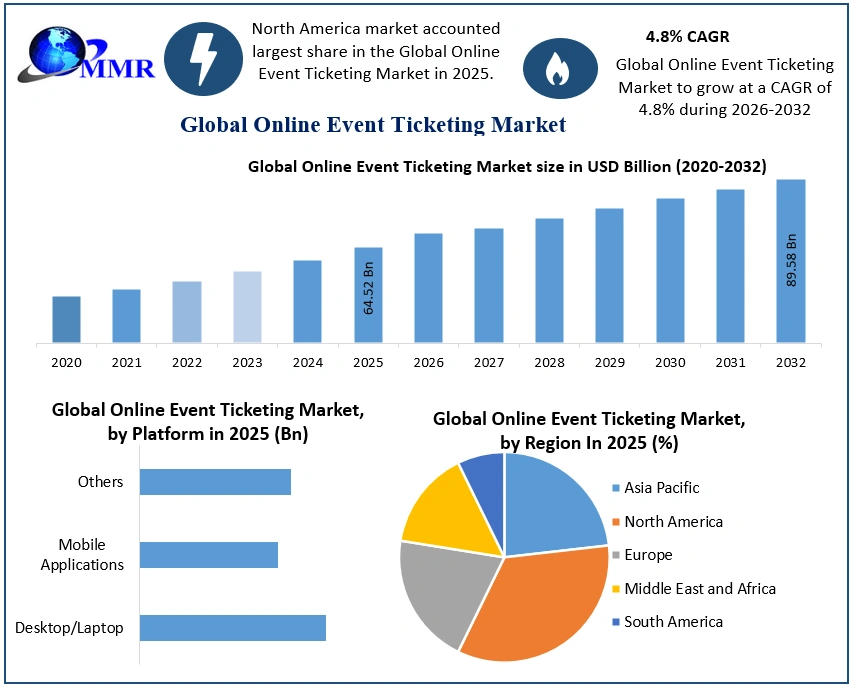
- Online Event Ticketing Market size reached USD 64.52 Billion in 2025.
- Market revenue is projected to reach nearly USD 89.58 Billion by 2032.
- CAGR is expected at 4.8% from 2025 to 2032.
- Digital ticket purchasing continues to replace traditional ticket distribution channels.
- Mobile-first consumer behavior is accelerating platform adoption.
- Event organizers are increasingly using ticketing platforms as customer acquisition and data intelligence tools.
- Competitive activity is shifting toward ecosystem expansion, technology integration, and customer engagement capabilities.
Why This Matters Now
The race for event audiences is no longer happening at venue entrances. It is happening on smartphones, payment gateways, and digital platforms long before an event begins.
A market valued at USD 64.52 billion in 2025 and expected to reach nearly USD 89.58 billion by 2032 signals more than ticket sales growth. It signals the transformation of ticketing platforms into critical infrastructure for the live-experience economy. Every percentage point of market expansion creates new opportunities for organizers to monetize audiences, personalize engagement, and improve event profitability.
Market Overview
The Online Event Ticketing Market Size is entering a phase where technology, consumer convenience, and experience-driven spending are converging. The projected 4.8% CAGR through 2032 indicates sustained demand for digital ticketing solutions across entertainment, sports, cultural events, exhibitions, and other live experiences. That growth trajectory suggests ticketing platforms are becoming an increasingly permanent component of event commerce rather than a supplementary sales channel.
The market’s expansion is closely linked to the growing preference for digital transactions and frictionless purchasing experiences. Consumers increasingly expect instant booking, mobile access, secure payments, and digital entry validation. For operators, this shift translates into lower distribution costs, broader audience reach, and access to valuable customer data.
Key Trends Driving Growth
Digital convenience remains the market’s most powerful growth engine. Consumers increasingly prefer purchasing tickets online due to accessibility, speed, and flexibility. This behavior change reduces dependence on physical sales channels and expands the addressable customer base for organizers.
Mobile ticketing is becoming a core competitive differentiator. As smartphone usage continues to rise, platforms capable of delivering seamless mobile purchasing journeys gain stronger customer retention and higher conversion rates. The business implication is clear: user experience is increasingly becoming a revenue driver.
Data-driven event management is also gaining importance. Ticketing platforms are evolving beyond transaction processing and becoming intelligence hubs that help organizers understand attendance patterns, optimize pricing, and improve marketing efficiency.
Another notable trend is the growing integration of payment technologies. Simplified digital payments reduce purchase friction and support higher transaction volumes. For platform operators, this means stronger customer engagement and repeat purchasing behavior.
E-commerce penetration continues to influence market development. Consumers who have become comfortable with digital purchasing across retail categories increasingly expect the same convenience when buying event tickets. This crossover effect continues to expand online ticket adoption.
Explore detailed analysis, insights, and growth opportunities
Segment Insights
- Dominant Segment: The report identifies the market-leading segment as the dominant contributor to overall revenue generation, supported by broad consumer adoption and established platform penetration.
- Fastest-Growing Segment: The report highlights the fastest-growing segment as a key future growth engine, benefiting from changing consumer engagement patterns and increasing digital accessibility.
- Online channels continue to capture demand from consumers seeking convenience, transparency, and immediate confirmation.
- Technology-enabled ticketing solutions are strengthening organizer capabilities through improved audience targeting and operational efficiency.
- Growth across segments indicates increasing acceptance of digital-first event participation journeys.
Regional Growth Story
Regional competition in the Online Event Ticketing Market increasingly mirrors broader digital economy development patterns. Markets with mature digital payment ecosystems, high internet penetration, and strong live-event industries continue to generate substantial revenue opportunities.
Developed markets benefit from established platform infrastructure and consumer familiarity with online transactions. These regions provide stable revenue streams and support innovation in ticketing technologies.
Emerging economies represent a different growth story. Rising smartphone adoption, expanding internet connectivity, and increasing participation in entertainment and cultural events are creating new demand pools. For market participants, these regions offer opportunities to acquire customers at scale while building long-term platform loyalty.
The regional outlook suggests that future market leadership will depend not only on technology capabilities but also on localization strategies, payment integration, and partnerships with event organizers.
Competitive Landscape
Competition is shifting beyond ticket distribution. The industry’s leading players are increasingly competing on ecosystem strength, customer data capabilities, and platform functionality.
The strategic significance is substantial. Companies that can combine ticket sales, audience analytics, marketing tools, and customer engagement features are positioning themselves closer to event organizers’ core operations. This creates higher switching costs and stronger long-term customer relationships.
For rivals, the message is clear: transaction processing alone is becoming insufficient as a differentiation strategy. Competitive advantage increasingly depends on delivering end-to-end event commerce solutions.
Over the next 12 to 24 months, competitive pressure is likely to intensify around platform integration, personalization capabilities, and customer experience innovation. Companies that fail to expand beyond basic ticketing services may face margin pressure as the market becomes more sophisticated.
Recent Developments
- Digital ticketing platforms continue investing in enhanced customer experience capabilities.
- Increased integration of mobile technologies is improving purchase convenience and event accessibility.
- Market participants are expanding platform functionality to support broader event management requirements.
- Technology adoption is strengthening operational efficiency for both organizers and consumers.
- Competitive activity increasingly focuses on ecosystem expansion rather than standalone ticketing services.
Strategic Implications
For platform providers, growth opportunities increasingly lie in value-added services rather than ticket sales alone. Analytics, marketing automation, audience engagement tools, and integrated payment capabilities can create new revenue streams and strengthen customer retention.
For event organizers, digital ticketing is becoming a strategic business function. The ability to gather customer insights, optimize pricing strategies, and improve attendance forecasting offers measurable commercial advantages.
Investors should view the market through the lens of digital commerce infrastructure. The industry’s future value will likely be driven by platforms that can monetize customer relationships across the entire event lifecycle rather than at the point of ticket purchase alone.
Technology providers also stand to benefit. Demand for cybersecurity, digital payments, customer analytics, and mobile engagement solutions is expected to grow alongside ticketing platform adoption.
Future Outlook
The Online Event Ticketing Market is expected to reach nearly USD 89.58 billion by 2032, supported by sustained digital adoption, expanding mobile commerce, and increasing demand for live experiences. The market’s projected 4.8% CAGR indicates steady momentum rather than short-term acceleration, suggesting long-term structural demand.
The next phase of competition will center on platform intelligence, customer engagement, and ecosystem integration. Ticketing providers that evolve into comprehensive event commerce platforms will capture disproportionate value, while those that remain transaction-focused risk becoming commoditized.
Winners will own audience relationships; losers will remain intermediaries in a market increasingly defined by data, experience, and digital reach.
Analyst Perspective
“The Online Event Ticketing Market is moving beyond digital convenience toward becoming a strategic platform economy. Future growth will be driven not only by ticket transactions but by the ability of providers to help organizers acquire, engage, and retain audiences through integrated digital experiences,” said Siddhi Dole, Analyst.
About Maximize Market Research
Maximize Market Research Pvt. Ltd. (MMR) is a global market research and consulting company that provides reliable, data-focused, and practical business insights. The firm serves a wide range of industries, including healthcare, pharmaceuticals, technology, automotive, electronics, chemicals, personal care, and consumer goods. Through market forecasts, competitive analysis, strategic consulting, and industry impact assessments, MMR helps organizations understand changing market conditions, identify growth opportunities, and make informed business decisions for long-term success.
Contact Us :
2nd Floor, Navale IT Park Phase 3
Pune Banglore Highway, Narhe
Pune, Maharashtra 411041, India
+91 9607365656
sales@maximizemarketresearch.com
