Key Highlights
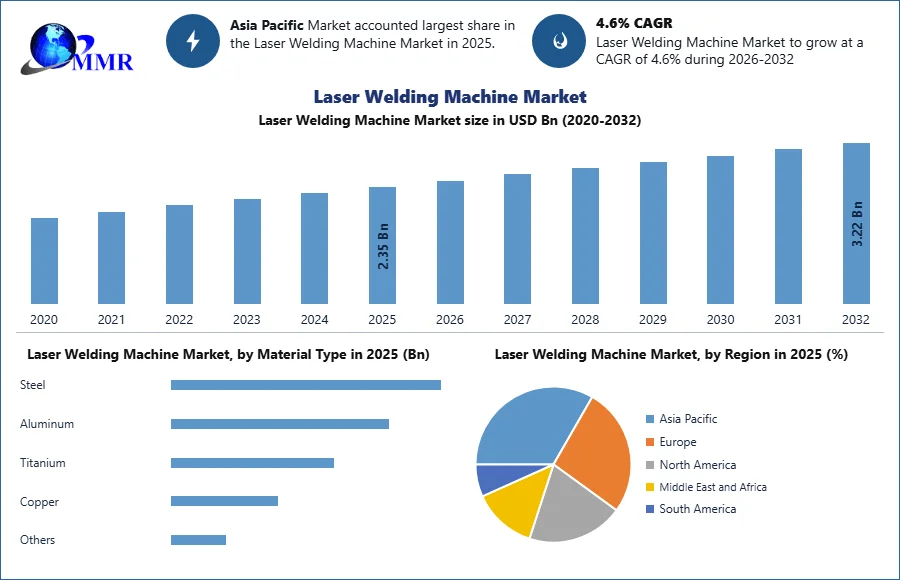
- The Global Laser Welding Machine Market was valued at USD 2.35 Billion in 2025 and is expected to reach nearly USD 3.22 Billion by 2032, growing at a CAGR of 4.6%.
- Manufacturers are increasingly investing in precision welding technologies to improve quality and operational efficiency.
- Industrial automation and smart factory initiatives are accelerating laser welding adoption.
- Automotive, electronics, aerospace, and industrial manufacturing sectors remain key demand generators.
- Fiber laser technology continues to strengthen its position due to efficiency and performance advantages.
- Competitive activity is increasingly focused on automation integration and advanced manufacturing capabilities.
Why This Matters Now
Manufacturers are facing a narrowing margin for error. Production quality, efficiency, and flexibility are becoming decisive competitive factors rather than operational advantages.
The Laser Welding Machine Market‘s projected growth from USD 2.35 billion in 2025 to nearly USD 3.22 billion by 2032 signals a broader transformation in industrial production. Every dollar invested in laser welding technology reflects growing demand for precision, automation, and manufacturing resilience. For equipment suppliers, industrial manufacturers, and investors, the shift represents a strategic evolution in how products are designed and produced.
Market Overview
Laser welding technology has moved beyond specialized industrial applications and become an essential component of modern manufacturing strategies.
Manufacturers increasingly require joining technologies capable of delivering precision, repeatability, and speed. Traditional welding processes remain important, but laser systems offer advantages that align with evolving production requirements. These include reduced material distortion, higher accuracy, faster processing speeds, and greater compatibility with automated production lines.
The market’s expected expansion to nearly USD 3.22 billion by 2032 demonstrates that manufacturers are prioritizing technologies capable of supporting long-term productivity improvements. This is particularly relevant as industries face rising labor costs, increasing quality expectations, and growing pressure to optimize production efficiency.
The trend extends beyond heavy manufacturing. Electronics, medical devices, automotive components, and precision engineering applications increasingly depend on laser welding systems capable of handling complex production requirements.
Key Trends Driving Growth
Industrial automation remains one of the strongest market catalysts.
Manufacturers are increasingly integrating laser welding systems into automated production environments. The objective is straightforward: improve throughput while maintaining consistent product quality. Laser systems align naturally with automation initiatives because they support repeatable and programmable operations.
Precision manufacturing is creating another significant growth driver. Industries producing complex components require joining technologies capable of maintaining strict tolerances. Laser welding enables manufacturers to achieve accuracy levels that support advanced engineering applications.
The rise of Industry 4.0 initiatives is accelerating adoption. Connected production systems increasingly rely on technologies capable of generating data, supporting monitoring systems, and integrating with digital manufacturing environments. Laser welding equipment fits within this broader transformation.
Product quality requirements are also becoming more demanding. Manufacturers face increasing pressure to reduce defects, improve reliability, and enhance product performance. Laser welding technology supports these objectives through highly controlled and consistent processing capabilities.
Sustainability considerations are influencing investment decisions as well. Companies increasingly seek manufacturing technologies that improve resource utilization and operational efficiency. Laser welding systems help reduce material waste while supporting energy-efficient production processes.
𝐃𝐨𝐰𝐧𝐥𝐨𝐚𝐝 𝐏𝐃𝐅 𝐁𝐫𝐨𝐜𝐡𝐮𝐫𝐞 @https://www.maximizemarketresearch.com/request-sample/54605/
Segment Insights
- Dominant Segment: Fiber Laser Welding Machines represent the dominant segment due to their efficiency, operational reliability, and compatibility with modern industrial production environments.
- Fastest-Growing Segment: Automated laser welding systems are emerging as the fastest-growing category as manufacturers accelerate factory automation and smart manufacturing investments.
- Automotive manufacturing remains one of the largest application segments, driven by the need for lightweight materials, precision assembly, and production efficiency.
- Electronics manufacturing continues expanding laser welding adoption due to increasing demand for miniaturized and highly precise components.
- Industrial manufacturing applications are broadening as companies modernize production infrastructure and improve operational capabilities.
Regional Growth Story
Asia-Pacific continues to play a critical role in the global laser welding machine industry.
The region benefits from extensive manufacturing activity, industrial expansion, and increasing investment in advanced production technologies. Countries with strong automotive, electronics, and industrial manufacturing sectors continue driving equipment demand.
North America remains an important market due to its focus on automation, productivity enhancement, and advanced manufacturing initiatives. Manufacturers continue investing in technologies that improve competitiveness and operational efficiency.
Europe maintains strong demand supported by its established automotive, aerospace, and industrial engineering industries. The region’s emphasis on precision manufacturing and technological innovation continues to support laser welding adoption.
The regional growth story highlights a broader industrial trend. Competitive manufacturing increasingly depends on technology investments rather than labor-cost advantages alone.
Competitive Landscape
Competition is increasingly centered on technological sophistication rather than hardware availability.
Manufacturers are investing in automation capabilities, software integration, and advanced system performance. This signals that future market leadership will depend on the ability to deliver complete manufacturing solutions rather than standalone equipment.
Partnerships with automation providers and industrial technology companies indicate a shift toward integrated production ecosystems. For competitors, this means differentiation will increasingly come from connectivity, intelligence, and operational efficiency rather than basic welding functionality.
Product development efforts are also targeting higher-speed processing, improved precision, and greater production flexibility. These investments suggest that customers are demanding systems capable of supporting increasingly complex manufacturing requirements.
Over the next 12–24 months, competition is likely to intensify around automation integration and digital manufacturing compatibility. Equipment suppliers that successfully align with Industry 4.0 priorities may gain significant competitive advantages.
Recent Developments
- Manufacturers continue expanding automation-focused laser welding solutions.
- Investments in fiber laser technology remain a key industry priority.
- Integration with smart manufacturing systems is increasing across product portfolios.
- Industrial equipment providers are enhancing software and monitoring capabilities.
- Advanced precision applications continue driving product innovation efforts.
Strategic Implications
The Laser Welding Machine Market illustrates a broader shift in manufacturing economics.
Companies increasingly compete on production quality, speed, and flexibility. As a result, capital investments are moving toward technologies that deliver measurable operational improvements rather than incremental process enhancements.
For industrial manufacturers, laser welding systems support multiple strategic objectives simultaneously. They improve productivity, enhance product quality, reduce waste, and strengthen automation capabilities.
For investors, the market reflects growing demand for technologies that enable next-generation manufacturing. Equipment suppliers capable of supporting automation and digital transformation initiatives may benefit from sustained long-term demand.
The broader implication is clear: manufacturing competitiveness increasingly depends on technological capability rather than production scale alone.
Future Outlook
The Laser Welding Machine Market is expected to maintain steady growth through 2032 as industrial automation, precision manufacturing, and smart factory investments continue expanding worldwide.
Future growth will likely be driven by deeper integration between welding systems, automation platforms, and digital manufacturing environments. Companies will increasingly evaluate equipment based on its ability to contribute to broader operational transformation goals.
As the market approaches USD 3.22 billion by 2032, the winners will be manufacturers that use laser welding to create smarter and more efficient production systems, while the losers will be those relying on legacy processes in an increasingly precision-driven industrial economy.
Analyst Perspective
“The Laser Welding Machine Market is evolving alongside broader industrial transformation trends. Precision manufacturing, automation, and digital integration are becoming essential requirements for manufacturers seeking long-term competitiveness. Companies that invest in advanced laser technologies today will be better positioned to capture future productivity and quality advantages.” — Siddhi Dole, Analyst
About Maximize Market Research
Maximize Market Research Pvt. Ltd. (MMR) is a global market research and consulting company that provides reliable, data-focused, and practical business insights. The firm serves a wide range of industries, including healthcare, pharmaceuticals, technology, automotive, electronics, chemicals, personal care, and consumer goods. Through market forecasts, competitive analysis, strategic consulting, and industry impact assessments, MMR helps organizations understand changing market conditions, identify growth opportunities, and make informed business decisions for long-term success.
2nd Floor, Navale IT Park Phase 3
Pune Banglore Highway, Narhe
Pune, Maharashtra 411041, India
+91 9607365656
sales@maximizemarketresearch.com
