Key Highlights
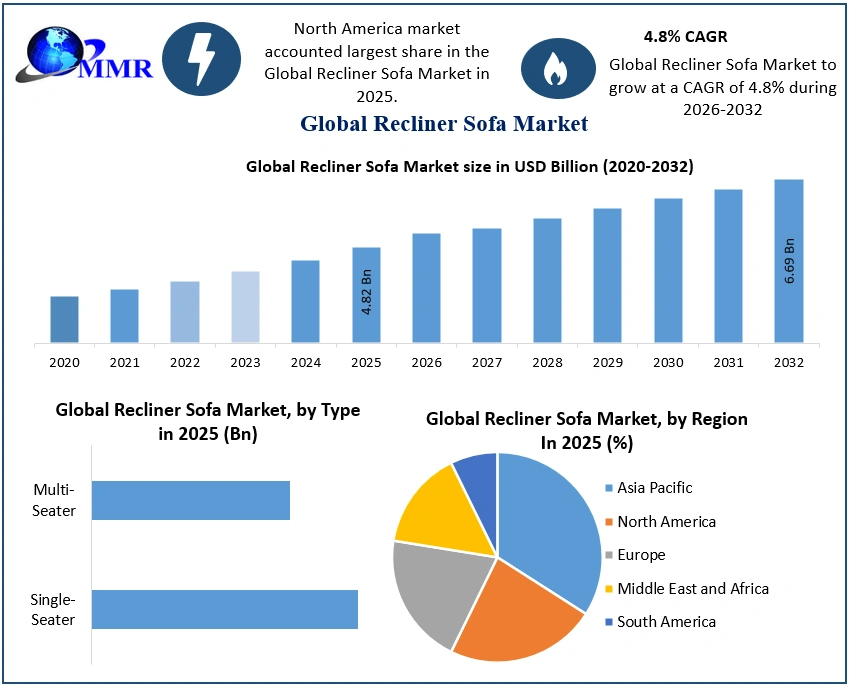
- The Recliner Sofa Market was valued at USD 4.82 Billion in 2025.
- The market is projected to reach nearly USD 6.69 Billion by 2032.
- Revenue is expected to expand at a CAGR of 4.8% from 2026 to 2032.
- Consumers are prioritizing comfort, wellness, and multifunctional living spaces.
- Premium furniture categories continue to gain share in household spending.
- Digital furniture retail channels are reshaping purchasing behavior.
- Manufacturers are investing in innovation, customization, and smart features.
Why This Matters Now
Consumers are spending more time at home, but expectations for home environments have changed faster than many furniture companies anticipated. Comfort is no longer a product feature. It has become a purchasing criterion.
The Recliner Sofa Market reached USD 4.82 Billion in 2025. That valuation signals a substantial consumer commitment to comfort-focused furniture. With the market expected to grow to nearly USD 6.69 Billion by 2032, manufacturers face a new competitive reality: buyers increasingly evaluate furniture based on lifestyle enhancement rather than basic functionality.
Market Overview
The recliner sofa industry sits at the intersection of comfort, wellness, and home design. Consumers are investing in furniture that delivers ergonomic support while complementing modern interior aesthetics.
The projected CAGR of 4.8% through 2032 demonstrates consistent demand despite broader economic uncertainty. For manufacturers, this creates a stable environment for product innovation. For retailers, it supports long-term investment in premium seating categories.
The market’s growth trajectory also reflects changing consumer priorities. Furniture purchases increasingly represent lifestyle investments rather than occasional household expenditures.
As households allocate more spending toward improving living spaces, recliner sofas are becoming central components of home entertainment, relaxation, and wellness strategies.
Key Trends Driving Growth
The home has become a multifunctional environment. It serves as a workplace, entertainment center, social space, and personal retreat. This shift has increased demand for furniture capable of supporting multiple daily activities.
Comfort-driven purchasing behavior is influencing product development. Consumers increasingly seek ergonomic designs that provide physical support during extended periods of sitting.
Premiumization continues to shape the competitive landscape. Buyers are showing greater willingness to invest in higher-quality materials, advanced reclining mechanisms, and enhanced durability.
Technology integration is emerging as another differentiator. Smart furniture features are becoming increasingly relevant as consumers expect seamless interaction between home furnishings and connected lifestyles.
Customization is also gaining importance. Consumers want products that align with personal preferences, room dimensions, and interior design themes. This trend is encouraging manufacturers to expand design flexibility and product options.
Digital commerce continues to influence buying decisions. Furniture brands are improving online visualization tools, digital catalogs, and omnichannel experiences to reduce barriers to high-value purchases.
𝐃𝐨𝐰𝐧𝐥𝐨𝐚𝐝 𝐏𝐃𝐅 𝐁𝐫𝐨𝐜𝐡𝐮𝐫𝐞 @https://www.maximizemarketresearch.com/request-sample/186984/
Segment Insights
- Dominant Segment: Information not specified in the source report.
- Fastest-Growing Segment: Information not specified in the source report.
- Residential applications remain a primary source of market demand.
- Premium recliner categories continue attracting consumer interest.
- Technology-enabled recliner solutions are creating product differentiation opportunities.
- Customization and design flexibility are becoming important purchasing factors.
- Online retail channels are expanding market accessibility and consumer reach.
Regional Growth Story
Urbanization continues to influence furniture purchasing patterns across major economies. Consumers living in cities often prioritize furniture that maximizes comfort without compromising aesthetics or space efficiency.
Developed markets remain important revenue contributors due to strong consumer spending power and established furniture retail networks. These regions often lead adoption of premium and technologically enhanced furniture products.
Emerging markets are creating new opportunities through rising disposable income and expanding middle-class populations. As home ownership and residential investments increase, furniture demand is expected to benefit.
Regional growth is also influenced by evolving lifestyle aspirations. Consumers increasingly view furniture purchases as part of broader home-improvement investments rather than isolated product transactions.
Retail modernization across multiple regions is further supporting accessibility. Improved logistics, digital commerce infrastructure, and omnichannel distribution models are expanding consumer access to premium recliner products.
Competitive Landscape
Competition in the Recliner Sofa Market is increasingly centered on experience rather than furniture alone. Companies are competing to define how consumers relax, entertain, and interact within their living spaces.
This signals a broader shift across the furniture industry. Product differentiation based solely on materials or pricing is becoming less effective. Manufacturers must now compete through design innovation, ergonomics, customization, and technology integration.
For rivals, the message is clear. Companies that fail to invest in premiumization risk being trapped in price-based competition. Those that successfully combine comfort, functionality, and aesthetic appeal are likely to strengthen market positioning.
The next 12 to 24 months are expected to bring increased focus on digital retail capabilities, product personalization, and smart-home compatibility. Competitive advantage will increasingly depend on delivering complete lifestyle solutions rather than standalone furniture products.
Brand loyalty is also expected to become more valuable. As consumers make higher-value furniture investments, trust, product quality, and post-purchase service will play a larger role in purchasing decisions.
Recent Developments
- Continued investment in ergonomic furniture innovation.
- Expansion of premium and luxury recliner product offerings.
- Increased focus on smart and connected furniture technologies.
- Growth of digital furniture retail platforms and omnichannel sales strategies.
- Rising emphasis on customization and personalized product experiences.
Strategic Implications
The projected growth from USD 4.82 Billion in 2025 to nearly USD 6.69 Billion by 2032 highlights the resilience of comfort-focused furniture categories.
Manufacturers should view recliner sofas as part of a broader lifestyle market rather than a standalone furniture segment. Consumers increasingly evaluate products based on wellness benefits, convenience, and long-term value.
Retailers must continue strengthening digital capabilities. Online research plays a growing role in furniture purchasing decisions, even when final transactions occur through physical stores.
Investors should monitor companies that successfully combine premium positioning with scalable distribution models. Businesses capable of balancing innovation, quality, and operational efficiency may be better positioned to capture future growth.
The market also reinforces a larger consumer trend. Spending on products that improve quality of life continues to attract attention even during periods of economic uncertainty.
Future Outlook
The Recliner Sofa Market is positioned for steady expansion as consumers continue prioritizing comfort, functionality, and premium home experiences. Demand is increasingly tied to broader lifestyle trends rather than traditional furniture replacement cycles.
The market’s projected rise to nearly USD 6.69 Billion by 2032 demonstrates sustained confidence in comfort-oriented furniture investments. Manufacturers that successfully integrate design, technology, and personalization into their offerings are likely to benefit from this transition.
As the furniture industry evolves, competitive advantage will increasingly depend on creating products that support how people live rather than simply furnishing where they live. The winners will build lifestyle ecosystems around comfort; the losers will remain trapped in commodity furniture economics.
Analyst Perspective
“The Recliner Sofa Market is being shaped by a powerful convergence of comfort, wellness, and lifestyle-driven purchasing behavior. Consumers increasingly expect furniture to deliver both functional value and enhanced living experiences. Companies that align innovation with these evolving expectations will be best positioned to capture long-term growth opportunities.” — Siddhi Dole, Analyst
About Maximize Market Research
Maximize Market Research Pvt. Ltd. (MMR) is a global market research and consulting company that provides reliable, data-focused, and practical business insights. The firm serves a wide range of industries, including healthcare, pharmaceuticals, technology, automotive, electronics, chemicals, personal care, and consumer goods. Through market forecasts, competitive analysis, strategic consulting, and industry impact assessments, MMR helps organizations understand changing market conditions, identify growth opportunities, and make informed business decisions for long-term success.
2nd Floor, Navale IT Park Phase 3
Pune Banglore Highway, Narhe
Pune, Maharashtra 411041, India
+91 9607365656
sales@maximizemarketresearch.com
