Key Highlights
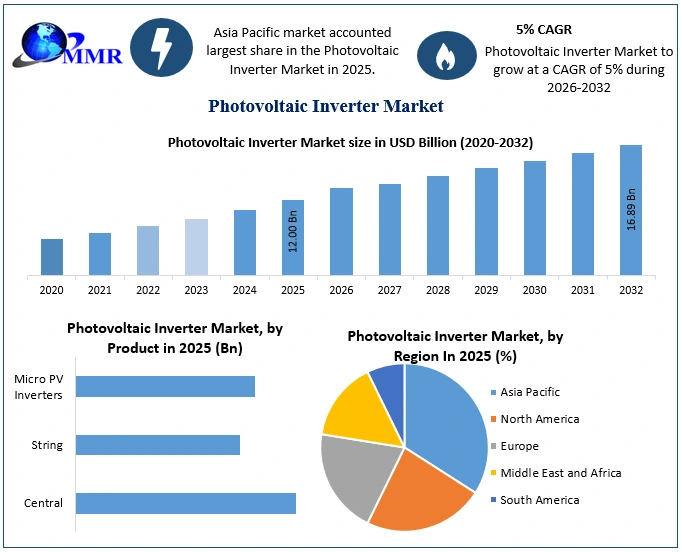
- Photovoltaic Inverter Market size stood at USD 12.00 billion in 2025.
- Market revenue is projected to reach nearly USD 16.89 billion by 2032.
- The market is expected to expand at a CAGR of 5% between 2026 and 2032.
- Solar deployment continues to create sustained demand for inverter technologies.
- Grid modernization initiatives are increasing the strategic importance of advanced inverter systems.
- Energy transition investments are strengthening long-term market fundamentals.
Why This Matters Now
The race to add renewable energy capacity is no longer centered on solar panels alone. The critical bottleneck is increasingly the infrastructure that converts, manages, and integrates solar power into modern electricity networks.
The Photovoltaic Inverter Market, valued at USD 12.00 billion in 2025, is expected to reach nearly USD 16.89 billion by 2032. That growth signals more than rising equipment sales. It indicates a broader shift toward grid-ready renewable energy systems capable of supporting national decarbonization targets and energy security strategies.
Market Overview
Photovoltaic inverters Market Size remain one of the most important components in solar energy systems. They convert direct current generated by solar panels into alternating current suitable for commercial, residential, industrial, and utility applications.
As solar capacity expands globally, inverter deployment grows in parallel. Every new solar installation requires power conversion technology, making inverters an indispensable link in the renewable energy value chain.
The market’s projected 5% CAGR through 2032 indicates steady expansion rather than speculative growth. For investors and industry participants, this suggests a market driven by infrastructure demand and long-term energy policy rather than short-term adoption cycles.
Key Trends Driving Growth
The first major trend is the continued expansion of solar energy deployment worldwide. Governments and utilities are increasing renewable energy capacity to reduce carbon emissions and diversify power generation sources. Every additional megawatt of solar capacity creates corresponding inverter demand.
A second trend is grid modernization. Modern electricity networks require smarter, more responsive power conversion technologies capable of supporting stability, monitoring, and power quality requirements. This elevates inverters from simple conversion devices to strategic grid assets.
The third trend is the growing importance of distributed energy generation. Businesses and communities are investing in localized energy systems that require reliable conversion and management technologies. As distributed solar adoption expands, inverter deployment follows.
Investment flows also remain favorable. Renewable energy continues to attract infrastructure capital globally, supporting long-term demand for associated technologies such as photovoltaic inverters.
Explore detailed analysis, insights, and growth opportunities
Segment Insights
- Dominant Segment: Not specified in the supplied MMR report.
- Fastest-Growing Segment: Not specified in the supplied MMR report.
- Product Segmentation: Market analysis is conducted by product category.
- End-Use Segmentation: Market analysis includes end-use applications.
- Strategic Observation: Growth opportunities increasingly depend on technology performance, reliability, and integration capabilities rather than conversion functionality alone.
Regional Growth Story
The supplied report confirms regional analysis as part of the market assessment but does not identify leading or fastest-growing regions. Therefore, no regional rankings can be stated.
What remains clear is that photovoltaic inverter demand closely tracks solar investment activity. Regions accelerating renewable energy deployment will naturally create stronger demand for inverter infrastructure.
For manufacturers, this reinforces the importance of geographic diversification. Companies positioned across multiple solar growth markets are likely to capture a larger share of future expansion opportunities.
Competitive Landscape
Competition in the photovoltaic inverter industry is shifting from hardware supply toward system intelligence and integration capability.
The market’s moderate growth profile creates pressure on manufacturers to differentiate through efficiency, reliability, digital monitoring, grid compatibility, and service offerings. In an environment where solar deployment continues to expand, companies that deliver operational performance rather than commodity hardware are likely to strengthen market positions.
The next 12 to 24 months are expected to reward manufacturers that invest in advanced power electronics, grid-support functionality, and scalable deployment capabilities. As renewable penetration increases, utilities and project developers will place greater value on inverter technologies that improve system resilience and energy management.
The competitive battleground is increasingly moving beyond conversion efficiency toward network intelligence and operational flexibility.
Recent Developments
- Photovoltaic Inverter Market valuation reached USD 12.00 billion in 2025.
- Market revenue is projected to approach USD 16.89 billion by 2032.
- Forecast growth rate is estimated at 5% CAGR from 2026 to 2032.
- Industry focus continues to align with expanding solar infrastructure and renewable energy investment.
Strategic Implications
For utilities, inverter selection is becoming a grid strategy decision rather than a procurement exercise. System reliability, monitoring capabilities, and integration performance increasingly influence project economics.
For manufacturers, future growth will depend on delivering higher-value solutions rather than competing solely on pricing. Product innovation, software integration, and service ecosystems are becoming essential competitive differentiators.
For investors, the market’s growth trajectory highlights a critical enabling technology within the broader renewable energy transition. Unlike cyclical energy equipment categories, photovoltaic inverters remain directly tied to structural solar expansion.
Future Outlook
The photovoltaic inverter industry is entering a phase where infrastructure quality matters as much as renewable generation capacity itself.
Market revenue is forecast to increase from USD 12.00 billion in 2025 to nearly USD 16.89 billion by 2032, supported by sustained solar deployment and grid modernization initiatives.
The companies that transform inverters into intelligent energy management platforms will capture the next wave of value creation; those that remain hardware suppliers risk competing in an increasingly commoditized market.
Analyst Perspective
“The photovoltaic inverter market is becoming a strategic cornerstone of the renewable energy ecosystem. As solar deployment scales globally, the industry’s future will be shaped not only by conversion efficiency but by the ability of inverter technologies to support grid resilience, energy management, and long-term infrastructure performance.” — Siddhi Dole, Analyst
About Maximize Market Research
Maximize Market Research Pvt. Ltd. (MMR) is a global market research and consulting company that provides reliable, data-focused, and practical business insights. The firm serves a wide range of industries, including healthcare, pharmaceuticals, technology, automotive, electronics, chemicals, personal care, and consumer goods. Through market forecasts, competitive analysis, strategic consulting, and industry impact assessments, MMR helps organizations understand changing market conditions, identify growth opportunities, and make informed business decisions for long-term success.
Contact Us :
2nd Floor, Navale IT Park Phase 3
Pune Banglore Highway, Narhe
Pune, Maharashtra 411041, India
+91 9607365656
sales@maximizemarketresearch.com
