Cloud Adoption and Intelligent Fulfillment Accelerate Growth in Warehouse Operations
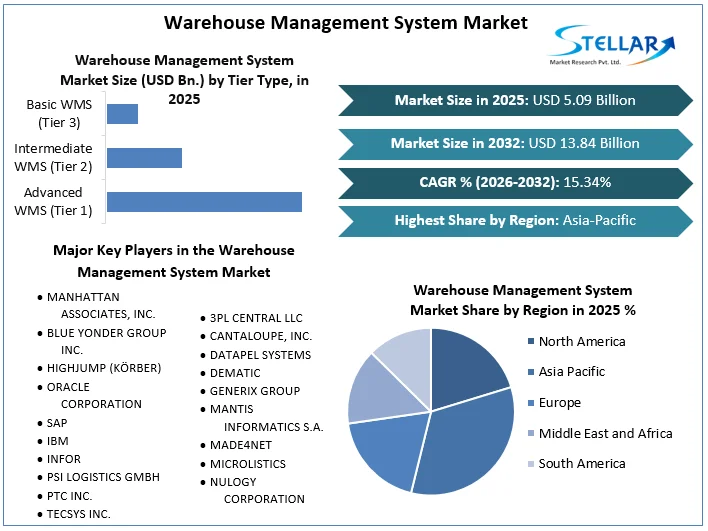
PUNE, India, June 24, 2026 – The Warehouse Management System Market is undergoing rapid digital transformation as artificial intelligence, cloud deployment, robotics integration, and omnichannel logistics redefine warehouse operations worldwide. According to a recent study by Stellar Market Research, the market was valued at USD 5.09 billion in 2024 and is projected to reach USD 13.84 billion by 2032, expanding at a CAGR of 15.34% during 2026-2032. Increasing demand for real-time inventory visibility and automated fulfillment is making WMS solutions a strategic priority across industries.
Market Opportunity Overview
The warehouse industry is shifting from conventional storage facilities to intelligent fulfillment ecosystems. The rapid rise of e-commerce, growing complexity in supply chains, and labor shortages are pushing companies toward AI-enabled warehouse management systems capable of optimizing inventory, workforce productivity, and delivery speed.
Cloud-based WMS platforms are emerging as the preferred deployment model because they provide scalability, lower infrastructure costs, and seamless integration with ERP, transportation management systems, and robotics. Businesses are increasingly investing in digital warehouses to improve order accuracy, reduce operating costs, and enhance customer satisfaction.
Third-party logistics providers (3PLs), manufacturers, healthcare companies, and retailers are among the major adopters seeking operational resilience and supply chain visibility.
Download Free PDF Brochure: https://www.stellarmr.com/report/req_sample/Warehouse-Management-System-Market/365
Key Findings from the Report
The global Warehouse Management System Market was valued at USD 5.09 billion in 2024.
The market is forecast to reach USD 13.84 billion by 2032, registering a CAGR of 15.34%.
Software solutions account for the dominant offering segment.
Cloud deployment represents the leading and fastest-growing deployment category.
Advanced WMS (Tier 1) systems dominate owing to increasing enterprise digitalization.
Third-Party Logistics (3PL) remains the largest end-user segment.
North America leads the global market, while Asia-Pacific is emerging as the fastest-growing region due to industrialization and e-commerce expansion.
Market Drivers and Restraints
Key Growth Drivers
Expansion of E-commerce and Omnichannel Retail
Growing online commerce is increasing warehouse throughput requirements, creating demand for intelligent inventory management and order fulfillment systems.
Rise of Automation and Robotics
Integration with automated guided vehicles (AGVs), robotics, and AI-based analytics is improving warehouse efficiency and reducing manual intervention.
Demand for Supply Chain Visibility
Companies are prioritizing real-time tracking and predictive analytics to enhance inventory accuracy and mitigate disruptions.
Major Restraints
High Implementation Costs
Initial investments and system integration expenses continue to limit adoption among small and medium enterprises.
Complex Legacy Infrastructure
Organizations operating outdated systems often face difficulties integrating advanced WMS solutions, resulting in prolonged deployment cycles.
Technology, Regulation, and Sustainability Trends
Artificial intelligence and machine learning are becoming central to warehouse optimization. Predictive analytics, digital twins, and automated task orchestration are improving labor productivity and reducing operational errors.
Cloud-native platforms are gaining momentum as businesses seek flexible and scalable solutions. Regulatory emphasis on traceability, inventory transparency, and supply chain compliance is further supporting adoption.
Sustainability initiatives are also influencing warehouse operations. Companies are deploying energy-efficient facilities, reducing packaging waste, and implementing smart routing technologies to minimize carbon emissions.
Regional Insights
North America Leads Market Revenue
The United States and Canada continue to dominate the market owing to extensive adoption of automation technologies and strong investments by logistics providers and retailers. High penetration of AI-driven supply chain platforms strengthens the region’s leadership position.
Asia-Pacific Emerges as High-Growth Region
China, India, Japan, and Southeast Asian economies are witnessing rapid warehouse modernization fueled by manufacturing expansion and booming e-commerce demand. Rising investments in smart logistics infrastructure are accelerating WMS adoption across the region.
Europe Focuses on Smart Warehousing
Germany, the United Kingdom, and France are investing heavily in Industry 4.0 technologies and sustainable warehouse operations, creating favorable growth opportunities.
Recent Industry Developments
SYSPRO (2025): Acquired DATASCOPE to strengthen integrated ERP and warehouse management capabilities, enhancing inventory visibility and scalability for manufacturing customers.
IFS (2025): Announced the acquisition of Softeon, expanding Industrial AI capabilities and accelerating next-generation warehouse execution solutions.
Ocado Group (2025): Ended exclusivity agreements with several retail partners, allowing broader commercialization of AI-powered robotic warehouse technologies.
Warehouse Technology Vendors (2025): Increased investments in AI-first orchestration platforms and robotic fulfillment capabilities as strategic transaction values reached multi-billion-dollar levels.
Cloud WMS Providers (2025-2026): Expanded software capabilities with predictive analytics, multi-location inventory visibility, and advanced automation features to support omnichannel fulfillment.
Competitive Landscape
The Warehouse Management System Market remains highly competitive, with leading players focusing on AI capabilities, cloud migration, strategic partnerships, and acquisitions.
Major companies operating in the market include:
Manhattan Associates Inc.
Blue Yonder Group Inc.
Oracle Corporation
SAP SE
IBM Corporation
Infor
Körber (HighJump)
PSI Logistics GmbH
Tecsys Inc.
Made4net
Dematic
Epicor Software Corporation
Companies are increasingly emphasizing warehouse automation, robotics integration, and SaaS-based business models to strengthen their market positions.
Download Free PDF Brochure: https://www.stellarmr.com/report/req_sample/Warehouse-Management-System-Market/365
Analyst Commentary
“Warehouse management systems are evolving beyond inventory tracking platforms into intelligent operational command centers. AI, cloud computing, and automation technologies are creating a new generation of digital warehouses capable of supporting resilient and highly responsive supply chains,” said a Senior Research Analyst at Stellar Market Research.
Future Outlook
Through 2032, demand for warehouse management systems is expected to be driven by digital transformation initiatives, rising e-commerce volumes, and increasing adoption of automation technologies.
Investments in AI-enabled warehouses, robotics integration, and cloud-native platforms are expected to intensify competition. Regulatory requirements around supply chain transparency and sustainability objectives will further accelerate the modernization of warehouse operations globally.
As enterprises pursue higher efficiency and customer responsiveness, WMS solutions are likely to become an essential component of next-generation supply chain ecosystems.
About Stellar Market Research
Stellar Market Research is a global market research and business consulting firm specializing in industry analysis, competitive intelligence, and strategic advisory services. The company delivers comprehensive reports across technology, healthcare, automotive, consumer goods, manufacturing, energy, and industrial sectors. Through data-driven methodologies and in-depth industry expertise, Stellar Market Research helps organizations identify emerging opportunities, evaluate competitive dynamics, and make informed business decisions. Its research solutions support corporations, investors, policymakers, and stakeholders seeking actionable insights to navigate rapidly evolving markets and achieve sustainable growth in the global economy.
Media Contact
Stellar Market Research
Website: Stellar Market Research – Global Research Reports & Consulting
Email: sales@stellarmr.com
