Key Highlights
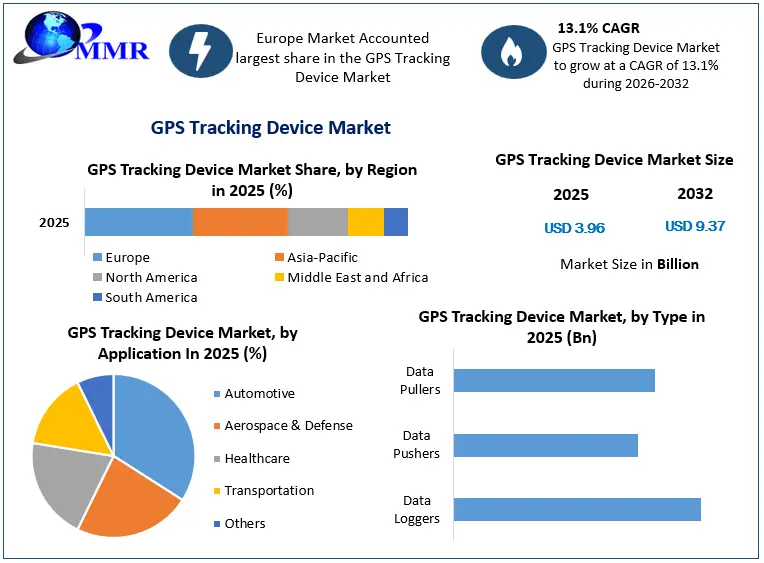
- GPS Tracking Device Market valued at USD 3.96 Billion in 2025
- Expected to reach nearly USD 9.37 Billion by 2032
- Forecast CAGR of 13.1% from 2026 to 2032
- Strong growth driven by IoT adoption and connected asset ecosystems
- Increasing semiconductor content in tracking hardware and communication modules
- Fleet digitization and real-time visibility becoming strategic priorities across industries
- Expansion of smart logistics and industrial monitoring applications accelerating demand
Why This Matters Now
The race to build intelligent, connected infrastructure is creating unprecedented demand for location intelligence. Every vehicle, shipment, industrial asset, and mobile device is becoming a data-generating endpoint in the broader IoT economy.
The GPS Tracking Device Market, valued at USD 3.96 Billion in 2025, represents far more than a tracking industry. Its growth toward nearly USD 9.37 Billion by 2032 at a CAGR of 13.1% signals expanding demand for semiconductor-enabled positioning systems, wireless communication modules, edge analytics, and real-time decision-making platforms.
For semiconductor manufacturers, electronics OEMs, logistics operators, and technology investors, location intelligence is becoming a foundational layer of digital transformation.
Market Overview
GPS tracking devices Market have evolved from simple navigation tools into intelligent connected systems. Modern devices combine satellite positioning, wireless communications, embedded processors, sensors, cloud connectivity, and software analytics.
The market’s expansion to nearly USD 9.37 Billion by 2032 reflects the growing importance of real-time asset visibility. This growth creates sustained demand for GNSS chipsets, microcontrollers, memory components, power management semiconductors, and connectivity solutions.
The industry’s strategic importance has increased because organizations now view location data as an operational asset. Real-time tracking enables predictive logistics, asset utilization optimization, theft prevention, compliance management, and automated decision-making.
As digital ecosystems expand, GPS tracking devices are becoming integral components of connected infrastructure rather than standalone hardware products.
Key Trends Driving Growth
The strongest growth driver is the rapid expansion of IoT ecosystems. GPS tracking devices serve as critical endpoints that connect physical assets to digital platforms. Every new connected vehicle, shipment, industrial machine, or mobile asset increases demand for positioning technologies.
Fleet management modernization is creating another major opportunity. Transportation operators increasingly require real-time visibility to improve route optimization, fuel efficiency, safety management, and operational performance. This demand directly supports adoption of advanced tracking hardware and cloud-connected platforms.
Semiconductor innovation is accelerating device capabilities. Modern GPS trackers integrate increasingly sophisticated chipsets capable of delivering higher accuracy, lower power consumption, and improved signal reliability. These improvements expand deployment opportunities across industries.
Edge computing adoption is reshaping device architecture. Processing location data closer to the source reduces latency and enables faster operational decisions. This trend increases demand for more powerful embedded processors and intelligent tracking modules.
The growth of smart cities is also contributing to market momentum. Urban mobility systems, connected transportation networks, and public infrastructure monitoring increasingly rely on location-aware technologies.
Supply chain digitization continues to strengthen business demand. Organizations require end-to-end visibility across increasingly complex global logistics networks, making tracking technology a strategic investment rather than an operational expense.
Explore detailed analysis, insights, and growth opportunities
Segment Insights
- Dominant Segment: Not explicitly specified in the provided report data
- Fastest-Growing Segment: Not explicitly specified in the provided report data
- Fleet management applications remain a key demand center for GPS tracking solutions
- Asset tracking continues to expand across logistics and industrial operations
- IoT-enabled tracking devices are increasing the value proposition beyond location monitoring
- Connected transportation ecosystems are creating new deployment opportunities
- Advanced communication modules are improving device functionality and scalability
The market’s evolution suggests that differentiation is increasingly driven by software integration, connectivity capabilities, and analytics functionality rather than tracking hardware alone.
Regional Growth Story
North America continues to be a major market for connected mobility technologies, fleet management platforms, and enterprise tracking solutions. High technology adoption rates and mature logistics networks support sustained demand.
Asia-Pacific represents a critical manufacturing and consumption hub. China, Japan, South Korea, and India play essential roles in electronics production, semiconductor assembly, and device manufacturing. Expanding logistics networks and industrial digitization initiatives further strengthen regional demand.
China’s electronics manufacturing ecosystem remains central to GPS device production. Semiconductor supply chains, wireless module manufacturing, and electronics assembly capabilities provide scale advantages.
India is emerging as a significant growth opportunity due to transportation modernization, logistics digitization, and expanding IoT adoption across commercial sectors.
Europe continues to emphasize connected mobility, transportation efficiency, and industrial automation. Germany’s manufacturing leadership supports demand for industrial tracking solutions and smart logistics systems.
Across all regions, the strategic focus is shifting toward data-driven operations, making location intelligence a competitive necessity.
Competitive Landscape
Competition in the GPS Tracking Device Market is increasingly defined by technology integration rather than hardware specifications alone.
Manufacturers that combine positioning technologies with analytics platforms, cloud connectivity, and AI-driven insights are building stronger competitive advantages. This shift signals a transition from device-centric business models toward ecosystem-based value creation.
The semiconductor dimension is becoming increasingly important. Companies that secure access to advanced GNSS chipsets, communication modules, and low-power processing technologies can deliver superior device performance and longer operational lifecycles.
Technology leadership increasingly depends on the ability to integrate GPS functionality with broader IoT architectures. Vendors capable of supporting fleet intelligence, industrial monitoring, predictive analytics, and connected asset ecosystems are positioned to capture higher-value opportunities.
Supply chain resilience is also becoming a differentiator. Reliable access to semiconductor components, wireless modules, and electronics manufacturing capacity influences product availability and competitiveness.
Recent Developments
- Growing deployment of IoT-enabled tracking platforms
- Increased adoption of connected fleet management solutions
- Expansion of real-time logistics visibility technologies
- Continued integration of advanced semiconductor-based positioning modules
- Rising demand for edge-enabled tracking devices
- Growth of smart mobility and connected transportation initiatives
Strategic Implications
For semiconductor companies, GPS tracking represents a growing source of demand for GNSS chipsets, embedded processors, memory devices, power management ICs, and communication modules.
For electronics manufacturers, the opportunity extends beyond hardware production. Integrated software platforms, analytics capabilities, and cloud connectivity are becoming essential revenue drivers.
For investors, the market offers exposure to multiple long-term technology trends simultaneously, including IoT expansion, connected mobility, industrial digitization, and real-time data analytics.
For supply-chain leaders, GPS tracking devices are evolving into strategic infrastructure that supports operational resilience, visibility, and efficiency.
Future Outlook
The next phase of market expansion will be defined by the convergence of GPS technology, AI-powered analytics, edge computing, and IoT ecosystems. As location intelligence becomes embedded into virtually every connected asset, the companies that control semiconductor innovation, connectivity architectures, and real-time data platforms will define the future of intelligent mobility, while slower competitors risk becoming commodity hardware suppliers in a software-driven economy.
Analyst Perspective
“GPS tracking devices are rapidly evolving into intelligent connected systems that combine location data, IoT connectivity, and advanced semiconductor technologies to deliver real-time operational intelligence across industries,” said Rucha Deshpande, Analyst, Maximize Market Research.
About Maximize Market Research
Maximize Market Research Pvt. Ltd. (MMR) is a global market research and consulting company that provides reliable, data-focused, and practical business insights. The firm serves a wide range of industries, including healthcare, pharmaceuticals, technology, automotive, electronics, chemicals, personal care, and consumer goods. Through market forecasts, competitive analysis, strategic consulting, and industry impact assessments, MMR helps organizations understand changing market conditions, identify growth opportunities, and make informed business decisions for long-term success.
Contact Us :
2nd Floor, Navale IT Park Phase 3
Pune Banglore Highway, Narhe
Pune, Maharashtra 411041, India
+91 9607365656
sales@maximizemarketresearch.com
