Key Highlights
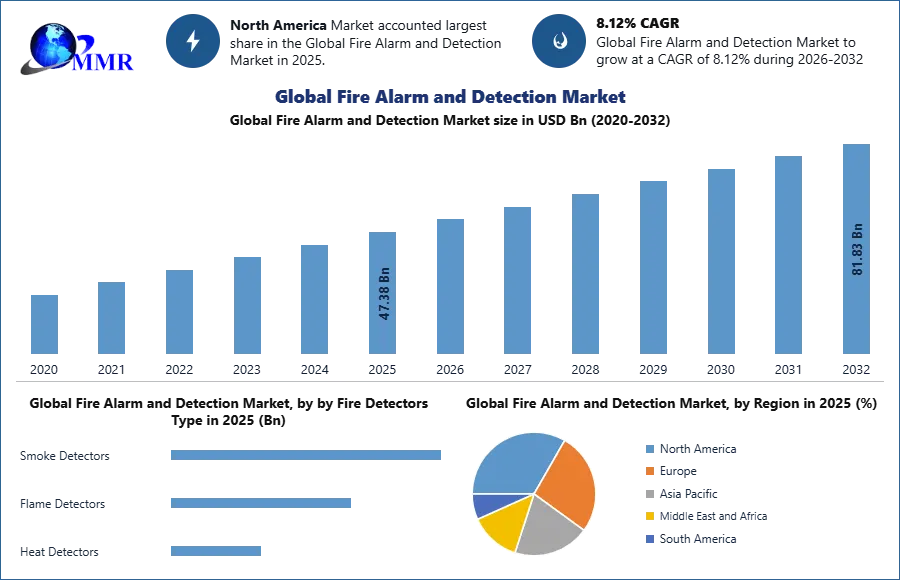
- Global Fire Alarm and Detection Market valued at USD 47.38 billion in 2025.
- Market expected to reach USD 81.83 billion by 2032.
- Forecast CAGR stands at 8.12% during 2025–2032.
- AI-enabled detection and smart monitoring are reshaping fire safety infrastructure.
- IoT integration is expanding the role of fire systems beyond compliance into operational intelligence.
- Commercial and industrial modernization programs are accelerating adoption globally.
Why This Matters Now
Fire safety is becoming a strategic technology investment rather than a compliance expense. As buildings become digitally connected and infrastructure operators seek real-time visibility into operational risks, fire alarm and detection systems are evolving into intelligent monitoring platforms.
The Fire Alarm and Detection Market was valued at USD 47.38 billion in 2025 and is expected to reach USD 81.83 billion by 2032, growing at a CAGR of 8.12%. That expansion signals rising investment in connected safety technologies across commercial facilities, industrial operations, public infrastructure, and smart-city projects.
The shift arrives as organizations face increasing pressure to improve operational resilience, reduce emergency response times, and integrate safety systems into broader building-management ecosystems.
Market Overview
What changed is the role of fire detection technology itself. Traditional systems focused on alarm generation. Modern platforms combine sensors, software analytics, cloud connectivity, and remote monitoring capabilities.
The market is benefiting from the convergence of digital transformation and safety modernization. Building owners increasingly view fire detection systems as part of an integrated operational technology stack alongside security, energy management, and facility automation.
This evolution is creating opportunities for technology providers that can deliver intelligent, interoperable, and scalable solutions capable of operating across complex environments.
As urbanization accelerates and infrastructure investments expand, fire safety systems are becoming foundational components of modern construction projects.
Key Trends Driving Growth
Artificial intelligence is emerging as a major technology catalyst. AI-powered analytics can improve threat identification, reduce nuisance alarms, and support predictive maintenance strategies. Research into machine-learning-based fire detection demonstrates growing industry focus on enhancing detection accuracy while minimizing false alerts.
IoT connectivity is transforming system architecture. Connected sensors, cloud platforms, and mobile notification capabilities are enabling real-time monitoring and remote management across distributed facilities. This trend is particularly relevant for large commercial campuses, industrial operations, and critical infrastructure assets.
Wireless technologies are gaining traction as organizations seek flexible deployment models. Wireless solutions simplify retrofitting projects and support modernization initiatives in older buildings where extensive wiring upgrades may be costly or disruptive.
Smart building adoption continues to expand demand. Fire detection systems increasingly integrate with broader building-management systems, supporting centralized monitoring and coordinated emergency response capabilities.
Another important trend is the growing use of advanced detection methods. Thermal imaging, intelligent smoke detection, video analytics, and AI-assisted fire recognition technologies are improving performance in complex operating environments.
Explore detailed analysis, insights, and growth opportunities
Segment Insights
- Dominant Segment: Not specified in the supplied source material.
- Fastest-Growing Segment: Not specified in the supplied source material.
- Smart and connected detection solutions are gaining momentum due to increasing integration requirements.
- Wireless deployment models are attracting investment due to installation flexibility.
- Commercial and industrial applications remain key adoption environments because of regulatory and operational requirements.
- Intelligent monitoring software is becoming a larger value-creation layer within fire safety ecosystems.
Regional Growth Story
North America remains a critical market because of stringent safety standards, modernization of commercial infrastructure, and strong adoption of advanced technologies. Organizations increasingly invest in integrated safety platforms capable of supporting enterprise-wide risk management objectives.
Europe continues to benefit from regulatory compliance initiatives and growing investments in smart-building technologies. The region’s focus on energy-efficient and digitally connected infrastructure supports ongoing deployment of advanced fire detection systems.
Asia-Pacific represents one of the most significant long-term opportunities. Rapid urbanization, large-scale infrastructure development, expanding commercial construction, and increasing awareness of safety standards are driving demand across major economies. Countries including China and India are witnessing substantial investment in modern building infrastructure, creating favorable conditions for fire safety technology adoption.
The Middle East is increasingly adopting sophisticated fire protection solutions as governments invest in smart cities, transportation infrastructure, and large commercial developments.
Competitive Landscape
Competition is shifting from hardware performance toward platform intelligence. Manufacturers are increasingly differentiating through software capabilities, connectivity features, analytics engines, and integration ecosystems.
Major industry participants include Honeywell International, Johnson Controls, Schneider Electric, Carrier Global, Robert Bosch, ABB, and Eaton Corporation.
What these competitive moves signal is a broader industry transition toward intelligent safety ecosystems. Vendors that can integrate fire detection with building automation, cybersecurity, energy management, and operational analytics are positioned to capture greater value.
The competitive battleground is increasingly defined by interoperability, software innovation, and recurring service revenues rather than standalone equipment sales.
Recent Developments
- AI-driven fire detection research is improving alarm accuracy and reducing false-positive events.
- Advanced fire and smoke recognition technologies are enhancing detection performance in complex environments.
- Wireless deployment architectures are expanding retrofit opportunities across existing building stock.
- Cloud-connected monitoring platforms are enabling real-time remote visibility and management.
- Smart-building integration is increasing demand for interoperable safety infrastructure.
Strategic Implications
For building owners, fire detection systems are becoming operational intelligence assets rather than isolated safety devices.
For technology providers, software-driven differentiation offers the strongest pathway to margin expansion. Intelligent analytics, predictive maintenance, and cloud-based monitoring services are creating new revenue streams beyond equipment sales.
For investors, the market’s growth trajectory reflects a structural shift toward connected infrastructure. Safety technologies increasingly occupy a central position within digital-building investment strategies.
For governments and regulators, modern fire detection infrastructure supports broader objectives around urban resilience, public safety, and smart-city development.
Future Outlook
The next phase of market expansion will be defined by intelligent automation. Fire detection systems will increasingly operate as part of integrated digital ecosystems capable of analyzing risks, coordinating responses, and generating actionable operational insights.
As AI, IoT, and cloud technologies converge, the distinction between safety systems and building intelligence platforms will continue to narrow. Organizations that deploy connected, data-driven fire protection infrastructure will gain operational advantages, while those relying on legacy systems risk falling behind in an increasingly digital safety landscape.
The ultimate competitive divide will emerge between organizations that treat fire detection as a strategic intelligence platform and those that continue to view it solely as a regulatory requirement.
Analyst Perspective
“The fire alarm and detection industry is entering a phase where intelligence, connectivity, and real-time decision-making are becoming as important as detection accuracy itself. Organizations that integrate fire safety into broader digital infrastructure strategies will be best positioned to enhance resilience and operational performance.” — Rucha Deshpande, Analyst
About Maximize Market Research
Maximize Market Research Pvt. Ltd. (MMR) is a global market research and consulting company that provides reliable, data-focused, and practical business insights. The firm serves a wide range of industries, including healthcare, pharmaceuticals, technology, automotive, electronics, chemicals, personal care, and consumer goods. Through market forecasts, competitive analysis, strategic consulting, and industry impact assessments, MMR helps organizations understand changing market conditions, identify growth opportunities, and make informed business decisions for long-term success.
Contact Us :
2nd Floor, Navale IT Park Phase 3
Pune Banglore Highway, Narhe
Pune, Maharashtra 411041, India
+91 9607365656
sales@maximizemarketresearch.com
