Key Highlights
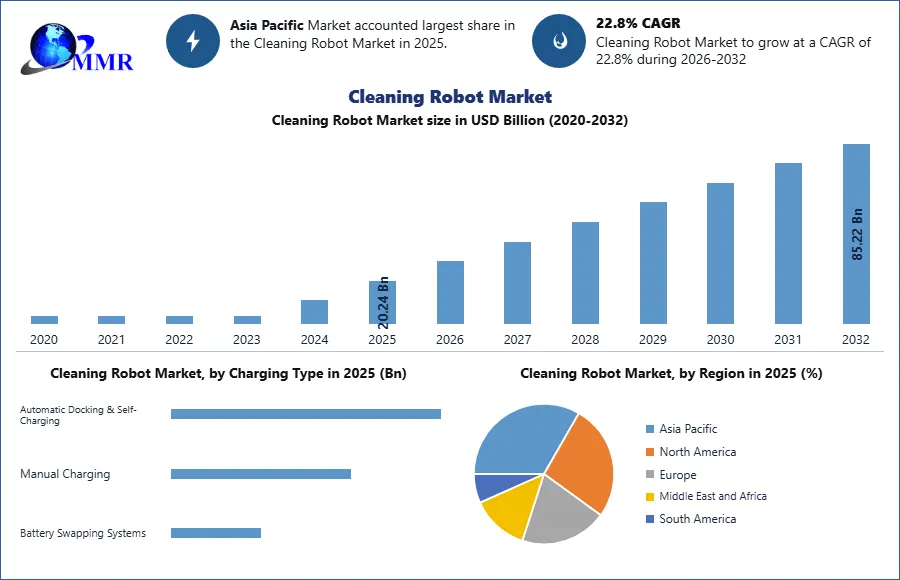
- Cleaning Robot Market valued at USD 20.24 Billion in 2025
- Market expected to reach USD 85.22 Billion by 2032
- Forecast CAGR stands at 22.8% during 2025–2032
- AI-powered navigation and autonomous operation are transforming cleaning efficiency
- Smart home adoption is accelerating residential robot demand
- Commercial facilities increasingly deploy robotic cleaning to reduce labor dependency
- IoT connectivity and intelligent mapping technologies are creating premium product opportunities
- Manufacturers are focusing on automation, battery performance, and intelligent sensing technologies
Why This Matters Now
The race toward intelligent automation is expanding beyond factories and data centers into everyday environments. Cleaning robots are emerging as one of the most visible examples of AI-enabled consumer and commercial automation, creating new revenue streams for robotics manufacturers, component suppliers, sensor developers, semiconductor companies, and smart-device ecosystems.
The Cleaning Robot Market was valued at USD 20.24 Billion in 2025 and is forecast to reach USD 85.22 Billion by 2032, growing at a 22.8% CAGR. This growth signals a major shift from manual cleaning toward autonomous systems capable of operating with minimal human intervention. For technology providers, it represents rising demand for processors, sensors, connectivity modules, batteries, and AI software platforms.
Market Overview
The Cleaning Robot Market Size have evolved from simple automated vacuum devices into intelligent systems capable of navigation, obstacle recognition, route optimization, remote monitoring, and multi-surface cleaning.
The industry is benefiting from advances in artificial intelligence, machine vision, edge computing, and IoT connectivity. These technologies enable robots to map environments, optimize cleaning patterns, and improve operational efficiency. As consumers and businesses prioritize productivity, hygiene, and labor optimization, robotic cleaning solutions are becoming a strategic investment rather than a discretionary purchase.
The market’s projected expansion to USD 85.22 Billion by 2032 indicates that cleaning automation is moving into mainstream adoption across households, healthcare facilities, retail environments, manufacturing sites, hospitality venues, and office buildings.
Key Trends Driving Growth
Artificial intelligence is becoming the core differentiator across the cleaning robot ecosystem. Advanced navigation systems now rely on intelligent algorithms capable of identifying obstacles, adapting to room layouts, and improving cleaning performance over time.
The expansion of connected homes is creating another powerful demand driver. Cleaning robots increasingly operate within broader smart-home ecosystems, communicating with mobile applications, voice assistants, and connected appliances. This interoperability is strengthening consumer adoption and increasing replacement cycles.
Commercial users are also changing procurement strategies. Businesses facing labor shortages and rising operational costs are deploying autonomous cleaning systems to improve consistency and reduce dependence on manual processes.
Battery innovations are further improving market economics. Longer operating cycles and faster charging capabilities allow robots to cover larger areas with greater efficiency, making them more attractive for industrial and commercial environments.
The industry is also witnessing growing demand for multifunctional robots capable of vacuuming, mopping, sanitizing, and monitoring indoor environments. This trend is increasing average selling prices while expanding addressable market opportunities.
Get a Sample Report Packed with Industry Statistics and Forecasts
Segment Insights
- Dominant Segment: Residential End-Use Segment
- Residential applications continue to generate significant demand as consumers adopt smart-home technologies and seek automated household solutions.
- Busy lifestyles, rising disposable income, and growing familiarity with connected devices are accelerating household penetration.
- Fastest-Growing Segment: Commercial and Industrial Automation Applications
- Businesses are increasingly deploying robotic cleaners to improve efficiency, reduce labor costs, and maintain hygiene standards.
- Warehouses, hospitals, airports, shopping centers, and manufacturing facilities are emerging as major growth opportunities.
- Navigation technology is becoming a key competitive differentiator.
- Autonomous operation modes are gaining preference over manually controlled systems.
- Premium product categories are benefiting from AI-enabled mapping and intelligent route optimization.
- IoT-enabled robots are creating recurring revenue opportunities through software updates and connected services.
Regional Growth Story
North America remains one of the most influential markets due to strong consumer adoption of smart-home technologies, high purchasing power, and rapid acceptance of automation solutions.
Europe continues to benefit from increasing investments in intelligent building management and automation technologies. Demand is supported by commercial cleaning applications across healthcare, retail, and hospitality sectors.
Asia-Pacific is becoming a critical growth engine as urbanization, rising disposable income, and technology adoption accelerate. Manufacturing strength, expanding electronics ecosystems, and increasing consumer awareness are driving regional opportunities.
China, Japan, South Korea, and India are emerging as important innovation and manufacturing centers. Their expanding electronics industries, robotics expertise, and smart-device adoption trends are helping strengthen the regional competitive landscape.
Competitive Landscape
Competition is shifting from hardware capabilities alone toward intelligent software ecosystems. Market leaders are investing in AI-powered navigation, machine learning algorithms, advanced sensors, and cloud-connected platforms to create differentiation.
Manufacturers that successfully integrate intelligent mapping, predictive maintenance, remote management, and smart-home compatibility are establishing stronger competitive positions. The battle is increasingly centered on user experience, autonomy, and software intelligence rather than basic cleaning performance.
The competitive environment also highlights the growing importance of semiconductor components. Advanced processors, sensing technologies, wireless connectivity modules, and edge AI capabilities are becoming essential for next-generation cleaning robots. Companies that secure reliable access to these technologies will gain advantages in innovation speed and product performance.
Strategic partnerships across robotics, software, electronics, and connectivity ecosystems are expected to intensify as vendors seek broader platform integration and recurring revenue opportunities.
Recent Developments
- AI-enabled navigation systems are improving cleaning precision and operational efficiency.
- Smart-home integration capabilities continue expanding across premium robot categories.
- Manufacturers are investing in enhanced sensing technologies and obstacle recognition systems.
- Commercial cleaning deployments are increasing across healthcare, retail, and industrial environments.
- Battery performance improvements are extending operating times and boosting productivity.
- Connected-device ecosystems are enabling remote monitoring and automated scheduling capabilities.
Strategic Implications
For robotics manufacturers, the market’s rapid expansion creates opportunities to scale product portfolios and strengthen software ecosystems.
For semiconductor suppliers, increasing robot intelligence translates into greater demand for processors, sensors, memory solutions, wireless communication modules, and power-management technologies.
For OEMs, differentiation will increasingly depend on software capabilities, AI performance, and ecosystem integration rather than hardware specifications alone.
For investors, the projected rise from USD 20.24 Billion in 2025 to USD 85.22 Billion by 2032 highlights a high-growth segment benefiting from multiple long-term technology trends, including automation, artificial intelligence, IoT adoption, and smart-device proliferation.
Future Outlook
The next phase of growth will be defined by fully autonomous cleaning systems capable of real-time decision-making, adaptive learning, and seamless integration into connected environments. As AI becomes more sophisticated and smart infrastructure expands, cleaning robots will evolve from standalone devices into intelligent service platforms operating across residential, commercial, and industrial ecosystems.
The companies that master AI-driven autonomy, software intelligence, and connected-device ecosystems will define the future of robotic cleaning, while those focused solely on hardware risk losing relevance in an increasingly intelligent automation market.
Analyst Perspective
“The Cleaning Robot Market is entering a transformative phase where artificial intelligence, smart connectivity, and autonomous operation are becoming core value drivers. Organizations that combine robotics innovation with intelligent software capabilities will be best positioned to capture the next wave of market expansion.” — Rucha Deshpande, Analyst
About Maximize Market Research
Maximize Market Research Pvt. Ltd. (MMR) is a global market research and consulting company that provides reliable, data-focused, and practical business insights. The firm serves a wide range of industries, including healthcare, pharmaceuticals, technology, automotive, electronics, chemicals, personal care, and consumer goods. Through market forecasts, competitive analysis, strategic consulting, and industry impact assessments, MMR helps organizations understand changing market conditions, identify growth opportunities, and make informed business decisions for long-term success.
Contact Us
2nd Floor, Navale IT Park Phase 3
Pune Banglore Highway, Narhe
Pune, Maharashtra 411041, India
+91 9607365656
sales@maximizemarketresearch.com
