Key Highlights
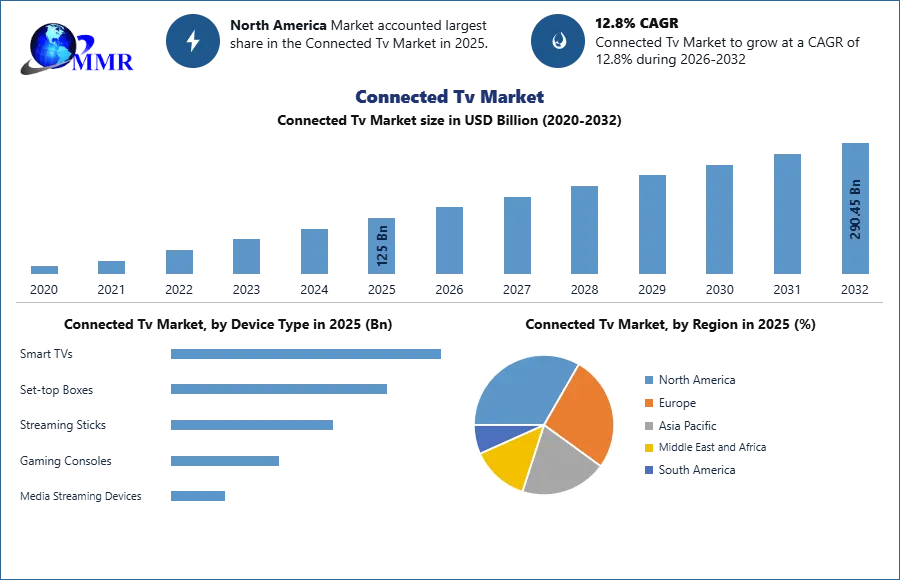
- Market size reached USD 125 Billion in 2025
- Expected to reach USD 290.45 Billion by 2032
- Projected CAGR of 12.8% from 2026 to 2032
- Streaming adoption continues to redefine television consumption
- Smart TV ecosystems are becoming central to digital advertising strategies
- AI-enabled personalization is increasing platform engagement
- Connected devices and smart-home integration are expanding use cases
- Display technology innovation remains a key competitive differentiator
Why This Matters Now
The television industry is undergoing its biggest transformation since the transition from analog to digital broadcasting. Consumers increasingly expect seamless access to streaming platforms, personalized recommendations, voice-enabled interfaces, and integrated smart-home functionality.
This shift is creating opportunities across the electronics value chain. Device manufacturers gain recurring platform revenues. Advertisers gain access to measurable audience targeting. Streaming providers gain direct household access. Semiconductor suppliers benefit from growing demand for processors, connectivity modules, memory solutions, and AI-capable chipsets powering next-generation smart televisions.
The result is a rapidly expanding ecosystem where connected TVs function as digital hubs rather than standalone display devices.
Market Overview
The Connected TV Market Size combine traditional television functionality with internet connectivity and application-based content delivery. Their growing popularity reflects changing consumer viewing habits as audiences move away from conventional broadcast schedules toward on-demand entertainment.
The market’s expansion is being driven by increasing broadband penetration, wider availability of streaming services, improvements in display technology, and growing consumer demand for personalized content experiences.
Unlike traditional television products, connected TVs create ongoing value through software ecosystems, content partnerships, advertising platforms, and data-driven services. This transformation is changing competitive dynamics throughout the consumer electronics industry.
Key Trends Driving Growth
Artificial intelligence is becoming a major differentiator within the connected TV landscape. AI-powered recommendation engines improve content discovery while increasing viewer engagement and platform retention.
Voice-enabled interfaces continue to gain traction as consumers seek more intuitive navigation experiences. Integration with broader smart-home ecosystems is also expanding the role of connected TVs beyond entertainment.
Display innovation remains another significant growth catalyst. Manufacturers continue investing in enhanced picture quality, improved color accuracy, and immersive viewing experiences to attract premium consumers.
Streaming platforms are simultaneously increasing investments in exclusive content libraries. This content competition is encouraging consumers to upgrade devices capable of supporting advanced streaming experiences.
The advertising industry is also accelerating connected TV adoption. As marketers shift spending toward measurable digital channels, connected TV platforms offer a unique combination of television-scale reach and digital-style targeting capabilities.
Access Market Intelligence Designed for Business Growth Planning
Segment Insights
- Dominant Segment: Smart connected television platforms continue to represent the largest share of market demand due to widespread consumer adoption and growing streaming consumption.
- Fastest-Growing Segment: Premium connected viewing experiences supported by advanced display technologies are witnessing accelerated growth as consumers increasingly prioritize immersive home entertainment.
- Connected ecosystems integrating multiple applications and services are strengthening user engagement and platform stickiness.
- Streaming-enabled devices are expanding opportunities for subscription services, digital advertising, and content monetization.
- Smart-home compatibility is creating new use cases beyond traditional entertainment consumption.
Regional Growth Story
North America remains a major market due to high streaming adoption, advanced digital infrastructure, and significant investments in connected advertising technologies.
Asia-Pacific continues to represent a critical growth engine as rising internet penetration, expanding middle-class populations, and increasing smart-device adoption drive connected television demand. Large consumer electronics manufacturing ecosystems across the region further strengthen market expansion.
Europe is benefiting from increasing adoption of connected entertainment services and growing consumer preference for integrated digital experiences.
India is emerging as a particularly important opportunity. Rapid digitalization, increasing broadband availability, and strong growth in streaming consumption are accelerating connected TV adoption across urban and semi-urban households.
These regional developments are creating opportunities not only for television manufacturers but also for semiconductor suppliers, software developers, cloud providers, and digital advertising companies.
Competitive Landscape
Competition is increasingly shifting from hardware specifications toward ecosystem ownership.
Leading manufacturers are investing heavily in operating systems, content partnerships, user-interface innovation, and advertising capabilities. This signals a broader industry transition from one-time hardware transactions to recurring digital revenue models.
Companies capable of building comprehensive ecosystems gain greater control over customer relationships, user data, content distribution, and advertising monetization. As a result, platform strategy is becoming as important as display quality.
The competitive environment also highlights growing convergence between consumer electronics companies, software providers, streaming platforms, and advertising technology firms. Success increasingly depends on ecosystem strength rather than standalone product performance.
For semiconductor suppliers, this trend creates sustained demand for more powerful processors, connectivity solutions, memory technologies, and AI acceleration capabilities required to support increasingly sophisticated television platforms.
Recent Developments
- Expansion of AI-driven recommendation and personalization capabilities
- Increasing integration of voice-assistant technologies
- Growing investment in premium display technologies
- Enhanced smart-home connectivity features
- Rising partnerships between hardware manufacturers and streaming providers
- Expansion of connected advertising platforms
- Continued evolution of operating-system ecosystems
- Greater focus on platform-based revenue generation
Strategic Implications
The connected TV market illustrates a broader shift occurring throughout consumer electronics. Value creation is moving from hardware manufacturing toward software-enabled ecosystems.
Manufacturers that successfully combine premium hardware with compelling content, advertising, and service offerings are likely to capture a larger share of future industry profits.
For investors, connected TVs represent exposure to several high-growth themes simultaneously, including digital advertising, streaming media, artificial intelligence, cloud services, IoT ecosystems, and smart-home technologies.
For component suppliers, growing platform complexity translates into rising demand for advanced processing, connectivity, memory, and power-management technologies.
Future Outlook
The next phase of market expansion will be defined by deeper AI integration, greater personalization, stronger ecosystem interoperability, and expanding monetization opportunities across advertising and subscription services.
As connected televisions become central control points for digital households, competitive advantage will increasingly depend on ecosystem intelligence rather than screen specifications alone. The companies that own the software platform, user data, and AI-driven engagement layer will define the next generation of digital entertainment, while hardware-focused laggards risk becoming commodity suppliers in an increasingly platform-driven industry.
Analyst Perspective
“Connected TVs are evolving into digital experience platforms that combine entertainment, connectivity, and intelligent user engagement. The convergence of streaming, AI-driven personalization, and smart-device integration is creating new opportunities across the consumer electronics ecosystem while redefining competitive dynamics throughout the industry,” says Rucha Deshpande, Analyst.
About Maximize Market Research
Maximize Market Research Pvt. Ltd. (MMR) is a global market research and consulting company that provides reliable, data-focused, and practical business insights. The firm serves a wide range of industries, including healthcare, pharmaceuticals, technology, automotive, electronics, chemicals, personal care, and consumer goods. Through market forecasts, competitive analysis, strategic consulting, and industry impact assessments, MMR helps organizations understand changing market conditions, identify growth opportunities, and make informed business decisions for long-term success.
Contact Us
2nd Floor, Navale IT Park Phase 3
Pune Banglore Highway, Narhe
Pune, Maharashtra 411041, India
+91 9607365656
sales@maximizemarketresearch.com
