Key Highlights
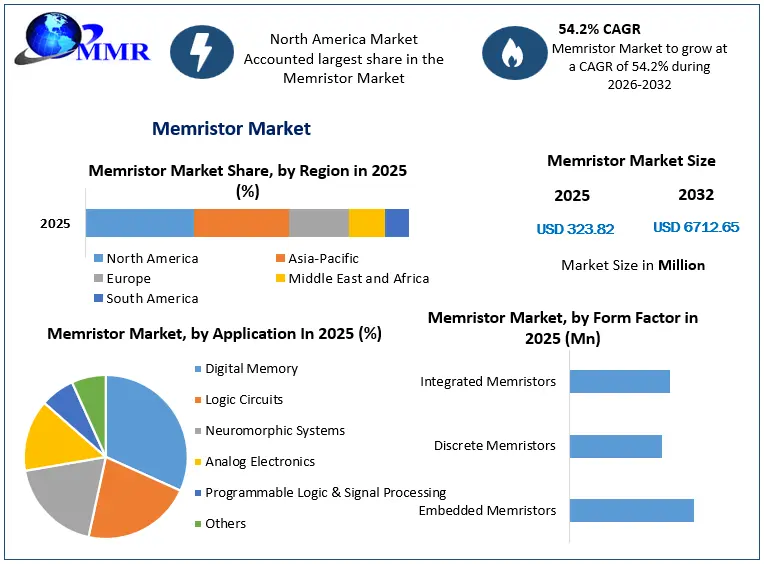
- Global Memristor Market valued at USD 323.82 million in 2025
- Market projected to reach USD 6712.65 million by 2032
- Expected CAGR of 54.2% during 2026–2032
- Rising demand for AI hardware and neuromorphic computing accelerating commercialization
- North America maintains leadership through strong semiconductor R&D investments
- Consumer electronics, automotive, healthcare, and telecommunications emerging as key adoption sectors
- Energy-efficient computing becoming a major competitive differentiator
Why This Matters Now
Artificial intelligence is reshaping semiconductor priorities. Memory architectures that once served as supporting components are becoming strategic assets as chipmakers race to reduce power consumption while increasing computational performance.
Memristors have moved from laboratory research toward commercial deployment. Their ability to store and process information simultaneously aligns with the industry’s push toward AI acceleration, edge intelligence, autonomous systems, and next-generation computing platforms. For semiconductor manufacturers, foundries, electronics OEMs, and investors, the technology represents one of the most significant memory innovations since flash storage.
Market Overview
The Memristor Market Size was valued at USD 323.82 million in 2025 and is expected to reach USD 6712.65 million by 2032, expanding at a 54.2% CAGR during the forecast period.
The industry’s growth story is increasingly tied to computing efficiency. Traditional memory architectures separate storage and processing, creating bottlenecks that consume power and increase latency. Memristors address this challenge by enabling memory and computation within the same structure.
This architectural shift arrives as AI workloads become more complex and data-intensive. Semiconductor companies are searching for alternatives that can deliver higher performance without proportionally increasing energy consumption. Memristors are emerging as a viable answer to that challenge.
Key Trends Driving Growth
Artificial intelligence has become the primary catalyst for memristor adoption. Neuromorphic computing systems require hardware that mimics neural networks while minimizing energy consumption. Memristors offer both capabilities, creating opportunities across AI accelerators and intelligent edge devices.
Edge computing is generating another growth wave. Real-time image recognition, speech processing, industrial automation, robotics, and autonomous systems require faster local processing. Memristor-based architectures reduce latency while lowering power requirements.
The expansion of IoT ecosystems is increasing demand for compact and durable memory technologies. Connected devices require persistent memory solutions that operate efficiently in constrained environments. Memristors meet these requirements while supporting long-term reliability.
Automotive electronics are becoming increasingly sophisticated. Advanced driver-assistance systems, autonomous driving functions, battery management systems, and vehicle intelligence platforms require faster data handling and resilient memory architectures. Memristors provide an attractive alternative for these mission-critical applications.
The semiconductor industry’s focus on sustainability is also contributing to adoption. Lower power consumption translates directly into reduced energy requirements across data centers, edge devices, and electronics manufacturing ecosystems.
Request a Sample Copy to Review Industry Opportunities and Challenges
Segment Insights
- Dominant Segment: Consumer electronics remains a major demand center due to increasing integration of advanced memory technologies into smart devices and connected products.
- Fastest-Growing Segment: Neuromorphic computing applications are experiencing rapid expansion as AI hardware developers pursue brain-inspired computing architectures.
- Molecular and ionic film memristors continue to attract strong industry attention because of their potential for high-density memory applications.
- Spin-based and magnetic memristors are gaining momentum for specialized computing workloads requiring durability and performance.
- Telecommunications applications are expanding as 5G infrastructure increases demand for efficient data processing.
- Healthcare adoption is growing through intelligent diagnostic systems and medical electronics requiring low-power computation.
Regional Growth Story
North America leads the global Memristor Market. The region benefits from a strong semiconductor innovation ecosystem, substantial R&D investments, and the presence of major technology companies pursuing advanced computing architectures.
The United States remains a focal point for AI hardware development. Growing investments in semiconductor sovereignty, domestic manufacturing capacity, and next-generation computing research support market expansion.
Asia-Pacific follows closely behind. Semiconductor manufacturing strength across Taiwan, South Korea, China, and Japan creates favorable conditions for future commercialization. The region’s leadership in electronics manufacturing and consumer device production positions it as a critical growth engine.
China’s focus on semiconductor self-sufficiency and advanced electronics production continues to stimulate demand for emerging memory technologies. Taiwan and South Korea maintain strategic importance through their positions in global semiconductor fabrication and advanced packaging ecosystems.
India is increasingly relevant as electronics manufacturing expands and government initiatives encourage semiconductor investment. Growing adoption of AI-enabled devices and connected technologies creates additional long-term opportunities.
Europe remains active through research initiatives and automotive innovation. Germany’s industrial technology ecosystem is expected to play an important role in future memristor integration across smart manufacturing and mobility applications.
Competitive Landscape
Competition is shifting from memory capacity toward computing efficiency. Companies participating in the memristor ecosystem are positioning themselves for a future where memory becomes an active computational resource rather than passive storage.
Major industry participants include HP Inc., Intel Corporation, Samsung Electronics, and Knowm Inc.
The strategic significance extends beyond individual product launches. Investments in memristor research signal a broader industry transition toward AI-native hardware architectures.
For semiconductor leaders, success will depend on integrating memristor technologies into scalable manufacturing processes. Companies that solve commercialization challenges can strengthen technology leadership while improving performance-per-watt metrics.
For OEMs, memristors create opportunities to deliver faster, more intelligent, and more energy-efficient products. For investors, the market represents exposure to one of the most disruptive developments in next-generation memory technology.
Recent Developments
- Increased industry focus on neuromorphic computing architectures.
- Rising integration of memristor technology into AI-driven edge devices.
- Growing research activity around low-power computing systems.
- Expanded exploration of memristors for automotive electronics applications.
- Continued investment in advanced memory alternatives to conventional architectures.
- Greater emphasis on commercialization pathways for next-generation semiconductor technologies.
Strategic Implications
The memristor market is developing at the intersection of AI, semiconductor innovation, and energy-efficient computing.
For foundries, commercialization could create new manufacturing opportunities beyond traditional memory products. For electronics manufacturers, memristors offer a route toward differentiated product performance. For cloud providers and AI developers, lower power consumption directly improves operational economics.
Supply chains are also likely to evolve. As demand for specialized memory components increases, semiconductor ecosystems will need to adapt manufacturing, packaging, and integration processes to support broader adoption.
The technology’s long-term value lies in its ability to redefine computing architectures rather than simply improve memory performance.
Future Outlook
The next phase of semiconductor competition will be determined by how effectively companies combine memory, processing, and AI acceleration into unified architectures. Organizations that successfully commercialize memristor-enabled computing platforms will shape the future of AI hardware, while those dependent on legacy memory approaches risk falling behind in the race for computational efficiency.
Analyst Perspective
“Memristors are emerging as a transformative technology for AI-centric computing. Their ability to combine storage and processing capabilities addresses critical challenges around power efficiency, scalability, and real-time intelligence. As commercialization advances, the technology is expected to influence the next generation of semiconductor architectures across consumer, industrial, automotive, and healthcare applications.” — Rucha Deshpande, Analyst
About Maximize Market Research
Maximize Market Research Pvt. Ltd. (MMR) is a global market research and consulting company that provides reliable, data-focused, and practical business insights. The firm serves a wide range of industries, including healthcare, pharmaceuticals, technology, automotive, electronics, chemicals, personal care, and consumer goods. Through market forecasts, competitive analysis, strategic consulting, and industry impact assessments, MMR helps organizations understand changing market conditions, identify growth opportunities, and make informed business decisions for long-term success.
Contact Us
2nd Floor, Navale IT Park Phase 3
Pune Banglore Highway, Narhe
Pune, Maharashtra 411041, India
+91 9607365656
sales@maximizemarketresearch.com
