Key Highlights
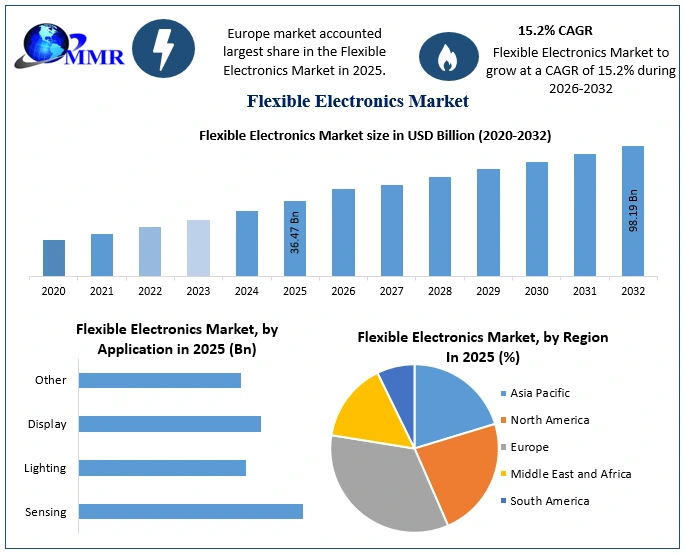
- Flexible Electronics Market size stood at USD 36.47 billion in 2025.
- Market revenue is projected to reach USD 98.19 billion by 2032.
- The market is expected to expand at a 15.2% CAGR during 2026–2032.
- Rising consumer electronics demand remains the primary growth catalyst.
- Flexible displays continue to be a major technology adoption area.
- Wearables, sensors, healthcare devices, and automotive electronics are creating new opportunities.
- Asia-Pacific remains the center of electronics manufacturing expansion.
- Flexible OLED and advanced display technologies are accelerating commercialization.
Why This Matters Now
The electronics industry is entering a new design era where devices are no longer constrained by rigid form factors. Manufacturers are racing to build thinner, lighter, foldable, and more energy-efficient products as consumers demand higher functionality in smaller footprints.
For OEMs, component suppliers, and technology investors, flexible electronics has evolved from a niche innovation into a strategic manufacturing priority. As AI-enabled devices, IoT ecosystems, advanced displays, and wearable technologies proliferate, demand for flexible electronic components is expanding across multiple industries simultaneously.
Market Overview
The Flexible Electronics Market Size was valued at USD 36.47 billion in 2025 and is forecast to reach USD 98.19 billion by 2032, registering a CAGR of 15.2% during the forecast period.
Flexible electronics refers to electronic components and systems built on bendable substrates that can conform to different shapes while maintaining functionality. The technology is increasingly integrated into smartphones, laptops, televisions, wearable devices, healthcare sensors, identification tags, industrial monitoring systems, automotive applications, and aerospace equipment.
The market’s growth trajectory is closely linked to the global shift toward portable, lightweight, and connected electronics. Manufacturers are increasingly replacing conventional rigid components with flexible alternatives to improve product design flexibility, reduce weight, and enhance user experience.
What changed is the scale of commercial adoption. Flexible electronics is no longer limited to research laboratories. It is becoming embedded within mainstream consumer and industrial products.
Key Trends Driving Growth
Consumer electronics remains the strongest force behind market expansion. Smartphones, tablets, laptops, smartwatches, and wearable devices increasingly require components that maximize functionality while minimizing space consumption.
Flexible displays are becoming a critical differentiator for device manufacturers. Foldable smartphones, rollable screens, and lightweight display systems allow brands to introduce premium features without increasing device dimensions.
The rise of wearable technology is creating another major demand center. Health-monitoring devices, fitness trackers, and smart healthcare systems require electronics capable of adapting to body movement while maintaining reliability.
IoT deployment is further accelerating adoption. Connected sensors used across manufacturing facilities, transportation systems, healthcare infrastructure, and smart buildings benefit from flexible designs that enable installation in space-constrained environments.
Automotive manufacturers are also integrating flexible sensors and display technologies into next-generation vehicles. The technology supports advanced dashboards, interior lighting systems, and human-machine interface applications.
The convergence of flexible displays, sensors, batteries, and printed electronics is creating entirely new product categories that were previously impractical with rigid electronic architectures.
Access Future Market Outlook and Growth Strategies with a Sample
Segment Insights
- Dominant Segment: Consumer Electronics
Consumer electronics continues to account for the largest share of demand. Smartphones, televisions, laptops, and wearable devices increasingly rely on flexible displays and lightweight electronic components to improve design efficiency and user experience.
- Fastest-Growing Segment: Wearable and Smart Device Applications
Growing adoption of health-monitoring devices, fitness trackers, and connected wearables is accelerating demand for flexible sensors and display technologies. Manufacturers are prioritizing comfort, portability, and durability, all of which favor flexible electronic architectures.
- Flexible OLED displays remain a major commercialization opportunity.
- Flexible sensors are gaining traction across healthcare, automotive, and industrial applications.
- Printed electronics continue to expand use cases in smart labels, tracking systems, and connected devices.
- Emerging applications in aerospace and industrial monitoring are creating additional revenue streams.
Regional Growth Story
Asia-Pacific remains the strategic center of flexible electronics manufacturing and innovation. The region benefits from strong consumer electronics production capacity, extensive supply-chain networks, and large-scale display manufacturing ecosystems.
China, South Korea, Japan, and India continue to strengthen their positions in electronics production and technology development. Their manufacturing scale allows faster commercialization of flexible displays, wearable electronics, and advanced sensor technologies.
North America remains an important innovation hub. Technology companies and research institutions continue to drive product development in healthcare devices, advanced materials, and industrial electronics.
Europe is expanding adoption through automotive electronics, industrial automation, and sustainability-focused innovation initiatives.
The competitive advantage increasingly belongs to regions capable of combining manufacturing scale with advanced materials expertise and electronics design capabilities.
Competitive Landscape
Competition is shifting beyond product performance toward ecosystem control.
Leading participants including Samsung Electronics, LG Electronics, E Ink Holdings, First Solar, General Electric, Palo Alto Research Center, and MFLEX are investing in technologies that enable next-generation device architectures.
Flexible display innovation signals a broader battle for leadership in premium consumer electronics. Companies capable of delivering reliable foldable and bendable displays gain pricing power and stronger differentiation in competitive device markets.
Investments in flexible sensors and wearable technologies indicate a move toward healthcare digitization and continuous monitoring applications. This creates opportunities that extend far beyond traditional consumer electronics.
Meanwhile, advancements in flexible photovoltaic technologies point to future applications in energy harvesting, smart infrastructure, and connected industrial systems.
The competitive landscape increasingly rewards companies that can integrate materials science, manufacturing expertise, and device engineering into scalable commercial platforms.
Recent Developments
- Growing commercialization of flexible OLED display technologies.
- Expansion of wearable device ecosystems requiring flexible components.
- Increased deployment of flexible sensors across healthcare applications.
- Rising adoption of lightweight electronic architectures in automotive systems.
- Greater integration of flexible electronics into industrial monitoring solutions.
- Continued innovation in printed electronics and smart labeling technologies.
Strategic Implications
For electronics manufacturers, flexible electronics represents a pathway toward product differentiation and premium pricing.
For component suppliers, the opportunity lies in enabling the next generation of displays, sensors, batteries, and connected devices.
For investors, the market’s growth reflects a broader transformation in device design and electronics manufacturing. Demand is expanding simultaneously across consumer electronics, healthcare, automotive, industrial automation, and IoT sectors.
For governments and regional manufacturing hubs, flexible electronics supports broader goals around advanced manufacturing competitiveness and technology leadership.
The market is moving from component innovation to ecosystem expansion.
Future Outlook
The next phase of growth will be defined by the convergence of flexible displays, intelligent sensors, wearable computing, connected devices, and AI-enabled electronics. Companies that successfully industrialize flexible electronic manufacturing at scale will shape the future of consumer technology, while those tied to conventional device architectures risk losing relevance as next-generation electronics become the industry standard.
Analyst Perspective
“Flexible electronics is transitioning from a specialized technology into a foundational platform for future device innovation. As manufacturers pursue lighter, smarter, and more adaptable products, flexible displays, sensors, and wearable technologies are expected to become central to competitive differentiation across global electronics markets.” — Rucha Deshpande, Analyst
About Maximize Market Research
Maximize Market Research Pvt. Ltd. (MMR) is a global market research and consulting company that provides reliable, data-focused, and practical business insights. The firm serves a wide range of industries, including healthcare, pharmaceuticals, technology, automotive, electronics, chemicals, personal care, and consumer goods. Through market forecasts, competitive analysis, strategic consulting, and industry impact assessments, MMR helps organizations understand changing market conditions, identify growth opportunities, and make informed business decisions for long-term success.
Contact Us
2nd Floor, Navale IT Park Phase 3
Pune Banglore Highway, Narhe
Pune, Maharashtra 411041, India
+91 9607365656
sales@maximizemarketresearch.com
