Key Highlights
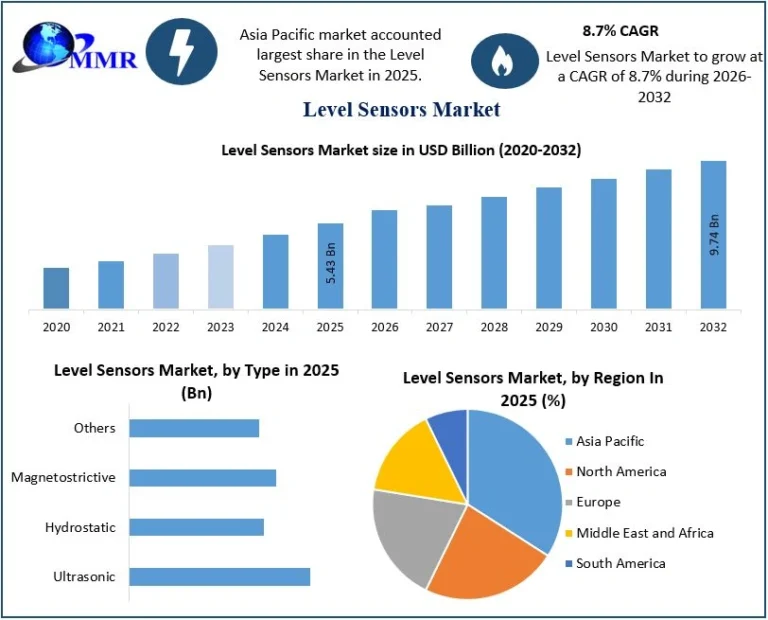
- Level Sensors Market valued at USD 5.43 billion in 2025.
- Market expected to reach nearly USD 9.74 billion by 2032.
- Revenue forecast reflects a CAGR of 8.7% from 2026 to 2032.
- Industrial automation remains a major catalyst for deployment.
- IoT-enabled monitoring systems are expanding sensor applications.
- Smart manufacturing investments continue to increase demand for precision sensing technologies.
Why This Matters Now
Factories are becoming data centers. Every production line, storage tank, processing facility, and utility network increasingly depends on real-time operational intelligence.
The Level Sensors Market was valued at USD 5.43 billion in 2025 and is expected to reach nearly USD 9.74 billion by 2032, growing at a CAGR of 8.7% from 2026 to 2032. That growth signals rising investment in digital industrial infrastructure where accurate measurement, predictive maintenance, and automated control systems have become operational necessities rather than optional upgrades.
For electronics manufacturers, semiconductor producers, OEMs, and industrial operators, level sensing technology has become a foundational component of Industry 4.0 deployment strategies.
Market Overview
What changed is the role of sensors within industrial ecosystems. Historically, level sensors were measurement devices. Today, they function as data-generation assets that support automation, analytics, and intelligent decision-making.
Manufacturers are pursuing higher productivity, lower downtime, and improved resource utilization. These objectives require continuous monitoring across liquids, solids, chemicals, fuels, and industrial materials.
The result is growing integration of level sensing technologies with cloud platforms, industrial IoT networks, edge-computing environments, and factory automation systems.
As production facilities become increasingly connected, sensor deployment is expanding beyond traditional industrial applications into broader digital infrastructure strategies.
Explore detailed analysis, insights, and growth opportunities
Key Trends Driving Growth
Industrial automation remains the strongest structural growth driver. Manufacturers are modernizing operations to improve efficiency, reduce labor-intensive processes, and increase operational visibility.
Industry 4.0 adoption is accelerating deployment of connected sensing technologies. Smart factories require continuous data streams to support automated workflows, predictive maintenance programs, and digital twin initiatives.
IoT integration is creating new opportunities. Connected level sensors can transmit operational data in real time, enabling centralized monitoring and faster decision-making across geographically distributed facilities.
Edge computing is also influencing market evolution. Processing sensor data closer to the point of generation improves response times and reduces network dependency, making level monitoring more effective in critical industrial environments.
Sustainability objectives are becoming another important growth catalyst. Industrial operators are under pressure to optimize water consumption, reduce waste, improve energy efficiency, and strengthen environmental compliance programs. Accurate level monitoring supports all four objectives.
Digital transformation across utilities, chemicals, food processing, energy, pharmaceuticals, and manufacturing industries continues to expand the addressable market for advanced sensing technologies.
Segment Insights
- Dominant Segment: Not specified in the supplied source.
- Fastest-Growing Segment: Not specified in the supplied source.
- Demand is increasing for intelligent sensing systems that integrate with digital industrial platforms.
- Non-contact monitoring technologies continue to attract attention in complex industrial environments.
- Industrial automation applications remain key demand centers.
- Connected sensors are becoming increasingly important within IoT-enabled operational ecosystems.
Regional Growth Story
Industrial digitization is reshaping regional investment priorities worldwide.
The United States continues investing in advanced manufacturing, industrial modernization, and digital infrastructure. Sensor technologies are becoming increasingly important as factories integrate automation, robotics, and AI-driven operational analytics.
Across Europe, industrial companies are pursuing efficiency improvements and sustainability objectives. Germany remains a major center for industrial engineering and smart manufacturing initiatives, creating favorable conditions for advanced sensing solutions.
Asia-Pacific continues to strengthen its position within global electronics manufacturing and industrial production networks. China, Japan, South Korea, and India are expanding manufacturing capabilities, increasing automation adoption, and investing in digital industrial ecosystems.
These developments are creating long-term opportunities for sensor manufacturers that can deliver reliability, precision, interoperability, and integration capabilities.
Supply-chain resilience initiatives are also encouraging investment in operational visibility technologies, further supporting adoption of advanced level sensing solutions.
Competitive Landscape
Competition is increasingly shifting toward intelligence rather than hardware alone.
Sensor manufacturers are competing on measurement accuracy, connectivity, software integration, analytics capabilities, and long-term reliability. The value proposition is moving beyond sensing toward actionable operational insight.
This transition mirrors broader developments across the electronics and semiconductor industries. Just as semiconductor companies compete on performance-per-watt and AI processing capabilities, sensor manufacturers are differentiating through intelligence, interoperability, and ecosystem integration.
The companies that successfully combine sensing hardware with software analytics, cloud connectivity, and industrial automation compatibility will likely strengthen pricing power and customer retention.
Technology leadership increasingly depends on enabling customers to transform raw operational data into measurable business outcomes.
Recent Developments
- Growing integration of level sensors into Industry 4.0 environments.
- Increased adoption of IoT-enabled monitoring systems.
- Expansion of predictive maintenance initiatives across industrial sectors.
- Rising demand for real-time process visibility and operational analytics.
- Greater emphasis on sustainability, efficiency, and resource optimization.
- Continued investment in smart manufacturing infrastructure.
Strategic Implications
For industrial manufacturers, level sensors are becoming strategic operational assets rather than standalone measurement tools.
For electronics and semiconductor suppliers, expanding industrial digitization creates opportunities for sensor components, embedded systems, connectivity modules, and edge-computing platforms.
For investors, market expansion reflects a broader shift toward intelligent infrastructure and automated industrial operations. The growth trajectory suggests increasing demand for technologies that enable efficiency, visibility, and operational resilience.
For OEMs, interoperability will become a key differentiator. Customers increasingly require sensor platforms that integrate seamlessly with enterprise software, automation systems, and industrial IoT architectures.
Future Outlook
The next phase of competition will be defined by data intelligence. Sensor performance will remain important, but the greatest value creation will come from platforms capable of transforming measurement data into predictive operational insight.
As AI, industrial IoT, edge computing, and smart manufacturing ecosystems converge, level sensing technologies will move closer to the center of industrial decision-making.
The companies that build intelligent, connected, and software-enabled sensing ecosystems will define the next generation of industrial infrastructure, while those that remain focused solely on measurement hardware risk losing relevance in an increasingly autonomous manufacturing economy.
Analyst Perspective
“The level sensors market is increasingly being shaped by industrial digitization, automation investments, and the growing need for real-time operational intelligence. Organizations that align sensing technologies with broader digital transformation strategies will be positioned to capture the greatest long-term value.” — Rucha Deshpande, Analyst
About Maximize Market Research
Maximize Market Research Pvt. Ltd. (MMR) is a global market research and consulting company that provides reliable, data-focused, and practical business insights. The firm serves a wide range of industries, including healthcare, pharmaceuticals, technology, automotive, electronics, chemicals, personal care, and consumer goods. Through market forecasts, competitive analysis, strategic consulting, and industry impact assessments, MMR helps organizations understand changing market conditions, identify growth opportunities, and make informed business decisions for long-term success.
Contact Us :
2nd Floor, Navale IT Park Phase 3
Pune Banglore Highway, Narhe
Pune, Maharashtra 411041, India
+91 9607365656
sales@maximizemarketresearch.com
