LiDAR Adoption in Mobile Robotics Gains Momentum Amid Rapid Expansion of Autonomous Warehousing and Smart Manufacturing
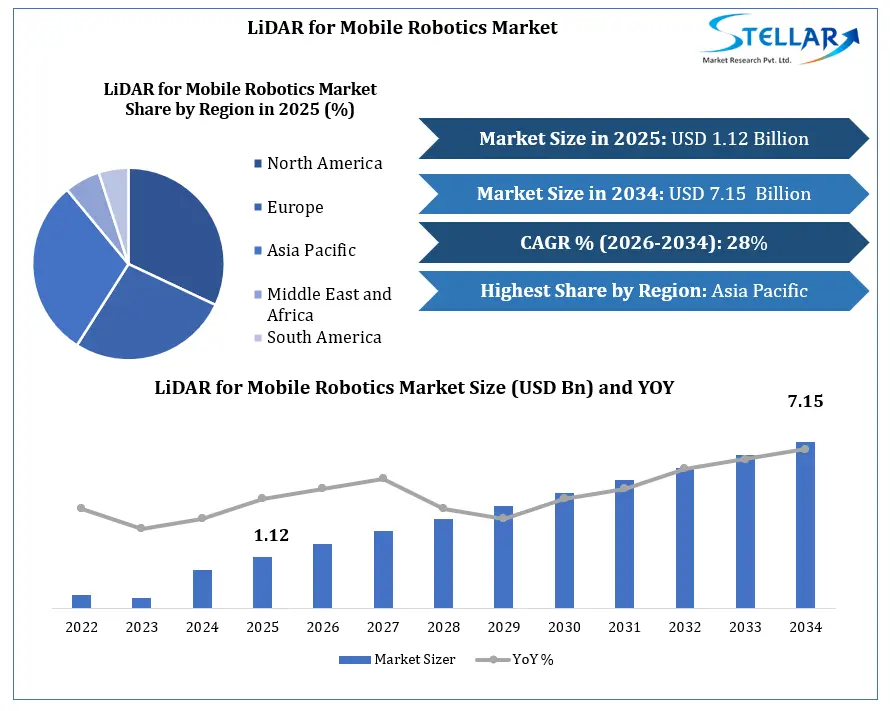
PUNE, India, June 25, 2026 — The LiDAR for Mobile Robotics Market is entering a new phase of growth as enterprises accelerate investments in autonomous mobile robots (AMRs), AI-powered navigation systems, and smart logistics infrastructure. According to a recent study by Stellar Market Research, the market is projected to witness robust expansion through the forecast period, supported by increasing deployment of robotics across warehousing, manufacturing, healthcare, and last-mile delivery operations. The LiDAR for Mobile Robotics Market was valued at USD 1.12 Billion in 2025 and is forecast to reach USD 7.15 Billion by 2034, growing at a 28% CAGR.
The report highlights that LiDAR sensors are becoming a foundational technology for next-generation mobile robotics, enabling precise mapping, obstacle detection, localization, and autonomous navigation in dynamic environments. As labor shortages, e-commerce growth, and industrial automation initiatives intensify globally, demand for advanced perception technologies continues to rise.
Market Opportunity Overview
The most significant transformation shaping the LiDAR for Mobile Robotics Market is the convergence of AI-driven autonomy with scalable warehouse automation. Organizations are shifting from manually operated systems toward fleets of intelligent mobile robots capable of real-time decision-making and collaborative operations.
LiDAR has emerged as a critical sensing technology because it delivers high-accuracy 3D environmental perception regardless of lighting conditions. As fulfillment centers, manufacturing facilities, airports, and healthcare institutions seek greater efficiency and operational resilience, LiDAR-enabled robots are becoming central to digital transformation strategies.
The market is also benefiting from declining sensor costs, advances in solid-state LiDAR architecture, and increasing integration with machine vision, edge computing, and sensor fusion technologies. These developments are expanding the commercial viability of autonomous robots across a broader range of applications.
Download Free PDF Brochure: https://www.stellarmr.com/report/req_sample/liDAR-for-mobile-robotics-market/2949
Key Findings from the Report
The market is forecast to register strong double-digit growth during the forecast period as industrial automation investments increase globally.
3D LiDAR remains the dominant product segment due to its superior mapping accuracy and navigation performance.
Solid-state LiDAR is projected to be the fastest-growing segment, driven by lower costs, compact design, and improved reliability.
Autonomous Mobile Robots (AMRs) account for a significant share of LiDAR deployment as warehouses expand robotic fleets.
Logistics and warehousing continue to represent the largest end-user category owing to rapid growth in e-commerce fulfillment operations.
North America currently leads market adoption due to strong investments in industrial automation and robotics technologies.
Asia-Pacific is emerging as the fastest-growing regional market, supported by robotics manufacturing expansion in China, Japan, South Korea, and India.
Market Drivers and Restraints
Key Drivers
Expansion of Warehouse Automation
Global fulfillment centers are increasingly deploying AMRs and automated guided vehicles (AGVs) to improve throughput, reduce labor dependency, and optimize operational efficiency.
Growth of AI-Powered Robotics
Advancements in machine learning, SLAM (Simultaneous Localization and Mapping), and edge processing are increasing the value proposition of LiDAR-enabled navigation systems.
Declining Cost of Solid-State LiDAR
Technological improvements and manufacturing scale are making LiDAR sensors more affordable, encouraging broader adoption across commercial and industrial robotics.
Key Restraints
High Initial System Integration Costs
Despite cost reductions, implementing LiDAR-equipped robotic fleets still requires significant investments in infrastructure and software integration.
Competition from Alternative Sensing Technologies
Computer vision systems, radar technologies, and sensor fusion solutions continue to compete with standalone LiDAR deployments in some applications.
Technology, Regulation, and Sustainability Trends
Recent innovation is centered on solid-state LiDAR, AI-enhanced perception algorithms, and multi-sensor fusion architectures. Manufacturers are focusing on improving range, accuracy, and energy efficiency while reducing sensor size and cost.
Governments across major economies are supporting robotics adoption through smart manufacturing initiatives, Industry 4.0 programs, and automation incentives. These policies are accelerating demand for autonomous systems capable of improving productivity and workforce safety.
From a sustainability perspective, mobile robotics contributes to optimized resource utilization, reduced energy waste, and improved operational efficiency in logistics facilities. Autonomous navigation systems also help reduce equipment collisions and downtime, extending asset lifecycles and supporting ESG objectives.
Regional Insights
North America: Market Leadership Through Automation Investment
North America maintains a leading position due to widespread deployment of robotics across warehousing, manufacturing, and logistics sectors. The United States continues to drive innovation through significant investments in automation technologies, AI research, and industrial digitalization initiatives.
Asia-Pacific: Fastest-Growing Opportunity
Asia-Pacific is expected to deliver the strongest growth through the forecast period. China’s manufacturing modernization strategy, Japan’s advanced robotics ecosystem, South Korea’s automation investments, and India’s expanding logistics infrastructure are creating substantial demand for LiDAR-equipped mobile robots.
Europe: Industry 4.0 Adoption Supports Growth
European markets are benefiting from strong Industry 4.0 adoption, increasing automation investments, and growing deployment of collaborative robotics in manufacturing and logistics operations.
Recent Industry Developments
RoboSense (2026): Reported robotics LiDAR sales growth exceeding 1,100% year-over-year, highlighting surging demand from robotics applications and strengthening the company’s diversification beyond automotive markets.
RoboSense (2024): Achieved more than 243,000 LiDAR unit shipments during the first half of 2024, reflecting accelerating commercialization of LiDAR technologies across robotics and ADAS applications.
Ouster (2024): Continued integration initiatives following its merger with Velodyne, strengthening product portfolios and expanding industrial robotics offerings.
Hesai Technology (2025): Expanded high-performance LiDAR deployments targeting autonomous logistics and industrial robotics applications.
Innoviz Technologies (2025): Advanced next-generation solid-state LiDAR platforms designed to improve scalability, durability, and cost efficiency for autonomous systems.
Competitive Landscape
The LiDAR for Mobile Robotics Market remains highly competitive, with companies focusing on sensor innovation, strategic partnerships, software integration, and manufacturing scale.
Key market participants include Ouster, Hesai Technology, RoboSense, SICK AG, Innoviz Technologies, Luminar Technologies, LeddarTech, Leuze Electronic, Cepton Technologies, and RIEGL Laser Measurement Systems. Market leaders are increasingly investing in solid-state architectures, AI-enhanced perception software, and robotics-specific sensor platforms to strengthen their competitive positions.
Download Free PDF Brochure: https://www.stellarmr.com/report/req_sample/liDAR-for-mobile-robotics-market/2949
Analyst Commentary
“The next wave of industrial automation will be defined by intelligent mobility. As enterprises deploy larger fleets of autonomous robots, demand for high-performance perception systems will accelerate. LiDAR technology is evolving rapidly, with solid-state innovation and AI integration making autonomous navigation more accessible across industries,” said a Senior Research Analyst at Stellar Market Research.
Future Outlook
Looking ahead, the LiDAR for Mobile Robotics Market is expected to benefit from sustained investments in warehouse automation, smart manufacturing, autonomous logistics, and service robotics. Continuous improvements in sensor performance, cost efficiency, and AI-enabled perception will further expand adoption across new use cases.
As organizations prioritize productivity, resilience, and operational intelligence, LiDAR-enabled mobile robotics will play an increasingly critical role in digital transformation strategies worldwide. Competitive dynamics are expected to intensify as technology providers accelerate innovation, pursue strategic partnerships, and expand production capabilities throughout the forecast period.
About Stellar Market Research
Stellar Market Research is a global market research and business consulting firm delivering actionable intelligence across industries including technology, healthcare, manufacturing, automotive, consumer goods, and energy. The company provides comprehensive market assessments, competitive benchmarking, strategic forecasting, and customized consulting solutions that help organizations identify growth opportunities and make informed business decisions. Through rigorous primary and secondary research methodologies, Stellar Market Research delivers reliable insights into market dynamics, emerging trends, customer behavior, and competitive landscapes. Its research supports corporate strategy, investment planning, product development, and market expansion initiatives for businesses worldwide.
Media Contact
Stellar Market Research
Website: https://www.stellarmr.com/
Email: sales@stellarmr.com
SEO Output
Meta Title:
LiDAR for Mobile Robotics Market Driven by AI Automation
Meta Description:
LiDAR for Mobile Robotics Market gains momentum as AI navigation, warehouse automation, and solid-state sensor innovation drive global growth.
URL Slug:
lidar-for-mobile-robotics-market-ai-automation-growth
SEO Tags:
LiDAR for Mobile Robotics Market
Autonomous Mobile Robots
Solid-State LiDAR
Warehouse Automation Market
Industrial Robotics Sensors
Alternative Headlines:
Warehouse Automation Fuels Next Growth Phase for LiDAR Robotics Market
AI-Powered Mobile Robots Drive Global Demand for Advanced LiDAR Systems
Solid-State LiDAR Innovation Reshapes Mobile Robotics Industry Outlook
Primary Keyword:
LiDAR for Mobile Robotics Market
Secondary Keywords:
Mobile Robotics LiDAR
Autonomous Mobile Robots
Solid-State LiDAR
Robotics Navigation Systems
Industrial Automation Sensors
Long-Tail Keywords:
Global LiDAR for Mobile Robotics Market Report
LiDAR sensors for autonomous mobile robots
Solid-state LiDAR for warehouse automation
AI-powered mobile robotics navigation market
LiDAR for industrial robotics applications
Buyer-Intent Keywords:
LiDAR for Mobile Robotics Market Report
Buy LiDAR for Mobile Robotics Market Analysis
Mobile Robotics LiDAR Industry Forecast
LiDAR Robotics Market Competitive Landscape
LiDAR Sensor Market Investment Opportunities
Suggested Anchor Text for Report Link:
LiDAR for Mobile Robotics Market Report by Stellar Market Research
