Key Highlights
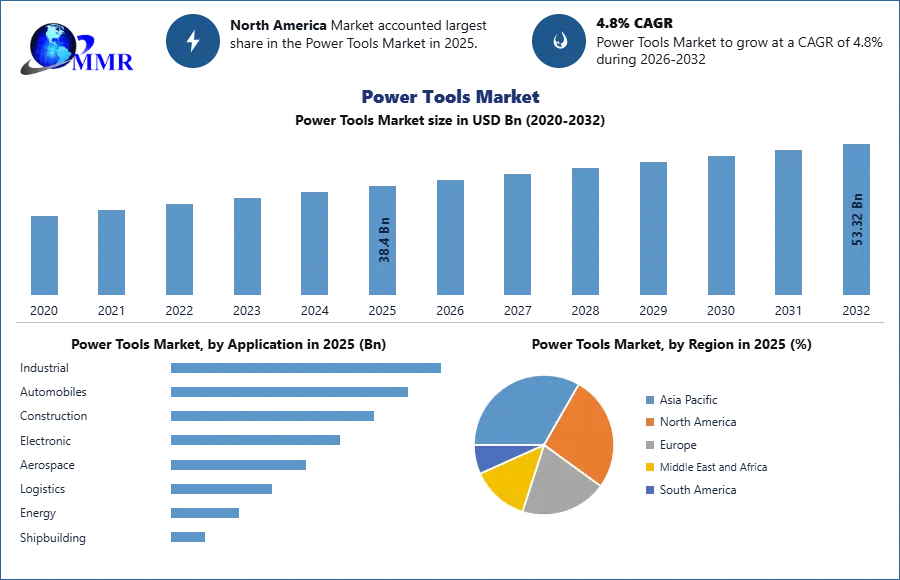
- Global Power Tools Market valued at USD 38.4 billion in 2025.
- Market expected to reach USD 53.32 billion by 2032.
- Revenue projected to expand at a CAGR of 4.8% during 2026–2032.
- Industrial applications accounted for more than 63% of total market revenue in 2025.
- Residential segment projected to grow at the fastest rate of 4.6% through 2032.
- Asia Pacific held the largest regional share of 33.2% in 2025.
- Cordless electric power tools continue gaining adoption due to advances in lithium-ion battery technology.
- Automotive, construction, aerospace, logistics, and manufacturing sectors remain major demand generators.
Why This Matters Now
Manufacturers are under pressure to improve productivity while controlling labor costs and meeting tighter project deadlines. Power tools have become critical productivity assets across construction sites, factories, logistics centers, and maintenance operations.
The market is also entering a technology transition. Cordless systems, high-density lithium-ion batteries, smart diagnostics, and connected tool ecosystems are changing purchasing decisions. Companies that lead in battery platforms and industrial productivity solutions are positioning themselves for long-term competitive advantage.
Market Overview
The Power Tools Market Size is moving through a period of modernization driven by industrial automation, infrastructure investment, and growing demand for portable productivity solutions. The market generated USD 38.4 billion in revenue in 2025 and is forecast to reach nearly USD 53.32 billion by 2032, expanding at a CAGR of 4.8%.
Power tools have evolved from standalone equipment into productivity platforms. Manufacturing facilities increasingly rely on advanced fastening, drilling, cutting, grinding, and material-removal solutions to improve operational efficiency. Every percentage gain in productivity translates directly into lower labor costs and faster project completion.
Construction activity remains a major catalyst. Expanding urban infrastructure, commercial developments, transportation projects, and industrial facilities continue to increase demand for professional-grade tools. At the same time, residential renovation activity is creating additional growth opportunities for manufacturers.
Key Trends Driving Growth
Cordless technology is becoming the industry’s most influential growth driver. Demand for mobile, versatile, and compact tools is accelerating as users seek greater flexibility across job sites and industrial environments.
Lithium-ion batteries are replacing traditional nickel-cadmium and nickel-metal hydride technologies. Longer runtime, improved energy density, and reduced charging frequency are making cordless tools more attractive to professional users.
Industrial automation is also strengthening demand. Modern manufacturing facilities require precise assembly tools, fastening equipment, and maintenance solutions that improve production consistency and reduce downtime.
Another emerging opportunity comes from renewable energy infrastructure. Wind turbine installation and maintenance require high-precision electric fastening tools capable of delivering exact torque levels. As renewable energy capacity expands globally, tool manufacturers gain access to new industrial demand streams.
Safety and regulatory compliance are becoming increasingly important competitive differentiators. Global customers demand reliable products that meet evolving environmental and workplace safety requirements, pushing manufacturers toward higher engineering standards and product innovation.
Get a Preview of Market Trends, Growth Drivers, and Opportunities
Segment Insights
- Dominant Segment: Industrial Applications
- Accounted for more than 63% of market revenue in 2025.
- Driven by strong adoption across automotive, construction, aerospace, logistics, and manufacturing industries.
- Industrial users prioritize productivity, durability, precision, and operational efficiency.
- Fastest-Growing Segment: Residential Applications
- Expected to grow at a CAGR of 4.6% through 2032.
- Expansion supported by rising DIY activity and increasing home renovation projects.
- User-friendly cordless products continue attracting non-professional consumers.
- Power Source Trend
- Cordless electric power tools continue gaining momentum.
- Improved battery technology is enhancing portability and productivity.
- Tool Type Trend
- Drilling, driving, sawing, cutting, demolition, routing, and material-removal tools remain critical categories across industrial operations.
Regional Growth Story
Asia Pacific remains the center of gravity for the global Power Tools Market, accounting for 33.2% of market revenue in 2025. The region benefits from rapid industrialization, expanding automotive production, infrastructure investments, and rising disposable incomes.
China and India are major contributors to regional growth. Manufacturing expansion and large-scale construction projects continue creating substantial demand for professional power tools.
North America represented 26.2% of global revenue in 2025. Infrastructure development, industrial modernization, and strong DIY culture continue supporting market expansion. Labor shortages in several sectors are increasing reliance on productivity-enhancing tools.
Europe remains an important market supported by advanced manufacturing capabilities. Germany and the United Kingdom are driving regional demand through industrial production, engineering excellence, and continued investment in manufacturing technologies.
Competitive Landscape
Competition is increasingly centered on cordless ecosystems, battery platforms, digital integration, and productivity enhancements rather than tool hardware alone.
Major participants including Stanley Black & Decker, Robert Bosch GmbH, Techtronic Industries, Makita Corporation, Hilti Corporation, Atlas Copco, Snap-on, Ingersoll Rand, Apex Tool Group, and others are investing in innovation to strengthen customer retention and ecosystem adoption.
Battery technology has become a strategic battleground. Manufacturers capable of delivering longer runtimes, faster charging, and cross-platform compatibility gain stronger pricing power and customer loyalty.
Digital tool management is emerging as another differentiator. Smart diagnostics, predictive maintenance capabilities, and connected equipment solutions help industrial customers reduce downtime and improve asset utilization.
The competitive landscape signals a broader industry transition from selling individual tools toward delivering integrated productivity solutions.
Recent Developments
- Robert Bosch GmbH launched Bosch Toolbox App 2.0 featuring AI-driven diagnostics for real-time tool health monitoring.
- Stanley Black & Decker commercialized circular saws equipped with next-generation brushless motors delivering 20% higher torque.
- Makita Corporation expanded lithium-ion battery manufacturing capacity to support its XGT 40V Max platform.
- Manufacturers continue investing in cordless ecosystems to strengthen platform adoption and recurring customer purchases.
- Product development is increasingly focused on predictive maintenance, digital connectivity, and productivity optimization.
Strategic Implications
The market’s future competitiveness will depend heavily on battery innovation, digital integration, and ecosystem strategy.
Manufacturers that establish strong battery platforms can generate recurring revenue through tool compatibility and customer lock-in. This creates higher switching costs and stronger margins.
Industrial customers are shifting purchasing criteria from initial tool cost to lifecycle productivity. Vendors that reduce downtime, improve efficiency, and simplify maintenance will capture greater market share.
Renewable energy installations, industrial automation, and infrastructure modernization represent long-term growth opportunities that extend beyond traditional construction demand.
Future Outlook
The Power Tools Market is transitioning from a hardware-driven industry into a technology-enabled productivity ecosystem. Cordless platforms, lithium-ion innovation, connected diagnostics, and industrial automation will increasingly determine market leadership.
Companies that combine battery innovation, smart tool intelligence, industrial productivity expertise, and scalable ecosystems will define the next generation of market winners, while manufacturers that remain focused solely on conventional tool sales risk losing relevance in an increasingly connected industrial landscape.
Analyst Perspective
“The Power Tools Market is entering a phase where innovation in cordless systems, battery technology, and intelligent tool management will drive competitive differentiation. Companies that align product development with industrial productivity, infrastructure growth, and emerging energy applications will be best positioned to capture long-term value creation opportunities.” — Rucha Deshpande, Analyst
About Maximize Market Research
Maximize Market Research Pvt. Ltd. (MMR) is a global market research and consulting company that provides reliable, data-focused, and practical business insights. The firm serves a wide range of industries, including healthcare, pharmaceuticals, technology, automotive, electronics, chemicals, personal care, and consumer goods. Through market forecasts, competitive analysis, strategic consulting, and industry impact assessments, MMR helps organizations understand changing market conditions, identify growth opportunities, and make informed business decisions for long-term success.
Contact Us
2nd Floor, Navale IT Park Phase 3
Pune Banglore Highway, Narhe
Pune, Maharashtra 411041, India
+91 9607365656
sales@maximizemarketresearch.com
