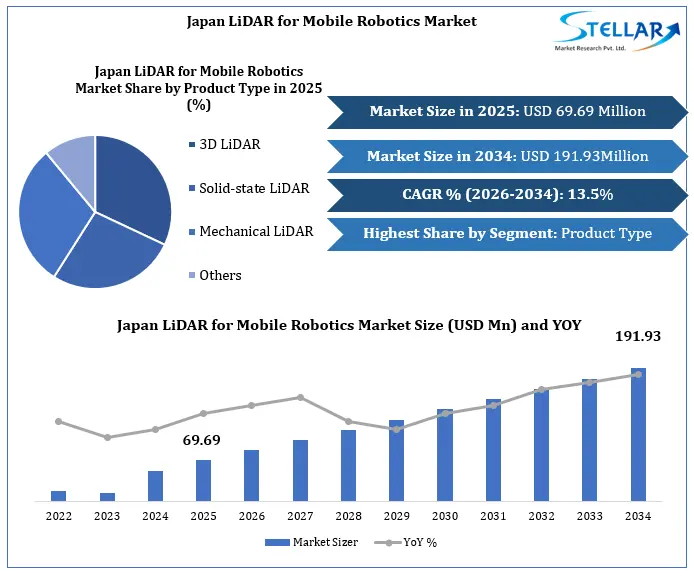
Japan LiDAR for Mobile Robotics Market valued at USD 96.8 Million in 2025 is projected to grow at a CAGR of 13.5% through 2034, driven by smart manufacturing, warehouse automation, and next-generation autonomous mobile robots.
PUNE, India, June 25, 2026 – The Japan LiDAR for Mobile Robotics Market is witnessing rapid expansion as advanced manufacturing facilities, logistics operators, and technology innovators accelerate investments in autonomous robotics and intelligent automation. According to a newly published study by Stellar Market Research, the market was valued at USD 69.69 Million in 2025 and is expected to reach approximately USD 191.93 Million by 2034, registering a robust 13.5% CAGR during the forecast period of 2026–2034.
The report identifies LiDAR technology as a critical enabler of Japan’s next phase of industrial automation, supporting autonomous navigation, obstacle detection, mapping accuracy, and real-time decision-making for mobile robotic platforms. As Japan addresses workforce shortages and productivity challenges, LiDAR-enabled robotics are becoming increasingly important across manufacturing, warehousing, healthcare, retail, and transportation sectors.
Market Opportunity Overview
Japan has long been recognized as a global leader in industrial robotics. However, the market is now shifting toward autonomous mobile robotics capable of operating independently in dynamic environments. This transformation is creating significant opportunities for LiDAR technology providers.
Unlike traditional automation systems that rely on fixed infrastructure, mobile robots require advanced perception capabilities to navigate changing environments safely and efficiently. LiDAR sensors provide highly accurate three-dimensional mapping and localization, enabling autonomous mobile robots (AMRs) and automated guided vehicles (AGVs) to operate with greater precision.
The growing adoption of Industry 4.0 initiatives, smart factories, and AI-powered logistics networks is driving demand for advanced sensing technologies. As Japanese enterprises pursue operational efficiency and supply chain resilience, LiDAR is increasingly viewed as a strategic investment rather than a discretionary technology upgrade.
Download Free PDF Brochure: https://www.stellarmr.com/report/req_sample/japan-liDAR-for-mobile-robotics-market/2951
Key Findings from the Report
The Japan LiDAR for Mobile Robotics Market was valued at USD 69.69 Million in 2025.
The market is forecast to reach approximately USD 191.93 Million by 2034.
The industry is expected to expand at a 25.4% CAGR between 2026 and 2034.
Autonomous Mobile Robots (AMRs) account for the dominant application segment due to widespread use in manufacturing and logistics.
Solid-State LiDAR is projected to be the fastest-growing technology segment as organizations prioritize lower-cost and more compact sensing solutions.
Manufacturing and warehouse automation represent the largest end-user sectors.
The Kanto region remains the leading market, while Kansai is emerging as a key growth hub supported by industrial modernization initiatives.
Market Drivers and Restraints
Key Drivers
Labor Shortages Accelerating Automation Investments
Japan’s aging population and shrinking workforce continue to create operational challenges across industrial sectors. Companies are increasingly deploying autonomous robots to maintain productivity while reducing dependence on manual labor.
Expansion of Smart Manufacturing Programs
Manufacturers are integrating robotics, IoT platforms, AI systems, and digital twins into production environments. LiDAR technology serves as a foundational component enabling autonomous navigation and intelligent material handling.
Growth in E-commerce and Automated Warehousing
Rising online retail activity is generating strong demand for autonomous logistics solutions. LiDAR-equipped robots improve inventory management, route optimization, order fulfillment speed, and warehouse safety.
Key Restraints
High Initial Implementation Costs
Although LiDAR prices have declined substantially over recent years, advanced robotics deployments still require considerable capital expenditure, particularly for small and medium-sized enterprises.
Integration and Deployment Complexity
Industrial facilities often face challenges integrating LiDAR systems with existing enterprise software, manufacturing execution systems, and warehouse management platforms.
Technology, Regulation, and Sustainability Trends
Technological innovation remains central to market growth. Advanced AI-powered perception systems, machine learning algorithms, and Simultaneous Localization and Mapping (SLAM) technologies are improving navigation performance and enabling robots to operate effectively in complex industrial environments.
Japan’s government continues to promote digital transformation through its Society 5.0 vision, encouraging businesses to adopt advanced automation technologies. Regulatory emphasis on workplace safety is further supporting deployment of intelligent robotic systems equipped with high-precision environmental sensing capabilities.
Sustainability objectives are also influencing purchasing decisions. LiDAR-enabled robots improve operational efficiency, reduce energy consumption, optimize transportation routes, and minimize material waste. As organizations strengthen ESG commitments, autonomous robotics are increasingly viewed as tools for achieving both productivity and environmental goals.
Regional Insights
Kanto Leads Market Adoption
The Kanto region, which includes Tokyo, Yokohama, Chiba, and Saitama, remains the largest contributor to the Japan LiDAR for Mobile Robotics Market. The region benefits from a strong concentration of advanced manufacturers, technology companies, research institutions, and logistics facilities.
Kansai Emerges as a Growth Center
Kansai, including Osaka, Kyoto, and Kobe, is becoming an important growth market due to rising investments in smart manufacturing, healthcare automation, and warehouse modernization. The region’s industrial diversification is creating favorable conditions for autonomous robotics deployment.
The Chubu region is also gaining momentum, particularly due to its strong automotive manufacturing base and increasing adoption of automated material-handling systems.
Recent Industry Developments
RoboSense (2025): The company reported shipments of more than 303,000 robotics LiDAR units during 2025, representing annual growth exceeding 1,100%, reflecting accelerating demand for autonomous robotic sensing solutions.
Hesai Technology (2025): Expanded production capacity and strengthened its robotics-focused product portfolio to support growing demand from industrial automation and warehouse robotics customers across Asia.
SICK AG (2025): Introduced next-generation safety LiDAR systems designed to improve autonomous navigation and worker protection in factory and logistics environments.
Mitsubishi Electric Corporation (2025): Expanded smart factory automation initiatives integrating AI-enabled robotics and advanced sensing technologies across manufacturing facilities.
Japan Government Digital Transformation Initiative (2024–2025): Increased support for Industry 4.0 and robotics adoption programs, encouraging wider implementation of autonomous systems across manufacturing and logistics sectors.
Competitive Landscape
The Japan LiDAR for Mobile Robotics Market is characterized by strong innovation activity and strategic partnerships between robotics manufacturers and sensor technology providers. Key companies operating in the market include:
Hokuyo Automatic Co., Ltd.
Keyence Corporation
Panasonic Holdings Corporation
Mitsubishi Electric Corporation
SICK AG
RoboSense
Hesai Technology
Ouster
Industry participants are focusing on solid-state LiDAR development, AI-enhanced perception capabilities, product localization, and strategic collaborations to strengthen market presence. Investments in research and development remain a key competitive differentiator.
Download Free PDF Brochure: https://www.stellarmr.com/report/req_sample/japan-liDAR-for-mobile-robotics-market/2951
Analyst Commentary
“Japan’s mobile robotics ecosystem is evolving rapidly as enterprises move beyond fixed automation toward intelligent autonomous operations. LiDAR technology is becoming a critical infrastructure layer that enables safe, scalable, and highly efficient robotic deployment. Organizations that successfully integrate AI, sensing technologies, and autonomous mobility platforms will be positioned to capture significant long-term value,” said a Senior Research Analyst at Stellar Market Research.
Future Outlook
The outlook for the Japan LiDAR for Mobile Robotics Market remains highly positive through 2034. Continued investments in smart manufacturing, autonomous logistics, healthcare automation, and digital transformation initiatives are expected to sustain strong demand.
Advancements in solid-state LiDAR, declining sensor costs, AI-driven navigation systems, and improved software integration capabilities will further expand adoption opportunities. As competition intensifies, companies that combine technological innovation with scalable deployment models will be best positioned to capitalize on emerging growth opportunities.
About Stellar Market Research
Stellar Market Research is a global market research and consulting firm providing strategic intelligence, market forecasts, competitive analysis, and business advisory services across diverse industries. The company supports organizations in identifying growth opportunities, evaluating investment strategies, understanding market dynamics, and navigating rapidly evolving business environments. Through data-driven methodologies, extensive industry expertise, and comprehensive research frameworks, Stellar Market Research delivers actionable insights that help enterprises, investors, policymakers, and stakeholders make informed decisions. Its research portfolio spans technology, healthcare, manufacturing, automotive, energy, consumer goods, industrial automation, and emerging markets worldwide.
Media Contact
Stellar Market Research
Website: Stellar Market Research – Global Research Reports & Consulting
Email: sales@stellarmr.com
