Key Highlights
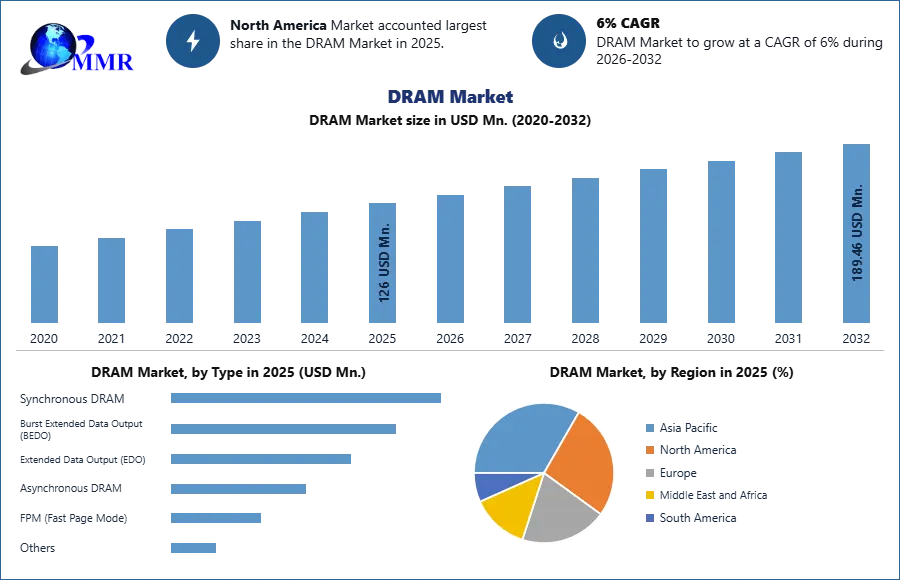
- DRAM Market valued at US$ 126 Bn in 2025
- Expected to reach US$ 189.46 Bn by 2032
- Projected CAGR of 6% during 2026–2032
- Data center expansion remains a primary demand catalyst
- AI and high-performance computing are accelerating memory requirements
- Semiconductor manufacturing growth is strengthening long-term demand
- Cost-efficient architecture continues to support broad adoption across computing systems
Why This Matters Now
Artificial intelligence is changing the economics of semiconductor manufacturing. As AI models become larger and enterprise workloads become more memory-intensive, DRAM has moved from being a supporting component to a strategic technology asset.
The race to expand AI infrastructure, build sovereign semiconductor ecosystems, and scale next-generation computing platforms is creating a new demand cycle for memory manufacturers. Companies that secure advanced memory supply chains will gain a competitive advantage in AI servers, cloud computing, edge devices, and high-performance computing environments.
Market Overview
The DRAM Market Size was valued at US$ 126 Bn in 2025 and is expected to grow at a 6% CAGR through 2032, reaching US$ 189.46 Bn.
Dynamic Random Access Memory remains one of the most important building blocks of modern computing systems. Every AI server, enterprise data center, personal computer, smartphone, and industrial computing platform depends on memory performance to process increasingly complex workloads.
What has changed is the scale of demand. Enterprises are processing larger datasets, governments are investing in digital infrastructure, and AI applications require significantly higher memory bandwidth. These trends are transforming memory from a commodity component into a strategic enabler of computing performance.
The market also benefits from DRAM’s cost advantages over alternative memory technologies. Its simpler architecture allows manufacturers to deliver high-density memory solutions at scale, making it the preferred option across multiple computing applications.
Key Trends Driving Growth
The strongest growth catalyst is the expansion of global data centers. Cloud providers, AI companies, and enterprise technology firms are investing heavily in computing infrastructure, creating sustained demand for high-capacity memory systems.
AI adoption is reshaping memory requirements across the semiconductor industry. Training and inference workloads require rapid access to massive datasets, increasing the need for advanced DRAM solutions with higher bandwidth and lower latency.
High-performance computing is emerging as another major demand driver. Scientific research, financial modeling, autonomous systems, and advanced simulation environments increasingly rely on memory-intensive architectures.
Semiconductor manufacturing expansion is creating additional momentum. Investments in fabrication capacity and advanced chip production technologies are supporting broader adoption of memory solutions across multiple end-use industries.
The rapid deployment of modern communication technologies is also increasing storage and processing requirements. As digital ecosystems expand, memory capacity becomes a critical factor in maintaining system performance and reliability.
Urbanization and industrial automation are further strengthening demand. Smart factories, connected infrastructure, and intelligent industrial systems require continuous data processing, driving additional memory consumption.
Request a Sample to Understand Emerging Market Opportunities
Segment Insights
- Dominant Segment: DRAM applications in computers, workstations, and servers continue to represent the largest demand base due to widespread deployment across enterprise and consumer computing environments.
- Fastest-Growing Segment: AI-oriented server infrastructure and data center applications are emerging as the fastest-growing opportunity as enterprises increase investments in machine learning and high-performance computing capabilities.
- DRAM maintains a competitive advantage through its high-density architecture and cost efficiency.
- Memory-intensive computing workloads continue to expand across cloud platforms and enterprise environments.
- Advanced semiconductor technologies are increasing DRAM deployment across multiple electronic systems.
Regional Growth Story
Asia-Pacific remains the center of gravity for the DRAM industry. The region benefits from established semiconductor manufacturing ecosystems, advanced fabrication capabilities, and deep integration with global electronics supply chains.
South Korea continues to play a pivotal role in memory production through its concentration of leading DRAM manufacturers. The country’s investments in advanced memory technologies position it at the forefront of AI-driven semiconductor demand.
Taiwan’s semiconductor ecosystem contributes significantly through manufacturing excellence, advanced packaging capabilities, and strategic integration with global computing supply chains.
China remains a major consumer of memory products due to its extensive electronics manufacturing base. Continued investments in semiconductor self-sufficiency are expected to influence future market dynamics.
The United States is benefiting from growing AI infrastructure investments, cloud computing expansion, and increasing focus on semiconductor sovereignty. Government-backed manufacturing initiatives are strengthening domestic semiconductor capabilities.
Japan and Germany continue to support demand through advanced industrial manufacturing, automotive electronics, and high-performance technology applications.
India is emerging as an important electronics manufacturing destination, supported by digital transformation initiatives and expanding semiconductor ambitions.
Competitive Landscape
Competition in the DRAM market is increasingly defined by technological leadership rather than production scale alone.
Leading manufacturers are competing to deliver higher performance, improved energy efficiency, and greater memory density. This shift reflects the industry’s transition toward AI-centric computing architectures where memory performance directly affects system capabilities.
The competitive focus is moving toward next-generation memory solutions capable of supporting advanced AI workloads, large-scale data analytics, and high-performance computing environments.
Manufacturers that successfully align product development with AI infrastructure requirements are likely to strengthen pricing power and capture premium market opportunities.
Another strategic shift involves supply-chain resilience. Memory producers are prioritizing manufacturing flexibility, geographic diversification, and closer partnerships with computing platform providers to reduce operational risks.
The industry’s future leadership will depend on the ability to balance technology innovation, manufacturing efficiency, and capacity expansion in a rapidly evolving semiconductor landscape.
Recent Developments
- Growing investments in semiconductor manufacturing capacity worldwide
- Increased focus on AI-oriented computing infrastructure
- Expansion of enterprise and hyperscale data centers
- Rising adoption of advanced memory technologies for high-performance workloads
- Continued development of next-generation semiconductor architectures
- Greater emphasis on supply-chain resilience and manufacturing security
Strategic Implications
For semiconductor manufacturers, the market signals a transition toward memory-intensive computing ecosystems. DRAM suppliers that align with AI infrastructure growth will be positioned to capture higher-value opportunities.
For cloud providers and hyperscale operators, memory availability is becoming a strategic consideration. Access to advanced DRAM technologies can directly impact computing performance and operational efficiency.
For investors, the market highlights the growing importance of memory technologies within the broader semiconductor value chain. Demand growth is increasingly tied to structural technology trends rather than traditional consumer electronics cycles.
For governments, semiconductor sovereignty initiatives underscore the strategic importance of maintaining secure memory supply chains and domestic manufacturing capabilities.
Future Outlook
The DRAM industry is entering a new phase where memory performance will increasingly determine the capabilities of AI systems, cloud platforms, and next-generation computing architectures. As enterprises race to deploy larger AI models and process unprecedented volumes of data, the competitive gap between memory leaders and laggards will widen rapidly. The companies that secure advanced memory technology, scalable manufacturing capacity, and AI-focused innovation pipelines will define the next era of semiconductor leadership.
Analyst Perspective
“The DRAM market is moving beyond traditional computing demand and becoming a foundational technology for AI-driven infrastructure. As data centers, cloud platforms, and advanced computing systems expand globally, memory innovation will increasingly determine competitive positioning across the semiconductor ecosystem.” — Rucha Deshpande, Analyst
About Maximize Market Research
Maximize Market Research Pvt. Ltd. (MMR) is a global market research and consulting company that provides reliable, data-focused, and practical business insights. The firm serves a wide range of industries, including healthcare, pharmaceuticals, technology, automotive, electronics, chemicals, personal care, and consumer goods. Through market forecasts, competitive analysis, strategic consulting, and industry impact assessments, MMR helps organizations understand changing market conditions, identify growth opportunities, and make informed business decisions for long-term success.
Contact Us
2nd Floor, Navale IT Park Phase 3
Pune Banglore Highway, Narhe
Pune, Maharashtra 411041, India
+91 9607365656
sales@maximizemarketresearch.com
