Key Highlights
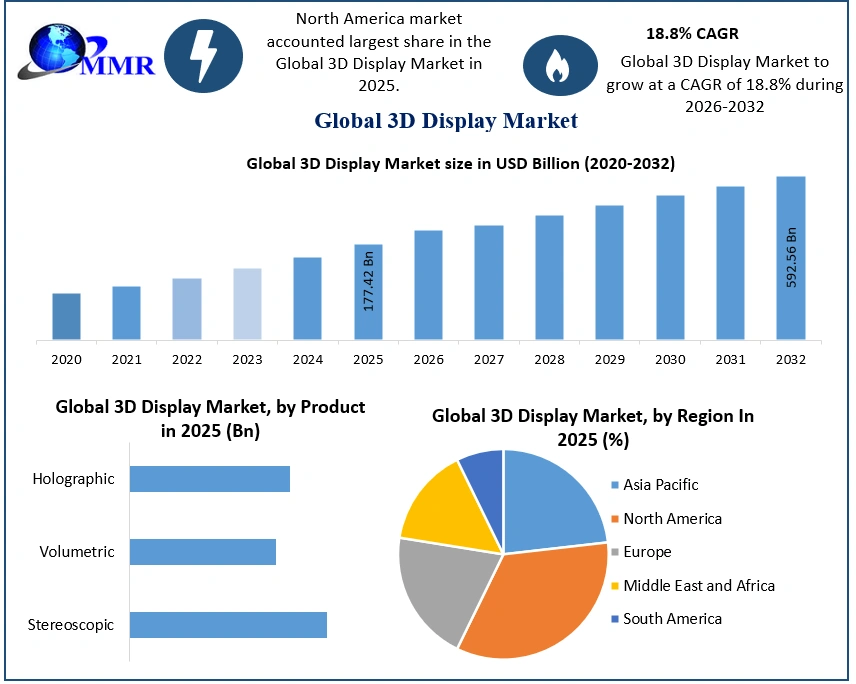
- Global 3D Display Market valued at USD 177.42 billion in 2025.
- Market projected to reach nearly USD 592.56 billion by 2032.
- CAGR expected at 18.8% from 2026 to 2032.
- North America remains the leading regional market.
- XR technology adoption is accelerating commercial deployment.
- AI-powered 3D content creation is lowering barriers to adoption.
- Holographic projection and light-field rendering are emerging next-generation technologies.
- Consumer electronics, healthcare, automotive, retail, aerospace, and entertainment are expanding use cases.
- Smart city and IoT integration are creating new deployment opportunities.
Why This Matters Now
The display industry is entering a new competitive phase. AI-generated content, spatial computing, XR ecosystems, and immersive digital experiences are transforming how information is visualized, consumed, and monetized.
For electronics manufacturers, display suppliers, semiconductor companies, OEMs, and investors, the shift is no longer about screen quality alone. The race now centers on immersive visualization platforms capable of supporting next-generation applications across healthcare diagnostics, automotive interfaces, industrial training, gaming, and digital commerce. The companies that control the hardware, software, and content ecosystems surrounding 3D displays are positioned to capture the next wave of value creation.
Market Overview
The global 3D Display Market was valued at USD 177.42 billion in 2025 and is expected to reach nearly USD 592.56 billion by 2032, expanding at a CAGR of 18.8%. This growth reflects a structural shift toward immersive computing environments rather than a cyclical increase in display shipments.
What changed is the economics of content creation. Historically, limited availability of 3D content constrained adoption. Today, advanced content creation tools and AI-enabled design platforms are reducing development complexity while expanding the commercial viability of volumetric and holographic displays. This is transforming the market from a hardware-driven industry into a broader ecosystem opportunity involving software developers, content creators, electronics manufacturers, and platform providers.
The result is growing demand from organizations seeking richer user engagement, enhanced visualization capabilities, and differentiated digital experiences.
Key Trends Driving Growth
The strongest growth catalyst is the rapid expansion of XR technologies. Enterprises are increasingly deploying immersive environments for training, collaboration, simulation, and customer engagement. As XR adoption expands, demand for advanced display systems rises alongside it.
Generative AI is becoming a significant market enabler. AI-powered tools are accelerating 3D content generation, reducing production costs, and enabling wider deployment of immersive applications. The technology is helping solve one of the industry’s largest historical bottlenecks: scalable content availability.
Display innovation is also advancing rapidly. Holographic projection systems and light-field rendering technologies are expected to improve image realism, viewing angles, brightness levels, and user interaction. These improvements expand commercial applications beyond entertainment into professional and industrial environments.
The emergence of smart cities and connected infrastructure creates another growth vector. As urban environments become increasingly digital, 3D displays are being positioned as interactive communication tools for public engagement, navigation, advertising, and information delivery. Integration with IoT ecosystems further expands deployment opportunities.
Explore detailed analysis, insights, and growth opportunities
Segment Insights
- Dominant Product Segment: Stereoscopic Displays remain a major commercial category due to broad deployment across consumer and professional applications.
- Fastest-Growth Opportunity: Holographic and volumetric display technologies are attracting increased investment because they deliver highly immersive experiences without traditional viewing constraints.
- Technology Segments: DLP, PDP, OLED, and LED technologies continue to serve as foundational display architectures supporting product innovation.
- Access Method Segments: Screen-based displays and micro displays address different use cases, ranging from consumer electronics to specialized enterprise deployments.
- Application Segments: TVs, monitors, projectors, and head-mounted displays are driving adoption across entertainment, professional visualization, and XR environments.
- End-User Segments: Consumer electronics remains a critical demand center, while healthcare, automotive, aerospace and defense, retail, and entertainment are generating new growth opportunities.
Regional Growth Story
North America leads the market due to strong technology innovation, substantial investment in XR technologies, and an active ecosystem of display manufacturers and immersive technology startups. This leadership gives the region a strategic advantage in commercializing next-generation visualization platforms.
Europe’s growth is driven by creative industries and cultural applications. The region is leveraging immersive technologies across digital art, exhibitions, and experiential installations, creating a distinct demand environment for advanced display systems.
Asia-Pacific remains the manufacturing engine of the global industry. The region’s extensive electronics supply chains, production capabilities, and consumer electronics leadership support rapid commercialization and large-scale adoption. Countries such as China, Japan, South Korea, and India continue to benefit from strong electronics manufacturing ecosystems that accelerate display innovation and deployment.
The competitive implication is clear: North America leads innovation, while Asia-Pacific drives manufacturing scale. Companies capable of bridging both strengths are likely to capture the largest market share over the next decade.
Competitive Landscape
The competitive field includes industry leaders such as LG Display, Samsung Electronics, Sony Corporation, BOE Technology Group, AU Optronics, TCL Corporation, and Panasonic Holdings Corporation.
Competition is increasingly shifting from panel manufacturing toward ecosystem control. Companies investing in XR integration, holographic visualization, software-enabled display experiences, and content partnerships are strengthening long-term competitive positioning.
The market is also witnessing growing participation from specialist innovators such as Light Field Lab and Leia Inc.. Their focus on next-generation visualization platforms signals a broader transition from traditional displays toward spatial computing environments.
Technology leadership increasingly depends on the ability to integrate hardware, software, AI-driven content generation, and immersive user experiences into a unified ecosystem.
Recent Developments
- Growing investment in XR technology platforms is expanding enterprise and consumer deployment opportunities.
- Generative AI tools are accelerating scalable 3D content creation and reducing production barriers.
- Holographic display technologies are advancing toward higher realism and broader commercial deployment.
- Light-field rendering innovations are improving image quality and user immersion.
- Smart city integration initiatives are opening new public infrastructure applications for 3D displays.
Strategic Implications
For OEMs, the opportunity extends beyond hardware sales. Future value will increasingly come from integrated visualization ecosystems, recurring software revenue, and immersive content services.
For investors, the strongest opportunities may emerge where AI, XR, and advanced display technologies converge. Companies enabling content generation, visualization software, and interactive user experiences could benefit from expanding market demand.
For supply-chain leaders, manufacturing agility will become a competitive differentiator as demand shifts toward more sophisticated display architectures and specialized immersive technologies.
Future Outlook
The next phase of the 3D Display Market will be defined by the convergence of AI-generated content, spatial computing, holographic visualization, and connected digital ecosystems. As immersive technologies move from niche deployments into mainstream enterprise and consumer environments, the distinction between displays and computing platforms will continue to blur.
The companies that build scalable immersive ecosystems around AI-powered content creation and next-generation display technologies will shape the future of digital interaction, while those that remain focused solely on conventional screen manufacturing risk losing relevance in the emerging spatial-computing economy.
Analyst Perspective
“The 3D Display Market is moving beyond traditional visualization and into the center of the immersive computing ecosystem. AI-enabled content creation, XR adoption, and holographic innovation are transforming display technologies from hardware products into strategic digital platforms.” — Rucha Deshpande
About Maximize Market Research
Maximize Market Research Pvt. Ltd. (MMR) is a global market research and consulting company that provides reliable, data-focused, and practical business insights. The firm serves a wide range of industries, including healthcare, pharmaceuticals, technology, automotive, electronics, chemicals, personal care, and consumer goods. Through market forecasts, competitive analysis, strategic consulting, and industry impact assessments, MMR helps organizations understand changing market conditions, identify growth opportunities, and make informed business decisions for long-term success.
Contact Us :
2nd Floor, Navale IT Park Phase 3
Pune Banglore Highway, Narhe
Pune, Maharashtra 411041, India
+91 9607365656
sales@maximizemarketresearch.com
