Key Highlights
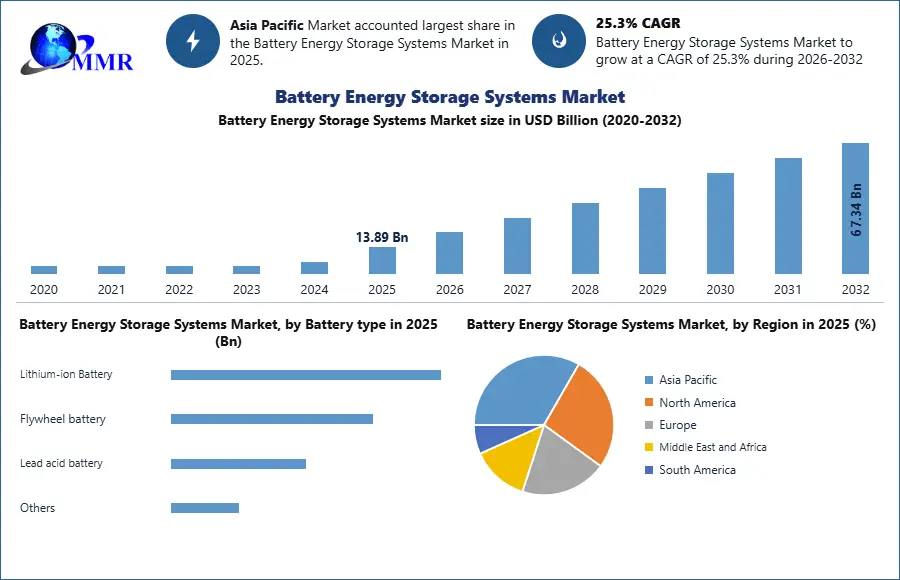
- Battery Energy Storage System Market valued at USD 13.89 Billion in 2025.
- Market expected to reach USD 67.34 Billion by 2032.
- CAGR projected at 25.03% from 2026 to 2032.
- Grid modernization is creating significant demand for large-scale storage deployments.
- Renewable energy integration continues to increase battery storage requirements.
- AI-enabled power management systems are improving storage utilization and efficiency.
- Governments are accelerating energy security initiatives through storage investments.
- Utility-scale projects are reshaping global energy infrastructure planning.
Why This Matters Now
The race to build AI infrastructure is rapidly increasing electricity demand. At the same time, governments and utilities are attempting to balance renewable energy expansion with grid reliability, creating unprecedented demand for energy storage technologies.
The Battery Energy Storage System Market, valued at USD 13.89 Billion in 2025 and expected to reach USD 67.34 Billion by 2032 at a CAGR of 25.03%, is becoming a cornerstone of the modern energy economy. The scale of growth signals a structural shift in how electricity is generated, stored, distributed, and consumed across industrial, commercial, and residential sectors.
Energy storage is no longer viewed as a supporting technology. It is becoming critical infrastructure for digital economies, AI data centers, electric mobility ecosystems, and renewable energy networks.
Market Overview
Global energy systems are undergoing a fundamental transformation. Renewable power generation continues to expand, but intermittent generation from solar and wind resources requires flexible storage solutions capable of balancing supply and demand.
Battery Energy Storage Systems have emerged as one of the most effective technologies for addressing this challenge. Utilities, independent power producers, industrial facilities, and commercial operators increasingly deploy storage systems to improve grid stability, reduce curtailment, and optimize energy use.
The projected increase from USD 13.89 Billion in 2025 to USD 67.34 Billion by 2032 demonstrates how rapidly storage is becoming embedded within energy infrastructure strategies. The business implication is significant: energy companies that invest in storage capabilities gain greater operational flexibility and resilience.
The market is also benefiting from broader electrification trends. Electric vehicles, smart buildings, industrial automation systems, and connected infrastructure all require reliable and responsive energy management solutions.
Key Trends Driving Growth
Renewable energy expansion remains the most powerful driver. As solar and wind installations increase worldwide, energy storage is becoming essential for managing fluctuations in power generation and ensuring consistent electricity availability.
Artificial intelligence is creating another major demand catalyst. AI-powered data centers require highly reliable energy supplies, while AI-driven grid management platforms improve storage optimization and energy forecasting. These developments are strengthening the strategic importance of battery storage systems.
Smart grid deployment is accelerating across developed and emerging economies. Utilities increasingly use digital technologies, advanced sensors, and real-time analytics to manage electricity networks. Battery storage enables these systems to respond quickly to changing demand conditions.
Energy security concerns are influencing investment decisions. Governments and utilities seek to reduce vulnerability to supply disruptions and price volatility by strengthening domestic energy resilience. Storage technologies provide a practical pathway toward more stable energy systems.
Declining battery costs and manufacturing scale improvements continue to enhance commercial viability. Larger production volumes, supply-chain efficiencies, and technology improvements are expanding adoption opportunities across multiple end-use sectors.
Sustainability initiatives are also driving momentum. Organizations pursuing decarbonization targets increasingly view battery storage as an important mechanism for maximizing renewable energy utilization and reducing dependence on conventional generation assets.
𝐃𝐨𝐰𝐧𝐥𝐨𝐚𝐝 𝐏𝐃𝐅 𝐁𝐫𝐨𝐜𝐡𝐮𝐫𝐞 @https://www.maximizemarketresearch.com/request-sample/2753/
Segment Insights
- Dominant Segment: The report identifies the leading segment based on market share contribution, supported by established deployment patterns and large-scale energy storage adoption.
- Fastest-Growing Segment: The report identifies the fastest-growing segment benefiting from increasing renewable integration, digital energy management, and infrastructure investments.
- Utility-scale storage continues to attract substantial investment due to its role in grid balancing and renewable integration.
- Commercial and industrial deployments are increasing as organizations seek greater energy independence and cost optimization.
- Residential energy storage adoption is expanding alongside distributed renewable energy installations.
- Advanced battery technologies continue to improve performance, reliability, and operational flexibility across applications.
Regional Growth Story
Asia-Pacific remains a major center for battery manufacturing, energy storage deployment, and renewable energy expansion. Strong industrial capabilities and large-scale energy infrastructure investments continue to support market development.
China plays a critical role across battery supply chains, manufacturing capacity, and storage deployment initiatives. The country’s investments are helping accelerate technology commercialization and cost reductions throughout the industry.
The United States is advancing grid modernization programs, renewable energy integration efforts, and energy resilience strategies. Large-scale storage projects increasingly support utility operations and power market participation.
India is emerging as an important growth market due to renewable energy expansion, electrification objectives, and government initiatives supporting energy transition goals. Storage technologies are becoming increasingly relevant as power demand continues to rise.
South Korea and Japan remain influential participants through battery innovation, manufacturing expertise, and advanced energy technology development.
Germany and other European markets continue investing in storage solutions to support renewable integration, grid flexibility, and energy transition objectives.
Across regions, storage investments increasingly serve strategic priorities that extend beyond electricity management, including economic competitiveness, industrial development, and energy security.
Competitive Landscape
Competition in the Battery Energy Storage System Market is evolving from battery supply toward integrated energy solutions.
Leading companies are expanding capabilities across software platforms, power electronics, grid management technologies, and energy optimization systems. This shift signals a broader move toward value-added energy infrastructure services rather than standalone hardware sales.
Technology leadership increasingly depends on the ability to combine advanced batteries with intelligent energy management. Companies that integrate AI-driven analytics, predictive maintenance, and digital monitoring capabilities are strengthening their competitive positions.
Strategic partnerships throughout the battery ecosystem are becoming more important. Collaboration among battery manufacturers, utilities, renewable developers, semiconductor suppliers, and technology providers is accelerating deployment timelines and improving project economics.
Supply-chain control is emerging as another competitive advantage. Organizations securing reliable access to battery materials, manufacturing capacity, and component suppliers are better positioned to manage costs and respond to growing demand.
The competitive landscape also highlights increasing convergence between energy infrastructure and digital technologies. Future leaders are likely to be companies capable of connecting energy storage assets with intelligent grid platforms and next-generation power management systems.
Recent Developments
- Increased deployment of utility-scale battery storage projects worldwide.
- Expansion of renewable energy integration initiatives supported by storage investments.
- Growing adoption of AI-enabled energy management and grid optimization technologies.
- Continued investment in battery manufacturing capacity and supply-chain development.
- Stronger government support for energy security and decarbonization initiatives.
- Rising demand for smart grid infrastructure and flexible energy resources.
- Broader adoption of distributed energy systems incorporating battery storage.
Strategic Implications
For utilities, battery storage is becoming an essential tool for improving grid reliability and integrating variable renewable resources. The ability to store and dispatch electricity strategically is creating new operational and economic opportunities.
For investors, energy storage represents one of the fastest-growing segments of the broader energy transition economy. The market’s projected expansion reflects increasing confidence in storage as a long-term infrastructure asset class.
For technology providers, opportunities extend beyond batteries themselves. Software, AI, power electronics, monitoring systems, and digital grid platforms are becoming critical components of the storage ecosystem.
For policymakers, battery storage supports multiple objectives simultaneously, including decarbonization, energy security, industrial development, and grid modernization.
Future Outlook
Battery Energy Storage Systems are moving from niche energy assets to foundational infrastructure supporting modern economies. Renewable energy growth, AI-driven electricity demand, electrification trends, and digital grid transformation are reinforcing long-term market expansion.
The next phase of industry competition will focus on manufacturing scale, software intelligence, supply-chain resilience, and energy ecosystem integration. Organizations capable of combining storage hardware with digital energy management platforms will gain the strongest strategic advantage.
As AI infrastructure, electrified transportation, and renewable power systems converge, the defining divide will emerge between companies that control intelligent energy storage networks and those that remain dependent on legacy power architectures.
Analyst Perspective
“Battery Energy Storage Systems are becoming a strategic pillar of modern energy infrastructure. Organizations that combine storage deployment with digital energy intelligence, renewable integration, and resilient supply chains will be best positioned to capture long-term value in the evolving global energy landscape.” — Rucha Deshpande, Analyst
About Maximize Market Research
Maximize Market Research Pvt. Ltd. (MMR) is a global market research and consulting company that provides reliable, data-focused, and practical business insights. The firm serves a wide range of industries, including healthcare, pharmaceuticals, technology, automotive, electronics, chemicals, personal care, and consumer goods. Through market forecasts, competitive analysis, strategic consulting, and industry impact assessments, MMR helps organizations understand changing market conditions, identify growth opportunities, and make informed business decisions for long-term success.
2nd Floor, Navale IT Park Phase 3
Pune Banglore Highway, Narhe
Pune, Maharashtra 411041, India
+91 9607365656
sales@maximizemarketresearch.com
