Bike Sharing Market Projected to Reach USD 6.48 Billion by 2032 as Cities Prioritize Sustainable Urban Mobility
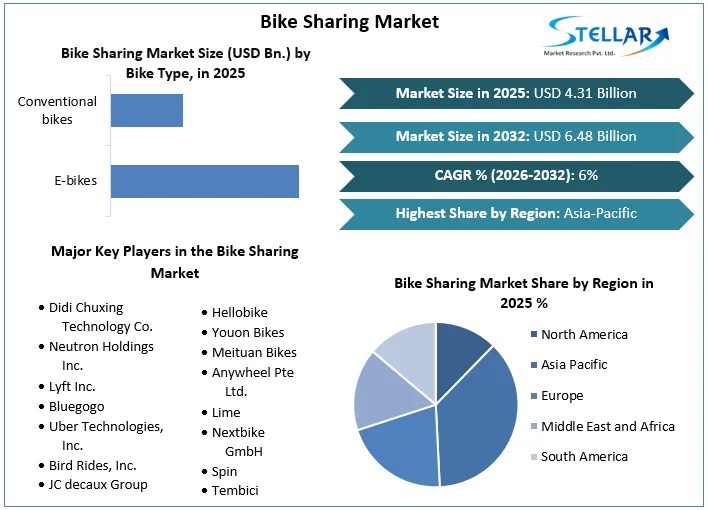
PUNE, India, June 25, 2026 — The Bike Sharing Market is entering a new growth phase as cities worldwide accelerate investments in sustainable transportation, digital mobility platforms, and low-carbon urban infrastructure. According to the latest Bike Sharing Market Report published by Stellar Market Research, the market was valued at USD 4.31 billion in 2025 and is expected to reach USD 6.48 billion by 2032, growing at a CAGR of 6% during the forecast period (2026–2032). The industry is being reshaped by e-bike integration, smart city initiatives, mobility-as-a-service (MaaS) ecosystems, and government-backed climate action programs.
Market Opportunity Overview
Bike sharing is evolving from a niche urban transport solution into a strategic component of city-wide mobility networks. Municipal governments, transit agencies, and private mobility operators are increasingly integrating bike-sharing systems with metro, bus, and rail infrastructure to solve first-mile and last-mile connectivity challenges.
The market’s transformation is being driven by the rapid adoption of app-based rental systems, GPS-enabled fleet management, AI-powered demand forecasting, and growing consumer preference for environmentally responsible transportation. As cities seek to reduce traffic congestion, carbon emissions, and transportation costs, bike-sharing networks are emerging as a scalable alternative to traditional commuting.
The rise of electric bicycles is further expanding the addressable market by enabling longer travel distances, improving rider convenience, and increasing adoption among commuters who previously viewed cycling as impractical.
Download Free PDF Brochure: https://www.stellarmr.com/report/req_sample/bike-sharing-market/2439
Key Findings from the Report
The global Bike Sharing Market was valued at USD 4.31 billion in 2025 and is projected to reach USD 6.48 billion by 2032 at a CAGR of 6%.
E-bikes represent the fastest-growing bike type segment due to superior convenience and longer travel capability.
Station-based bike-sharing systems continue to hold a significant market share owing to organized fleet management and higher operational reliability.
Dockless bike-sharing systems are witnessing strong growth because of their flexibility and lower infrastructure requirements.
Asia-Pacific remains the leading regional market, supported by large-scale deployments in China, India, Japan, and Southeast Asia.
Increasing investments in cycling infrastructure and smart city projects are creating long-term opportunities for operators and investors.
Mobility platforms integrating bike-sharing with public transit are generating new recurring revenue streams and improving urban transportation efficiency.
Market Drivers and Restraints
Key Drivers
Growing Urban Congestion and Sustainability Goals
Cities worldwide are promoting shared mobility solutions to reduce vehicle dependency, traffic congestion, and greenhouse gas emissions. Bike-sharing systems align closely with climate-action targets and urban sustainability strategies.
Expansion of E-Bike Fleets
Electric bicycles are significantly improving user adoption by reducing physical effort and increasing trip distances. This trend is attracting commuters, tourists, and corporate mobility users.
Government Support for Active Transportation
Public investments in cycling lanes, bike parking facilities, and integrated mobility infrastructure continue to support market expansion across developed and emerging economies.
Key Restraints
Infrastructure Limitations
Many cities still lack dedicated cycling lanes and supporting infrastructure, restricting widespread adoption and raising safety concerns.
Vandalism, Theft, and Fleet Maintenance Costs
Operators face ongoing challenges related to bike theft, vandalism, and fleet rebalancing expenses, which can affect profitability and service availability.
Technology, Regulation, and Sustainability Trends
Technology is becoming a critical competitive differentiator in the Bike Sharing Market. Operators are deploying IoT sensors, GPS tracking, predictive maintenance tools, AI-powered fleet optimization platforms, and dynamic pricing systems to improve utilization and reduce operating costs. Emerging research also demonstrates the potential of AI-driven pricing algorithms to optimize bike availability and reduce relocation expenses.
On the regulatory front, governments are introducing safety standards, speed controls for e-bikes, and operational guidelines for dockless mobility providers. While these regulations improve safety and urban order, they also require operators to invest in compliance technologies and rider education programs.
Sustainability remains a central market theme as cities increasingly prioritize non-motorized transportation within broader decarbonization strategies.
Regional Insights
Asia-Pacific Leads Global Market
Asia-Pacific continues to dominate the Bike Sharing Market due to rapid urbanization, population density, strong government support, and extensive bike-sharing deployments. China remains the world’s largest bike-sharing ecosystem, while India, Japan, and Southeast Asian nations are expanding public bicycle-sharing programs and smart mobility initiatives.
Europe Emerges as a High-Growth Region
European cities are aggressively expanding cycling infrastructure and integrating bike-sharing with public transportation systems. Demand is being driven by climate policies, urban sustainability programs, and increasing investment in e-bike fleets. Large-scale datasets and digital mobility planning initiatives are also improving operational efficiency across the region.
North America Gains Momentum
Cities across the United States and Canada continue expanding bike-sharing networks while investing in electrification and multimodal transportation connectivity. Rising ridership and public-private partnerships are supporting long-term growth opportunities.
Recent Industry Developments
Hellobike (2025): Established a new autonomous mobility venture with Ant Group and CATL, backed by more than CNY 3 billion in initial funding, strengthening future smart mobility ecosystems.
Lime (2025): Expanded shared e-bike operations across Australian cities while deploying enhanced safety and fleet-management technologies to support rising demand.
Anywheel (2024): Acquired user accounts and operational assets from SG Bike in Singapore, consolidating market leadership and expanding service coverage.
Bike Share Toronto (2024): Proposed acquisition of 750 additional bicycles to meet rapidly growing ridership and improve city-wide accessibility.
Washington D.C. Shared Mobility Operators (2025): Implemented new e-bike speed controls and compliance measures in response to evolving urban safety regulations.
Competitive Landscape
The global Bike Sharing Market remains highly competitive, with operators focusing on fleet electrification, digital platform enhancements, strategic partnerships, and geographic expansion.
Key participants include Hellobike, Lime, Anywheel, Mobike, Yulu, Bounce, Zypp, and other regional mobility providers. Companies are increasingly investing in AI-enabled fleet management, e-bike deployment, and multimodal mobility integration to strengthen market positioning.
Download Free PDF Brochure: https://www.stellarmr.com/report/req_sample/bike-sharing-market/2439
Analyst Commentary
“The next phase of growth in the Bike Sharing Market will be defined by the convergence of electrification, smart mobility platforms, and sustainable urban planning. Operators that successfully integrate bike sharing into broader mobility ecosystems while improving operational efficiency through data-driven technologies will be best positioned to capture long-term value,” said a Senior Research Analyst at Stellar Market Research.
Future Outlook
Through 2032, the Bike Sharing Market is expected to benefit from continued investments in urban mobility infrastructure, rising e-bike adoption, favorable sustainability policies, and expanding smart city initiatives. Demand growth will increasingly be supported by digital transformation, integrated transportation networks, and regulatory frameworks that encourage low-carbon mobility solutions.
As governments and private investors prioritize climate resilience and urban livability, bike-sharing systems are expected to become an increasingly important component of future transportation ecosystems.
About Stellar Market Research
Stellar Market Research is a global market research and business consulting firm delivering strategic intelligence across industries including transportation, technology, healthcare, consumer goods, energy, manufacturing, and industrial sectors. The company provides comprehensive market assessments, competitive benchmarking, growth forecasting, investment analysis, and customized consulting solutions that help organizations identify emerging opportunities and make informed business decisions. Through rigorous primary and secondary research methodologies, Stellar Market Research delivers actionable insights that support corporate strategy, product development, market entry, and investment planning across global and regional markets.
Media Contact
Stellar Market Research
Website: https://www.stellarmr.com/
Email: sales@stellarmr.com
